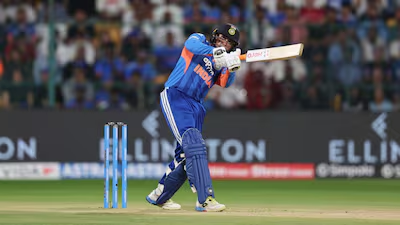
India opener Abhishek Sharma has earned a reputation for aggressive batting in T20 cricket, but expectations surrounding his scoring rate may need to be more realistic. A former India cricketer has pointed out that expecting the left-handed batter to score at a strike rate above 200 in every innings is a misconception, highlighting the balance between attacking intent and consistency in the shortest format.
Abhishek's explosive approach has made him an important part of India's T20 batting plans. His ability to attack from the opening overs can put opposition bowlers under pressure and give India a rapid start. However, even the most aggressive batters cannot maintain an extraordinary scoring rate in every match, particularly when conditions, bowling quality and match situations vary.
The discussion reflects a broader question in modern T20 cricket: how should a batter's performance be judged when teams increasingly value quick scoring alongside reliability?
Why a 200-Plus Strike Rate Is Difficult to Sustain
A strike rate of 200 means scoring two runs for every ball faced. Maintaining that pace over a substantial number of deliveries requires exceptional timing, favourable scoring opportunities and the ability to handle different bowling strategies.
Opponents also adapt when a batter becomes known for attacking aggressively. Bowlers may vary their pace, change their lengths, use wider deliveries or adjust their field placements to limit boundary opportunities.
Abhishek must also respond to different match conditions. A flat pitch may reward attacking strokes, while a slower surface can make timing more difficult. Strong winds, changes in ball behaviour and pressure during a chase can further influence scoring.
As a result, an innings played at a lower strike rate does not automatically indicate poor form. A batter may need to rebuild after an early wicket, rotate the strike against disciplined bowling or preserve wickets before accelerating later in the innings.
The important consideration is whether the player contributes effectively to the team's overall scoring objective.
Abhishek Sharma's Aggressive Role in India's T20 Setup
Abhishek has become known for taking on bowlers early rather than spending an extended period settling at the crease. His left-handed batting provides India with an attacking option at the top of the order, particularly during the powerplay, when fielding restrictions can create opportunities for boundaries.
This approach can be highly effective when he makes full use of scoring opportunities. A quick start allows the middle order to build on an aggressive platform and can force opposing captains to change their bowling plans earlier than expected.
However, an attacking role also carries risks. Batters who attempt to score quickly are likely to face situations in which their shots do not produce the intended result. The challenge is to maintain positive intent without allowing the pursuit of a high strike rate to become an inflexible target.
For Abhishek, the ability to recognise when to attack and when to adapt could be as important as his natural power and timing.
Why Strike Rate Must Be Viewed Alongside Other Numbers
Strike rate is an important measure in T20 cricket, but it does not provide a complete picture of a player's contribution. Runs scored, balls faced, dismissals, match conditions and the team's position all matter when evaluating an innings.
For example, a batter who scores quickly before losing his wicket may have a different impact from one who maintains an aggressive pace while batting deep into the innings. Both performances must be assessed in context rather than through a single statistical threshold.
Teams also need flexibility. Requiring every innings to exceed a particular strike rate could encourage unnecessary risks and make it harder for players to respond to changing circumstances.
The Bigger Picture for Indian Cricket
The debate around Abhishek reflects the growing emphasis on attacking batting in T20 cricket. While rapid scoring can transform matches, consistency should not be confused with producing identical statistics in every appearance.
Abhishek's value will ultimately depend on how effectively he helps India win matches, rather than whether he crosses a strike rate of 200 each time he bats.
The central message is straightforward: aggressive cricket remains an important strength, but adaptability, decision-making and match awareness are equally essential for sustained success at the international level.