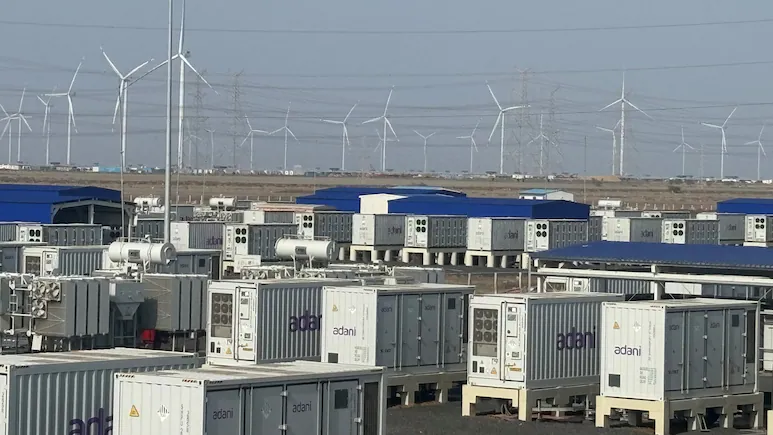
Adani Green Energy Limited (AGEL) has increased the operational capacity of its battery energy storage system (BESS) at Khavda, Gujarat, to 6.63 gigawatt-hours (GWh). The expansion marks a significant increase from the 3.55 GWh capacity reported in June 2026 and gives the company more than half of India’s operational battery storage capacity.
The development comes as India works to strengthen its electricity infrastructure and integrate a growing share of renewable energy into the power grid. Solar and wind generation depend on weather conditions, making energy storage an important part of ensuring electricity is available when demand rises or renewable generation falls.
According to the company, the Khavda facility is now the world’s largest operational battery energy storage installation at a single location.
More Than Half of India’s Operational BESS Capacity
With its operational storage reaching 6.63 GWh, AGEL accounts for over 50% of India’s total operational BESS capacity, estimated at approximately 12.6 GWh.
The company said it achieved the milestone within 14 months of beginning construction at the site. The latest capacity addition was commissioned within 10 months of construction starting.
The scale of the installation highlights the growing role of battery storage in India’s energy sector. Unlike conventional power generation, battery systems do not produce electricity themselves. Instead, they store electricity and release it when required, helping manage fluctuations in supply and demand.
How Much Energy Can the Khavda Facility Store?
AGEL estimates that its 6.63 GWh battery storage capacity can hold enough clean energy to power around two million homes for a day. The company also says the storage capacity is equivalent to the battery capacity of more than 150,000 mid-sized electric vehicles, based on a 40 kWh battery pack.
The facility can also store energy equivalent to nearly twice the Delhi Metro’s estimated daily electricity requirement.
These comparisons help illustrate the scale of the project, although actual electricity delivered to consumers will depend on operating conditions, storage losses and grid requirements.
Supporting the 30 GW Renewable Energy Project
The battery installation is integrated with AGEL’s wider renewable energy development at Khavda. The company is developing a 30 GW renewable energy project across approximately 538 square kilometres in Gujarat.
The battery system uses lithium-ion technology, supported by energy management systems and automated monitoring. These systems manage charging and discharging, monitor performance and help provide electricity when required.
By storing surplus renewable generation, the facility can help reduce energy wastage and improve the ability to supply power during periods of higher demand.
Expansion Plans and Future Targets
AGEL has stated that it aims to add more than 10 GWh of battery storage capacity during FY 2026–27. The company is also targeting 50 GWh of storage capacity over the next five years.
Its strategy includes both battery-based storage and pumped storage projects, reflecting the need for different technologies to support a reliable electricity network.
Why Battery Storage Matters for India
As electricity demand increases, energy storage can help address one of the key challenges of renewable power: matching generation with consumption.
The Khavda expansion represents a major addition to India’s operational storage infrastructure. Its longer-term impact will depend on how effectively the system operates, connects with the grid and supports renewable electricity delivery.