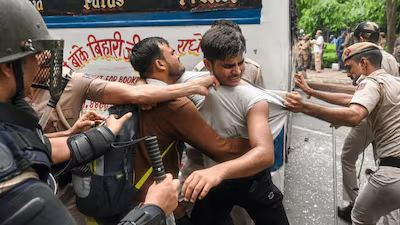
The Delhi Police Crime Branch has begun examining the circumstances surrounding the violence that broke out during a protest in central Delhi on July 20, with investigators looking into whether the unrest was spontaneous or involved prior planning.
The probe is focused on identifying those who allegedly participated in the violence and determining how the situation escalated during the protest. Investigators are also examining whether people with previous criminal records may have joined the gathering and contributed to the clashes.
A major part of the investigation involves analysing video evidence from the incident. Police teams are examining footage from mobile phones, CCTV cameras, drones and police body cameras to establish the sequence of events and identify individuals allegedly involved in vandalism and attacks on police personnel.
According to reports, investigators are also looking at the possibility that the violence may have been coordinated before the protest. Digital communications and social-media activity are being examined to determine whether participants were mobilised or encouraged to engage in disorder through online groups.
The July 20 demonstration had been organised as a Parliament march and later witnessed clashes in parts of central Delhi. Police have been particularly interested in establishing whether those involved in the violence were regular protesters or whether outside elements joined the gathering with a different objective.
Another aspect of the investigation concerns the destruction of public property and damage to police vehicles during the unrest. A case has been registered in connection with the incidents, with investigators working to identify the people involved.
The Crime Branch's inquiry is therefore expected to address two separate possibilities: whether the violence developed unexpectedly as tensions rose at the protest, or whether individuals arrived with a coordinated plan to create disorder.
The investigation could also help establish whether there were gaps in security arrangements around the protest location. Authorities are expected to assess available footage and other evidence before drawing conclusions about the sequence of events.
The police investigation comes amid competing claims about what triggered the confrontation. While allegations of deliberate planning have emerged, the probe is intended to establish the facts through evidence rather than assumptions.
For investigators, the extensive video material could prove important in reconstructing the movement of people during the protest and identifying specific individuals accused of involvement in the violence.
As the inquiry progresses, police are expected to examine digital records, visual evidence and the backgrounds of suspects. The findings will determine whether the July 20 unrest was primarily the result of a protest escalating into violence or whether there was a broader organised effort behind the incidents.