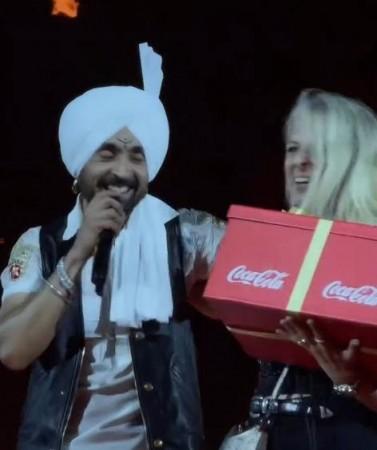
Punjabi singer and actor Diljit Dosanjh became the centre of attention after an unexpected interaction with a female fan during his Ahmedabad concert went viral on social media. The November 21 performance at Narendra Modi Stadium featured a light-hearted moment that saw the singer blush after the fan kissed him on the cheek. The concert also sparked a wider debate over restrictions on song lyrics, with a Chandigarh-based professor responding to Diljit’s allegations of unequal treatment of Indian and international artists.
Viral Fan Moment at Diljit Dosanjh’s Ahmedabad Concert
The incident took place during Diljit’s Aura India Tour performance in Ahmedabad. A female fan joined the singer on stage and approached him while he was interacting with the audience. As she leaned towards him, Diljit initially raised his arm, apparently attempting to prevent her from getting too close. He eventually allowed her to kiss him on the cheek.
The singer responded with his characteristic humour, drawing laughter from the crowd. He joked about the fan dancing to bhangra and quipped that although his English might not be handsome, he certainly was.
After the exchange, Diljit continued his performance and presented the fan with a gift. She hugged him before leaving the stage, while the singer’s amused reaction added to the moment’s popularity online.
The video quickly attracted attention, with viewers sharing the clip and commenting on the singer’s spontaneous response. The interaction became one of the most discussed moments from the Ahmedabad show.
Diljit Questions Restrictions on His Songs
Beyond the viral incident, the concert drew attention because of Diljit’s remarks about restrictions affecting some of his songs. The singer questioned why Indian performers faced objections over certain lyrics while international musicians appeared to receive different treatment.
He referred to British band Coldplay’s performance at the same stadium in January 2025, highlighting the band’s song Hymn for the Weekend, which includes a reference to feeling drunk and high.
Diljit questioned why similar concerns were not raised when international artists performed such material, while his own songs attracted scrutiny. He described the situation as a potential case of double standards and emphasised that he and his team were born and raised in India.
His comments brought renewed focus to the debate over artistic expression, the interpretation of song lyrics and the responsibilities of performers during large public events.
Professor Punditrao Dharennavar Rejects Allegations
Responding to the singer’s remarks, Punditrao Dharennavar, an associate professor of sociology based in Chandigarh, denied that his objections targeted Diljit alone.
Dharennavar said he had also raised concerns before Coldplay’s 2025 Ahmedabad concert. According to him, he submitted a complaint to the District Child Protection Officer in Ahmedabad, following which a notice was issued concerning the performance of Hymn for the Weekend. He said he would share a copy of the notice to support his claim.
The professor maintained that his campaign focused on songs he believes promote alcohol consumption, drug use or gun culture, regardless of whether the performers are Indian or international.
He also named several Indian singers, including Karan Aujla, Yo Yo Honey Singh, Sunidhi Chauhan, Babbu Maan and Sharry Mann, saying he had raised concerns about their music as well.
Dispute Over Song Choices Continues
Before Diljit’s Ahmedabad concert, Dharennavar had objected to tracks including Patiala Peg, 5 Taara Theke and Jeeb Vicho Feem Labbiya. He also welcomed the singer’s decision not to wear a bullet belt during the performance.
The contrasting positions have highlighted a broader discussion about music censorship, artistic freedom and substance-abuse awareness. While Diljit has questioned the consistency of restrictions, Dharennavar argues that performers should consider the messages conveyed by their songs, particularly to younger audiences.
The debate continues to place the spotlight on the balance between creative expression and concerns about the influence of popular music.