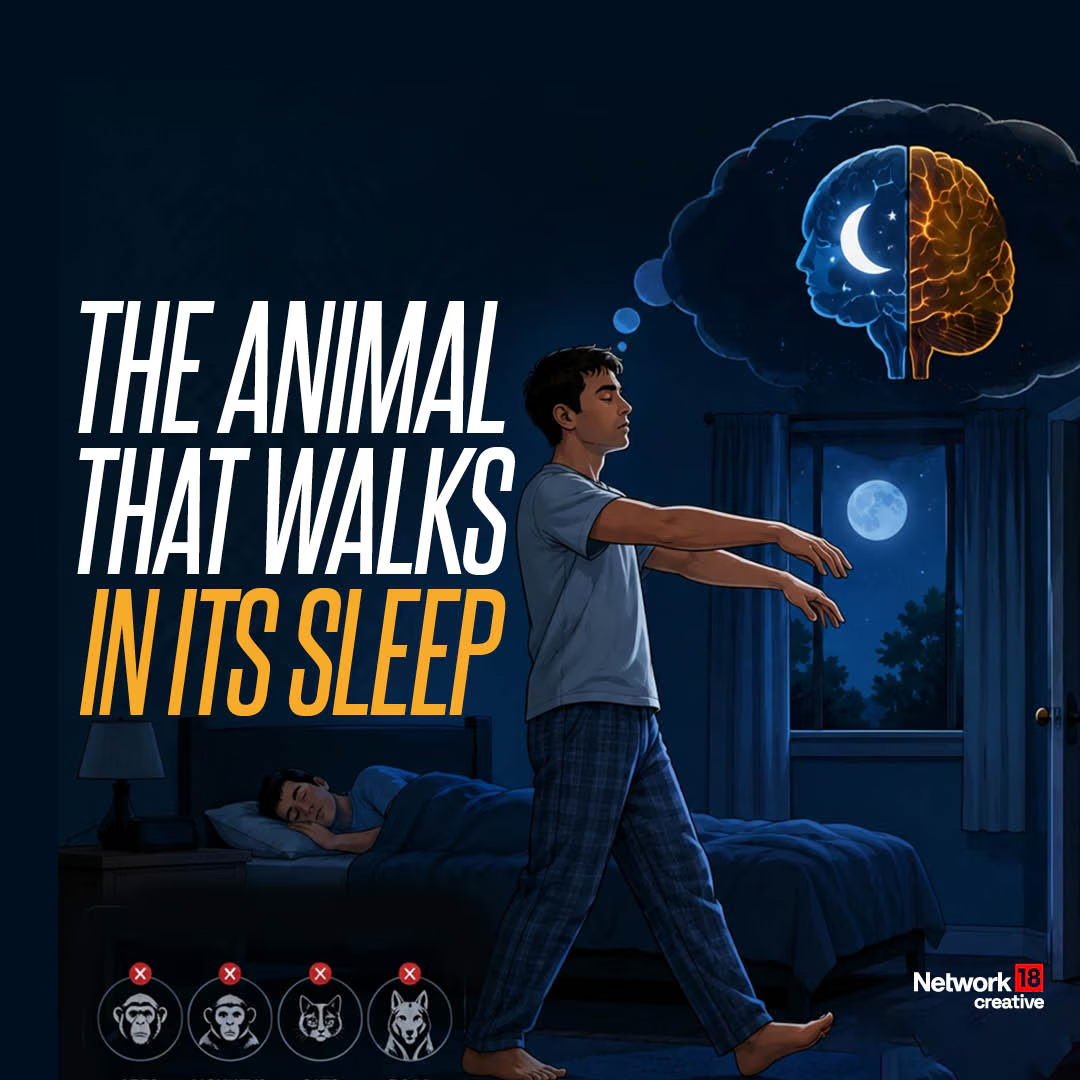
Sleep is often associated with stillness, but the natural world offers many surprising examples of unusual sleeping habits. Dolphins can rest with one half of their brain at a time, some birds sleep while standing, and dogs may move their paws during dreams. These behaviours raise an interesting question: can animals actually walk while they are asleep?
The scientific answer is more complicated than a simple yes or no. True sleepwalking, also known as somnambulism, is well recognised in humans. However, researchers have not established that other animals experience the same condition in the way people do.
What Does Sleepwalking Really Mean?
Sleepwalking is not simply moving during sleep. It is a sleep-related behaviour in which a person gets up and performs movements or activities while remaining partly asleep. Someone experiencing an episode may walk around, appear awake or carry out familiar actions without being fully conscious.
The condition is generally associated with deep, non-rapid eye movement (NREM) sleep. It is more common among children and may be influenced by factors such as insufficient sleep, fatigue and stress.
For scientists, identifying sleepwalking in animals is difficult because movement alone does not prove that an animal is walking while asleep. Researchers need evidence about the animal’s brain activity and state of awareness to distinguish sleepwalking from ordinary movement during sleep.
Why Animal Movements Can Be Misleading
Many animals display movements while resting. Dogs may twitch their legs, move their faces or make small sounds during sleep. These actions are often linked to normal sleep processes and do not necessarily indicate that the animal is walking.
Some species also have specialised sleeping patterns. Dolphins, for example, can allow one side of the brain to rest while the other remains active, helping them continue essential activities such as surfacing to breathe. Birds may rest while perched, while other animals adopt positions suited to their surroundings and safety needs.
These behaviours demonstrate how sleep has adapted to different environments. However, they should not be confused with human-style sleepwalking.
Is Sleepwalking Unique to Humans?
Current scientific understanding suggests that sleepwalking is overwhelmingly documented in humans. Researchers have not confirmed a non-human species that regularly experiences the same clearly defined behaviour.
That does not necessarily prove that no animal could ever display something similar. Studying sleep in wild animals is challenging, and scientists cannot directly ask animals what they experience. Observations may also be limited by the difficulty of recording brain activity in natural environments.
A scientific paper examining whether sleepwalking occurs in non-human primates noted that the available evidence was insufficient to settle the question conclusively. This highlights the difference between saying a behaviour has not been documented and proving that it cannot occur.
What Makes Animal Sleep So Fascinating?
The diversity of animal sleep shows that there is no single pattern followed by every species. Some animals sleep for long periods, while others take shorter periods of rest. Certain species remain alert to environmental dangers, while others have developed unusual ways to rest without interrupting essential functions.
Understanding these differences can help scientists learn more about brain activity, evolution and the biological purpose of sleep.
The idea of an animal walking in its sleep may sound fascinating, but the evidence calls for a careful distinction. Many animals move during sleep, yet true sleepwalking has not been reliably established beyond humans. As research methods improve, scientists may discover more about what happens inside the sleeping brains of other species.