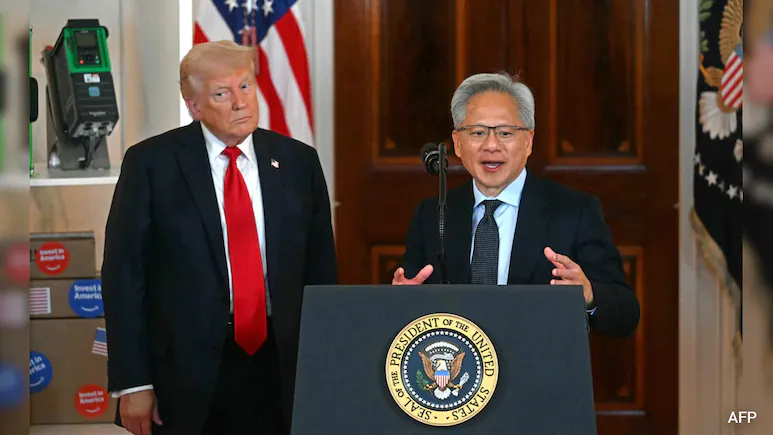
US President Donald Trump’s reported investment in Nvidia grew to an estimated $13 million to $62 million by the end of August 2026, according to a review of his financial disclosures. The reported increase has drawn fresh scrutiny of his financial interests as his administration makes key decisions affecting the artificial intelligence chipmaker and its access to the Chinese market.
The estimated value of Trump’s Nvidia holdings was substantially higher than the $615,000 to $1.3 million in shares reported at the end of 2024. However, the figures are based on financial disclosures reviewed by The Washington Post, and the latest filings do not capture all transactions from the two most recent months. The estimates also do not establish the exact number of shares Trump held at the end of August.
The White House said Trump does not personally select or trade individual stocks and that independent financial managers handle his portfolio. Nvidia and the White House did not immediately respond to requests for comment on the reported holdings when the findings were published.
Nvidia Investment Draws Attention Amid China Chip Policy
The reported investment has attracted attention because the Trump administration has made several decisions affecting Nvidia’s ability to sell advanced AI processors internationally.
In December, Trump announced that the United States would permit Nvidia to export its H200 artificial intelligence chips to approved customers in China, with 25% of revenue from the sales going to the US government. The H200 is among Nvidia’s most powerful processors, making the policy significant for the global semiconductor industry and the competition between Washington and Beijing.
The administration’s approach to advanced chip exports has been a subject of debate among lawmakers and national security officials. Supporters argue that allowing controlled sales can help US companies remain competitive, while critics warn that advanced computing technology could strengthen China’s military and technological capabilities.
Because Nvidia stands to benefit from policies affecting chip exports, Trump’s reported investment has raised questions about how government decisions and personal financial interests are managed.
However, the reported stockholding alone does not establish that Trump’s policy decisions were influenced by his investments.
Financial Disclosures Show a Sharp Increase
The reported range of $13 million to $62 million reflects the valuation estimates derived from financial disclosures rather than a confirmed single figure.
The filings also come with an important limitation: reporting delays mean transactions from the most recent months were not included in the review. The actual value of the holdings could therefore differ from the published estimate.
Nvidia’s share-price movements also affect the value of any investment. As one of the largest companies in the artificial intelligence sector, its stock has attracted considerable attention from investors betting on continued demand for advanced chips and data-centre infrastructure.
The increase in the estimated value of Trump’s Nvidia investment has therefore become a point of interest for financial observers, particularly as the company remains closely connected to the administration’s technology and trade policies.
Trump’s Relationship With Nvidia Leadership Under Scrutiny
Trump has maintained a close relationship with Nvidia co-founder Jensen Huang, who had emerged as an influential voice in discussions about artificial intelligence and US semiconductor policy.
Huang has met Trump on several occasions and advocated policies aimed at strengthening the American AI industry. The administration has also promoted domestic investment in advanced computing infrastructure as part of its broader strategy to maintain US technological leadership.
The relationship has come under greater scrutiny following the controversy surrounding Huang’s departure as Nvidia chief executive. The company’s board launched an investigation into concerns involving the former CEO and his relationship with a businesswoman suspected by US authorities of having links to Chinese intelligence. Those suspicions have not been conclusively established, and the allegations remain disputed.
The developments have increased attention on the connections between technology executives, government officials and national security decisions.
Calls for Greater Transparency
Trump’s investment has prompted renewed debate over whether senior government officials should be permitted to hold individual stocks in companies affected by their administration’s decisions.
Government ethics rules restrict many executive-branch employees from participating in official matters that could affect their personal financial interests. However, the federal criminal conflict-of-interest statute generally does not apply to the president in the same way it applies to other executive-branch officials.
Ethics advocates argue that clearer restrictions on stock ownership could reduce public concerns about potential conflicts of interest. Others maintain that independent investment management can help separate government decisions from personal trading activity.
The White House has said Trump’s portfolio is managed independently, with financial decisions made by outside managers rather than the president himself.
Nvidia’s Next Moves Remain Important
The issue comes as Nvidia continues to play a central role in the global AI industry and US-China technology competition. The company’s quarterly financial results, scheduled for November 17, 2026, are expected to provide further insight into demand for its chips and the outlook for its business.
For now, the reported value of Trump’s Nvidia investment has intensified questions about transparency, technology policy and the financial interests of political leaders. The available disclosures reveal a substantial increase in the estimated holdings, but they do not by themselves prove misconduct or establish that the president’s decisions were shaped by his stock portfolio.