Former India strength and conditioning coach Soham Desai has revealed that Rohit Sharma suffered a career-threatening hip injury in 2017, explaining why the veteran batter has needed a carefully managed fitness routine throughout his career.
Desai, who worked with the Indian team for nearly five years, also pushed back against criticism that Rohit is lazy or does not train hard enough. He said the public perception overlooks the physical challenges the former India captain has faced and the work required to remain competitive at the highest level.
Speaking during a podcast conversation, Desai explained that Rohit's injury history has made strength training an essential part of his preparation.
Rohit Sharma’s Serious Injury in 2017
According to Desai, Rohit experienced a significant injury around his hip following India's defeat to Pakistan in the 2017 Champions Trophy final in England. The problem involved areas around his hip flexor and hamstring, requiring surgical treatment.
The injury represented a major challenge for Rohit, whose career has since included sustained performances across international cricket and the Indian Premier League.
Desai argued that the batter's longevity at the highest level should be considered when assessing his commitment to fitness. Rohit has continued to score runs and compete across demanding schedules despite recurring physical concerns.
The former coach's account provides context for the fitness discussions surrounding Rohit, particularly as he approaches another important phase of his international career.
Why Strength Training Is Essential for Rohit
Desai explained that the area around Rohit's hip remains a particular weakness that requires consistent attention. He said the batter needs to complete at least two strength-training sessions every week to manage the risk of further problems.
According to Desai, missing this routine could leave Rohit vulnerable to physical setbacks. He described regular strength work as a non-negotiable requirement that has helped the cricketer sustain his career over the past seven to eight years.
Desai stressed that Rohit's continued involvement in high-level cricket would not have been possible without a disciplined approach to managing his physical condition.
He also highlighted that fitness requirements differ between players. Training programmes must account for individual injury histories, movement patterns and the physical demands of their roles on the field.
How Rohit Sharma and Virat Kohli Differ in Training
Desai also compared the training approaches of Rohit and Virat Kohli, explaining that the two experienced Indian batters have different physical requirements.
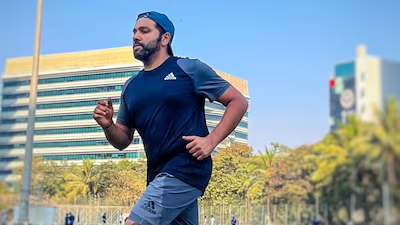
According to the former coach, Rohit's programme places considerable emphasis on strength, explosive movements and reactive exercises. He also needs regular running work to help maintain the condition of his hamstrings, quadriceps and related muscle groups.
Kohli, by contrast, follows a different routine suited to his own requirements. Desai said Kohli focuses on lifting and fundamental strength exercises, with much of his conditioning work coming through his activity on the field.
The comparison underlines that there is no single training method suitable for every elite cricketer. A player's routine must be designed around their individual needs rather than judged solely by visible gym work or running volume.
More Time to Manage Fitness After International Retirements
Desai also offered an explanation for Rohit's improved physical condition, saying the batter now has greater control over his schedule after retiring from Test and T20 international cricket.
Playing multiple formats can leave international cricketers with limited time to manage recovery, strength work and individual training plans. A more controlled schedule can make it easier to prioritise these areas.
Rohit's recent performances in the three-match ODI series against the West Indies also demonstrated his continued batting ability. He scored 32, 102 and 92 in the series and is expected to return for India's five-match ODI tour of New Zealand, beginning November 4.
Rohit’s Fitness Remains Important Ahead of the 2027 World Cup
With the 2027 ODI World Cup approaching, Rohit's fitness and form are likely to remain important considerations for India's plans.
Desai's comments offer a perspective on the physical demands behind the batter's career and challenge assumptions based solely on public appearances. His central argument is that Rohit's long-term success has required consistent, carefully targeted work to manage previous injuries.
For Rohit, maintaining that routine will remain crucial as he continues competing at the highest level.