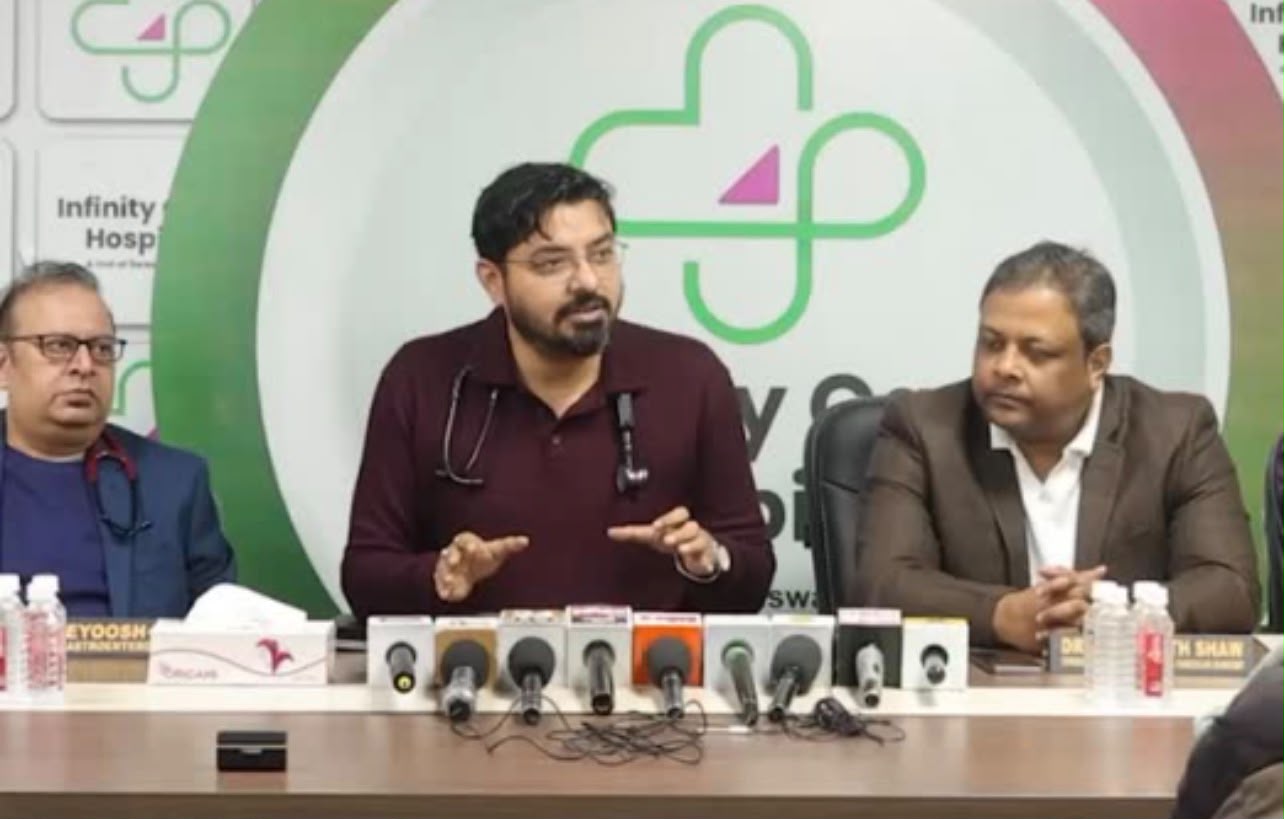
VARANASI: Doctors are trained to focus on individual patients, but building a hospital requires a broader perspective. It involves creating teams, infrastructure, systems and processes capable of delivering specialised care consistently. The professional journey of Dr Abhishek Vikram Singh, an interventional cardiologist and Founder and Managing Director of Infinity Care Hospital in Varanasi, reflects this transition from specialist clinical practice to institution building.
Dr Singh holds an MD and DM in Interventional Cardiology, while his professional profile records experience with institutions including AIIMS New Delhi, Fortis Escorts and Safdarjung Hospital. His clinical work includes complex coronary interventions, peripheral vascular procedures, structural-heart interventions, valvuloplasty and cardiac-device implantation.
Interventional cardiology is a technology-intensive field. Treating increasingly complex cardiac conditions requires more than individual expertise. Complex coronary procedures depend on an appropriately equipped catheterisation laboratory and trained teams, while structural-heart interventions require detailed imaging, planning and multidisciplinary coordination. Cardiac-device procedures also require systems for continued monitoring and follow-up.
For specialists working with complicated cases, these requirements can highlight the importance of the institution surrounding the physician. Establishing a hospital can therefore become one way of creating an environment where specialised treatment can be supported by the necessary infrastructure and teams.
Infinity Care Hospital describes itself as a multispecialty institution in Varanasi, with cardiology as a major area of focus. Its cardiology department describes a multidisciplinary model involving cardiologists, vascular surgeons and cardiothoracic surgeons, alongside critical-care and emergency cardiac capabilities.
The institution's development has remained closely connected with advanced cardiac care. In July 2023, Infinity Care Hospital recorded what it describes as Purvanchal's first Transcatheter Aortic Valve Implantation, or TAVI. The procedure is used in selected patients with severe aortic valve disease and requires a specialised structural-heart programme. In February 2025, the hospital reported another regional milestone involving minimally invasive double-valve replacement performed through a multidisciplinary approach.
These milestones are significant not simply because they represent complex procedures, but because they demonstrate the infrastructure and coordination required to undertake them. An advanced cardiac programme cannot be established by purchasing a single piece of equipment. It requires specialists from different disciplines, trained nurses and technicians, anaesthesia services, intensive care, diagnostic capabilities, emergency systems and other supporting infrastructure.
This distinction becomes particularly important when considering the role of a hospital founder. The responsibilities of an interventional cardiologist are primarily centred on determining the safest and most effective treatment for an individual patient. A managing director must consider a much wider set of questions: whether the right specialists are available, whether equipment can be maintained, whether critical-care teams are prepared, how services can remain accessible and whether the organisation can recruit and retain skilled professionals.
Those challenges are especially relevant in a regional healthcare centre such as Varanasi. The city serves a large population across eastern Uttar Pradesh, meaning that for many families, seeking advanced specialist care elsewhere can involve travelling to another city rather than simply choosing a different hospital nearby.
Dr Singh's stated institutional objective has been to make advanced healthcare more accessible in Varanasi and eastern Uttar Pradesh. Achieving such an objective, however, requires balancing multiple factors, including specialist recruitment, technology, affordability, patient expectations and the rapidly changing nature of medical treatment.
The multispecialty model also reflects the reality that patients often present with more than one medical problem. A person receiving treatment for heart disease may simultaneously have kidney dysfunction, diabetes, infection or other complications. A multispecialty environment can make coordination between different medical disciplines more practical, although the presence of multiple departments alone does not automatically guarantee quality of care.
For Dr Singh, the institutional role now exists alongside his continued work in interventional cardiology. His clinical profile remains associated with complex coronary intervention, peripheral vascular procedures, structural-heart treatment, valvuloplasty and cardiac devices.
The combination of physician and institution builder creates a different measure of professional responsibility. A doctor working within an established hospital primarily contributes through clinical care, while a founder also has responsibility for the systems that surround that care. The long-term performance of such an institution depends not only on landmark procedures but also on clinical governance, patient safety, recruitment, patient experience, outcomes and financial sustainability.
This broader perspective reflects a gradual change in India's healthcare landscape. Specialist services that were once concentrated largely in major metropolitan centres are increasingly being developed in regional cities. Patients consequently have more opportunities to access specialised treatment closer to where they live, while referral to larger centres remains important for selected cases.
Dr Abhishek Vikram Singh's journey from interventional cardiology to hospital leadership therefore represents more than a change in professional title. It reflects an attempt to build the wider system around specialist medical expertise. In the evolving healthcare landscape of Varanasi, the cath lab remains an important part of the story, but the larger challenge is building the people, infrastructure and systems around it.