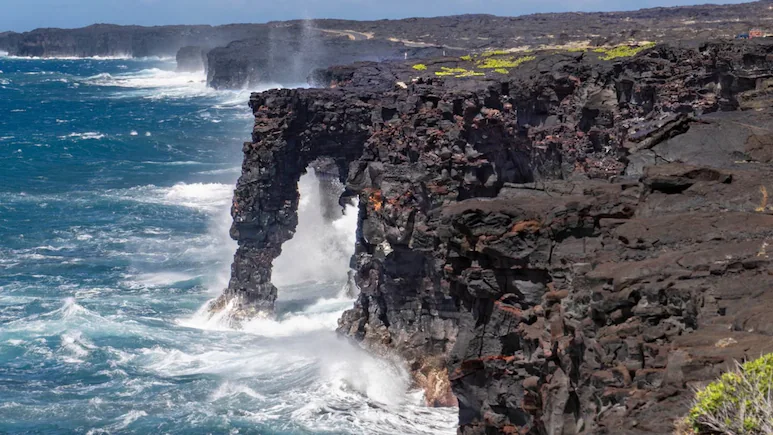
A landmark that stood along Hawaii’s rugged coastline for around 550 years has disappeared into the Pacific Ocean. Hōlei Sea Arch, a striking natural formation inside Hawaiʻi Volcanoes National Park on the Big Island, collapsed sometime between September 23 and September 27, 2026. The National Park Service confirmed that the 90-foot basalt structure was no longer standing after the area reopened following a temporary closure during Tropical Storm Nolo. <Cite refs={["turn904218search11","turn904218news15"]}/>
The collapse marks the loss of one of the park’s best-known coastal features. Formed from ancient volcanic rock and gradually shaped by powerful ocean waves, the arch had become a popular sight for visitors travelling along Chain of Craters Road.
How the Natural Arch Was Formed
Hōlei Sea Arch was created from a lava flow that reached the coast around 550 years ago. Over time, waves from the Pacific gradually wore away weaker sections of the rock, eventually creating an opening through the cliff.
This process, known as differential erosion, occurs when softer rock is removed faster than harder material. As the opening widened, it developed into the distinctive arch that remained visible for centuries.
Standing approximately 90 feet, or 27 metres, high, the formation extended from the coastal cliffs above the ocean. Its dramatic shape made it a recognisable feature of Hawaii’s volcanic landscape.
Storms and Geological Activity Weakened the Structure
Although the collapse happened recently, the arch had shown signs of instability for years. The 2018 Kīlauea volcanic eruption and the associated summit collapse triggered earthquakes that damaged nearby cliffs.
In January 2020, park officials closed the original viewing area after cracks and other signs of instability were identified. A safer viewpoint was subsequently established farther from the cliff edge.
The formation suffered further damage in July 2022, when powerful waves associated with Tropical Storm Darby broke away a section of rock near the base. Officials warned at the time that the entire structure could fall without warning. <Cite refs={["turn904218search11","turn904218search14"]}/>
Tropical Storm Nolo May Have Played a Role
The exact moment of the collapse remains unknown. According to the National Park Service, the arch was still standing on September 23 but had fallen by the night of September 27.
The park was temporarily closed during Tropical Storm Nolo, which brought rough weather to the region. Officials have said the collapse may have occurred during that closure, although the precise cause has not been confirmed.
The incident highlights how storms can accelerate changes along coastlines already weakened by erosion and geological activity.
Officials Warn Visitors About Unstable Cliffs
Following the collapse, park authorities urged visitors to remain away from closed sections and unstable coastal edges. The cliffs drop sharply towards the ocean, and weakened areas may give way without warning.
Officials have also expressed concern after photographs showed people entering restricted areas near the site. Such actions can endanger visitors as well as rescue personnel.
A Reminder That Natural Landmarks Are Temporary
Hōlei Sea Arch survived centuries of waves, earthquakes and changing weather, but its disappearance reflects the constantly evolving nature of Hawaii’s coastline.
While the arch is gone, the surrounding cliffs remain part of the island’s remarkable volcanic landscape. Its collapse is a reminder that even long-standing natural formations are temporary, shaped continuously by the forces of the Earth and ocean.