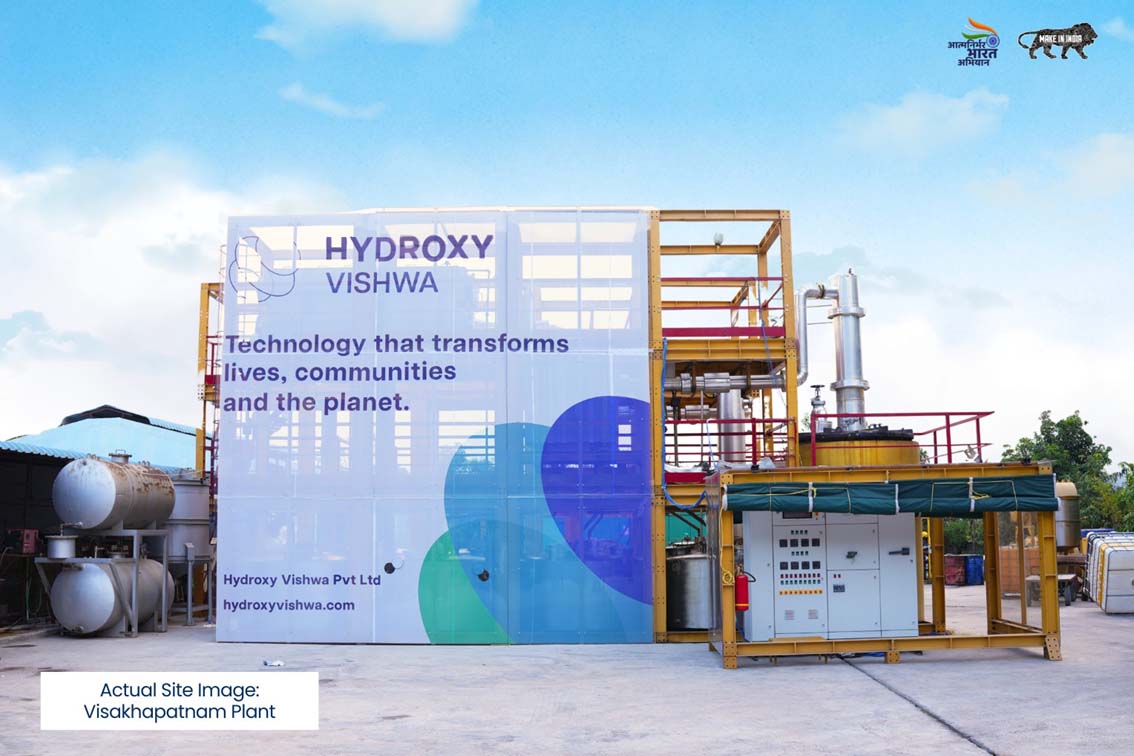
India, May 2026: In a significant development aligned with India’s vision of “Atmanirbhar Bharat” and “Viksit Bharat 2047,” Hydroxy Vishwa Pvt. Ltd. (HVPL) has introduced a patented waste-to-energy technology designed to address two of the world’s most pressing challenges — rising plastic waste and growing fuel dependency.
The company has developed a breakthrough plastic conversion technology protected under:
Patent No. 562285 (2025)
Patent No. 574603 (2025)
The innovation enables the conversion of:
Unwashed plastic waste
Unsorted mixed plastics
Contaminated landfill plastics
Difficult-to-recycle waste streams
into:
Automotive-grade diesel
Petrol
Kerosene
Specialty hydrocarbon products
Industrial chemicals
The company believes the technology could contribute significantly toward:
Plastic waste reduction
Energy sustainability
Lower crude oil dependency
Circular economy development
Environmental protection
Converting Plastic Waste into Energy
Plastic waste remains one of the largest global environmental concerns, with millions of tons ending up in:
Landfills
Oceans
Rivers
Urban dumping sites
At the same time, countries worldwide continue depending heavily on imported fossil fuels and crude oil.
HVPL’s technology attempts to address both issues simultaneously through a simple but scalable concept:
Converting discarded plastic into usable fuel and energy resources.
According to the company, the innovation was developed by an Indian scientist and his research team with the objective of supporting India’s long-term sustainability and energy independence goals.
The company states that the solution demonstrates how Indian innovation can contribute toward solving global environmental challenges such as:
Ocean plastic pollution
Plastic islands
Land contamination
Waste accumulation
Fuel shortages
A Shift Away from Traditional Plastic Disposal Methods
At the core of HVPL’s innovation is an advanced:
Thermal Depolymerisation Process
Unlike traditional plastic disposal or recycling methods such as:
Incineration
Conventional pyrolysis
Combustion-based processing
the company claims its technology operates through:
A closed-loop system
Zero combustion process
Catalyst-free operation
Pollution-controlled processing
According to HVPL:
No plastic is burned during the operation
No secondary waste streams are generated
No harmful emissions are released
No water is wasted during processing
The process reportedly functions:
At room pressure
Without operational noise
Under environmentally controlled conditions
Solving the Challenge of Unsorted Plastic Waste
One of the biggest limitations of existing recycling technologies globally is their dependence on:
Segregated plastic waste
Clean feedstock
Homogeneous plastic inputs
Most systems struggle to process:
Dirty plastics
Mixed waste streams
Municipal landfill plastics
Contaminated materials
HVPL states that its technology has been specifically engineered to process:
Heterogeneous and unsorted plastic waste.
This capability is particularly relevant for developing countries like India where large-scale source-level waste segregation remains a logistical challenge.
The company claims this allows low-value plastic waste to be converted into:
Valuable fuel
Industrial chemicals
Energy products
thereby transforming landfill waste into economic output.
Energy-Positive and Scalable Infrastructure
HVPL has designed the system using:
Modular deployment architecture
allowing the technology to operate across:
Small decentralized rural units
Urban waste management facilities
Large industrial-scale processing plants
The company also states that the system is:
“Energy-positive”
meaning the energy generated through fuel outputs exceeds the operational energy consumed during processing.
This could potentially make the model commercially viable for:
Municipal waste systems
Industrial recycling projects
Sustainable energy ecosystems
Decentralized waste processing infrastructure
Key Features of HVPL Technology
According to the company, the major highlights of the platform include:
Patented Thermal Depolymerisation Technology
Zero-combustion processing
Catalyst-free operation
Closed-loop system
Mixed Waste Processing
Handles unsorted plastics
Processes contaminated plastic waste
Accepts heterogeneous feedstock
Energy-Positive Output
Fuel output exceeds energy input
Reduced operational energy dependence
Circular Economy Model
100% mass balance approach
Waste converted into usable products
Supports sustainable resource recovery
International Expansion and Commercial Operations
HVPL has reportedly commenced commercial operations and has already begun establishing an international footprint.
The company confirmed it has received:
Approval from the Australian Government
to operate a:
150 TPD (Tonnes Per Day) facility
This expansion reflects increasing global interest in:
Sustainable waste management
Alternative fuel technologies
Circular economy systems
Plastic-to-fuel innovations
India’s Growing Waste-to-Energy Opportunity
India generates millions of tonnes of plastic waste annually, while simultaneously remaining one of the world’s largest importers of crude oil.
Industry experts increasingly believe technologies focused on:
Waste-to-energy conversion
Circular economy systems
Fuel recovery
Sustainable recycling
could become critical to India’s future environmental and energy strategy.
Government initiatives around:
Clean energy
Swachh Bharat
Circular economy
Sustainable infrastructure
Viksit Bharat 2047
are also accelerating investment and innovation in the clean technology sector.
Final Outlook
With its patented plastic-to-fuel technology, Hydroxy Vishwa Pvt. Ltd. is positioning itself within the growing global movement toward:
Sustainable waste management
Alternative energy generation
Circular economy infrastructure
Climate-positive industrial innovation
By converting difficult-to-recycle plastic waste into automotive-grade fuel and industrial outputs, the company aims to demonstrate how indigenous Indian innovation can contribute toward both:
Environmental sustainability
Energy independence
As global demand for scalable clean technologies rises, solutions that combine:
Waste reduction
Fuel generation
Operational efficiency
Low environmental impact
may play an increasingly important role in shaping the future of sustainable industrial ecosystems.