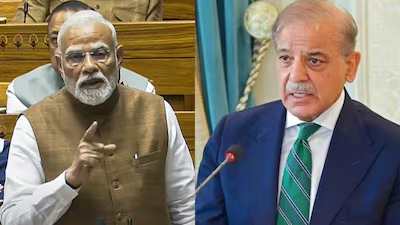
New York, September 26, 2026: India and Pakistan once again exchanged sharply contrasting positions at the United Nations General Assembly after Pakistan Prime Minister Shehbaz Sharif raised the Kashmir issue and warned that any attempt to stop, restrict or divert Pakistan’s share of Indus river waters would be treated as an “act of war.”
Speaking at the 81st UN General Assembly, Sharif criticised India’s decision to keep the Indus Waters Treaty in abeyance and argued that the agreement remained legally valid. He also referred to the 2025 military confrontation between the two countries and credited US President Donald Trump with intervening at a critical moment.
Sharif Raises Indus Waters Treaty at UN
Sharif described the Indus river system as vital for Pakistan and said water should not be used as a tool of political pressure. He warned that any effort to stop, impede or divert Pakistan’s share of the waters would be regarded by Islamabad as an act of war.
The remarks came amid an ongoing dispute over the 1960 Indus Waters Treaty. India placed the treaty in abeyance in April 2025 following the Pahalgam terror attack, which killed 26 people. New Delhi has maintained that the arrangement will remain in abeyance until Pakistan takes credible steps against cross-border terrorism.
India Uses Right of Reply
India responded to Pakistan’s address through its Right of Reply at the UN. Petal Gahlot, First Secretary at India’s Permanent Mission to the United Nations, rejected Pakistan’s allegations and focused on what New Delhi describes as Islamabad’s continued support for cross-border terrorism.
India argued that cooperation between the two countries cannot operate on the basis of trust while terrorism remains a major security concern. Gahlot also said that India’s position on the Indus Waters Treaty remains consistent with its broader security concerns.
The Indian statement further rejected Pakistan’s presentation of the Kashmir issue and criticised what it described as repeated attempts to portray a different version of events before the international community.
Dispute Over International Legal Proceedings
The disagreement over the water treaty has also moved into the international legal arena. A Court of Arbitration in The Hague recently issued a ruling concerning the treaty, while India rejected the proceedings and questioned the tribunal’s jurisdiction and constitution.
Pakistan has cited the ruling in support of its position that the treaty continues to remain binding. India, however, has maintained that its decision to keep the agreement in abeyance remains unchanged. The two countries therefore continue to hold fundamentally different positions on both the legal status of the treaty and the circumstances surrounding its suspension.
Terrorism Remains Central to India’s Position
For New Delhi, the Indus Waters dispute is closely connected to the wider security relationship with Pakistan. Indian officials have repeatedly said that meaningful engagement requires Pakistan to take credible and concrete action against cross-border terrorism.
The Ministry of External Affairs reiterated this position earlier in September, stating that Pakistan would need to demonstrate credible action before its assurances could be viewed differently by the international community.
Kashmir and the 2025 Conflict Also Feature
Sharif’s UN speech also revisited Kashmir and the 2025 conflict between India and Pakistan. He presented Pakistan’s position on the confrontation and credited Trump’s intervention with helping prevent a larger escalation.
India has consistently disputed claims of third-party mediation in the conflict. The two governments continue to present different accounts of the events surrounding the 2025 confrontation and its subsequent diplomatic developments.
India-Pakistan Tensions Remain Under International Focus
The latest exchange at the UN highlights how the India-Pakistan relationship continues to involve several interconnected disputes, including terrorism, Kashmir, water-sharing arrangements and the aftermath of the 2025 military confrontation.
With both sides maintaining opposing positions on the Indus Waters Treaty and security concerns, the issue is likely to remain part of wider diplomatic discussions at the United Nations and beyond.