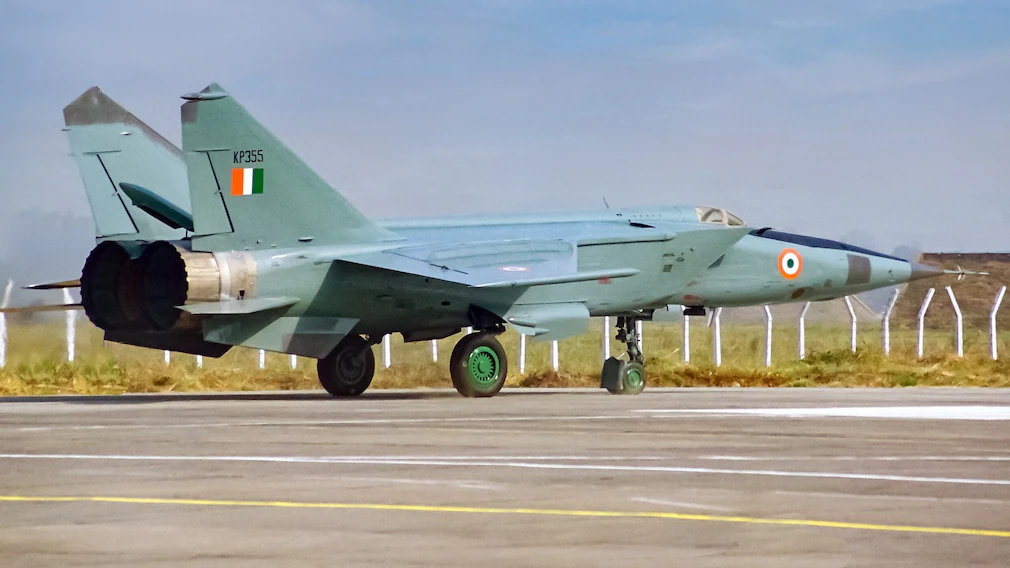
India’s MiG-25 reconnaissance aircraft carried out a high-altitude mission over Pakistani airspace in May 1997, according to accounts from former Indian Air Force personnel. The flight became associated with reports of sonic booms over Islamabad and claims that Pakistani fighter jets had attempted to intercept the aircraft.
The mission’s details, now discussed by retired military officers, offer a glimpse into the secretive reconnaissance operations conducted by the Indian Air Force during a period of heightened India-Pakistan tensions.
MiG-25: The Aircraft Behind the Mission
The MiG-25, known by NATO as the Foxbat, was designed for high-speed flight at extreme altitudes. India operated the aircraft primarily for strategic reconnaissance, using it to collect photographs and intelligence about areas of military interest.
On May 27, 1997, an Indian MiG-25 reportedly crossed into Pakistani airspace at approximately 20 kilometres above the ground. Retired Wing Commander Pradeep Jaswant Thakur, who served with the aircraft's squadron, later confirmed that the flight took place.
According to his account, the aircraft travelled at approximately Mach 2.4, equivalent to around 2,550 kilometres per hour. Its mission involved aerial photography of sensitive locations, although the specific targets have not been publicly identified.
Why the Flight Attracted Attention in Pakistan
The aircraft's passage became widely discussed after reports of loud sonic booms over Islamabad. These sounds occur when an aircraft travels faster than the speed of sound, producing pressure waves that can be heard on the ground.
Pakistani authorities reportedly detected an unidentified aircraft and suspected it was an Indian MiG-25. Accounts of the incident also described attempts by Pakistani F-16 fighters to intercept it.
However, the aircraft's speed and operating altitude made interception exceptionally difficult. By the time opposing aircraft could respond, the reconnaissance jet was reportedly already leaving the area.
Thakur has also challenged a popular version of the episode: the claim that the pilot deliberately accelerated to create a dramatic sonic boom as a show of strength. His account indicates that the aircraft was already flying at supersonic speed at its operating altitude.
How India Used the MiG-25 for Intelligence Gathering
The MiG-25's principal value to India was its ability to photograph strategically important locations from high altitude.
Its reconnaissance equipment included five cameras. Four captured images across the aircraft's flight path, while another recorded geographical coordinates. This information could help military planners identify the precise positions of important installations and other targets.
Such missions were conducted under strict secrecy. According to retired Air Marshal Sumit Mukerji, who commanded the squadron during the 1990s, operational instructions were passed directly to selected personnel rather than communicated through ordinary telephone channels.
The secrecy extended to flight schedules and recovery arrangements, limiting the number of people who knew when an aircraft would take off or return.
The MiG-25's Role During the Kargil War
The aircraft's contribution became particularly important during the 1999 Kargil conflict between India and Pakistan.
Indian forces faced difficulties locating small enemy positions in the mountainous terrain. Conventional reconnaissance from higher altitudes could not always provide the detail required to identify temporary shelters and concealed positions.
The MiG-25 was consequently assigned a different task from its traditional high-altitude missions. Thakur described flying at approximately 10 kilometres above the ground, substantially lower than the aircraft's usual reconnaissance altitude.
The lower flight profile allowed its cameras to capture more detailed images of positions in the mountains. The missions were supported by other Indian Air Force aircraft, which provided protection during the operations.
The resulting photographs helped establish more precise target coordinates for Indian strike aircraft. The reconnaissance missions demonstrated how the MiG-25 could support combat operations beyond its conventional strategic surveillance role.
Why India Retired the MiG-25
Despite its impressive performance, the MiG-25 eventually became less essential as satellite-based intelligence capabilities improved.
By the early 2000s, satellite imagery was offering increasingly detailed views of strategic locations without requiring an aircraft to enter potentially hostile airspace. This reduced the need for specialised reconnaissance flights of the kind performed by the Foxbat.
The Indian Air Force retired its MiG-25 fleet on May 1, 2006, after nearly 25 years of service.
The aircraft's retirement marked the end of a distinctive period in India's aerial reconnaissance history. Its combination of speed, altitude and specialised photographic equipment had provided capabilities that were difficult for other platforms to match at the time.
Conclusion
The 1997 MiG-25 mission over Pakistan remains a notable episode in the history of Indian military aviation. Accounts from retired Air Force personnel indicate that the aircraft did cross Pakistani airspace, while also questioning claims that the flight was intended as a deliberate public demonstration.
The mission illustrates the importance of intelligence gathering in military planning and the advantages that high-speed, high-altitude reconnaissance once offered. The MiG-25's later contribution during the Kargil War further demonstrated the value of aerial surveillance, before advances in satellite technology eventually made the aircraft redundant.