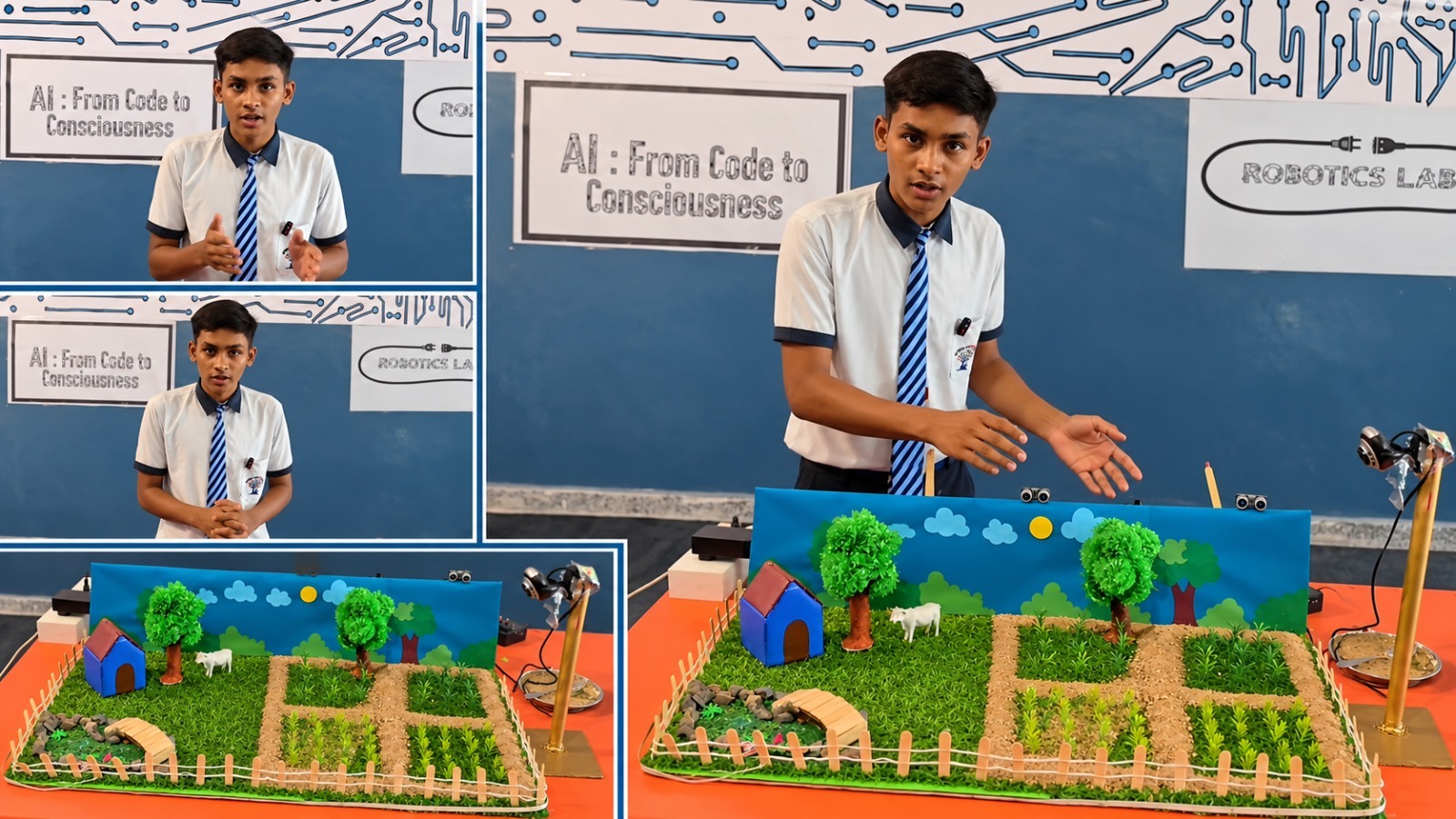
Kuchera, Nagaur, Rajasthan: Yash Sharma, a student of Mother World School, Kuchera, is exploring the practical applications of robotics, electronics and artificial intelligence through projects aimed at addressing real-world challenges. His work includes RAKSHAK-01, a humanoid robot developed with Neeraj Saini, and a sensor-based alarm system designed to alert farmers to possible wild animal activity near their fields.
RAKSHAK-01: Exploring Humanoid Robotics
The RAKSHAK-01 project reflects Yash and Neeraj Saini’s interest in combining robotics, electronics and software to develop an interactive machine. The project involves elements of humanoid design, servo-motor control, camera-based perception and voice interaction.
Developing a humanoid robot requires coordination between mechanical structures, electronic controllers, programming and power systems. Through this project, the students are exploring how different components can work together to support movement and interaction.
Technology to Address Agricultural Challenges
Alongside his robotics work, Yash has developed a sensor-based alarm system for crop protection in the laboratory of Mother World School, Kuchera. The model aims to address crop damage caused by wild animals, a challenge that can create financial difficulties for farming families.
The system is designed to detect activity within a designated area and activate an alarm when specified conditions are met. The warning could help farmers become aware of possible animal movement near their fields.
The project applies basic electronics and automation to an agricultural problem. Further field testing would be necessary to assess its detection accuracy, operating range, reliability and performance under different weather conditions before determining its suitability for practical use.
Mother World School Supports Practical Learning
Mother World School, Kuchera, has provided a laboratory environment where Yash could experiment with electronic components and develop his agricultural protection model. The support has helped him explore his interest in science and engineering beyond regular classroom lessons.
Project-based learning allows students to understand how theoretical concepts can be applied to practical situations. Activities involving sensors, programming, electronic circuits and mechanical construction can also strengthen problem-solving skills and technical understanding.
Project Coordinator Prashant Offers Support
Prashant, who is associated with the initiative, has expressed support for Yash’s efforts to develop his projects further. Guidance and collaboration can help young innovators test their ideas, identify technical challenges and improve their working models.
Such support also highlights the role of educators, mentors and local communities in encouraging scientific curiosity among students, particularly in smaller towns and rural areas.
Looking Ahead
Although humanoid robotics and agricultural monitoring serve different purposes, both projects involve identifying problems, integrating hardware and software, and improving designs through experimentation.
Yash’s crop-protection model could be developed further by evaluating its performance in actual agricultural settings. Reliability, affordability, power consumption and maintenance would be important considerations for potential use by farmers.
His work on RAKSHAK-01 and the sensor-based alarm system illustrates how practical learning can connect student interests with community challenges. With continued experimentation and appropriate technical guidance, these projects may provide a foundation for further exploration in robotics and agricultural technology.