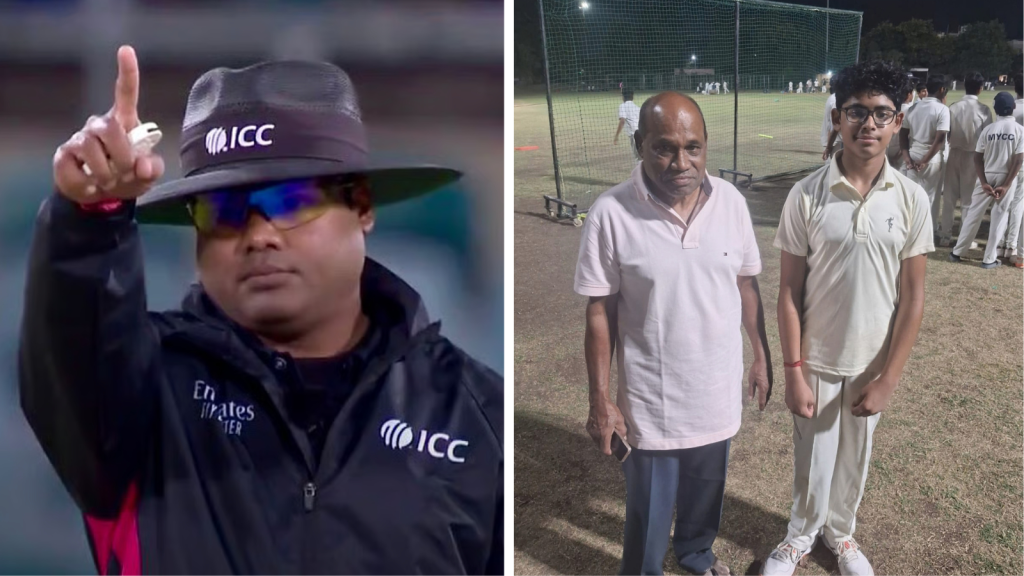
At 80, Narendra Menon still spends his evenings on the cricket field, helping young players understand the game he has devoted much of his life to. The former international umpire continues to officiate junior matches in Indore, teaching boys aged 12 to 15 the rules, discipline and decision-making that shape cricket beyond batting and bowling.
Menon’s work at the Central Gymkhana ground is a continuation of a career that began decades ago. While his international umpiring days ended in 1998, he has remained connected to the sport, passing his experience on to a younger generation. His son, Nitin Menon, has followed a similar path and is now an established international cricket umpire.
Teaching Cricket Through Match Situations
Menon’s approach is practical. Rather than limiting instruction to explanations away from the field, he uses situations that arise during matches to show young cricketers how the laws of cricket work.
Run-outs are one example. Young players may appeal before completing the necessary actions, or misunderstand when a batter can be given out. Menon explains details such as having the ball under control and removing the bails when required. He also helps them distinguish between situations that require an appeal and dismissals, such as being bowled, where an appeal is unnecessary.
The same method applies to no-balls and other decisions. By teaching during live games, he gives players an opportunity to understand the rules in context rather than simply memorising them.
The matches can be lengthy, with junior teams playing 50-over games that may continue into the evening. Initially, some parents were concerned about the time involved. Menon says their attitude changed after they saw the improvement in their children and understood the value of the experience.
A Return to the Ground Through His Grandson
Menon has been associated with the Maharaja Yashwant Rao Cricket Club since the 1960s. He had coached junior players in earlier years, but later stepped away from that regular involvement.
He returned to the ground about four years ago when his grandson, Hrishabh, began playing cricket. What started as a family connection soon became an opportunity to help many other youngsters.
The impact has been visible within the club. Menon has said that at least 30 boys associated with his club now represent the Indore division, while five or six have gone on to play at state level. He considers the progress of these players one of the most rewarding aspects of his continued involvement.
His presence is valued by players and coaches, who look to him for guidance on both the technical and behavioural sides of the game.
From First-Class Cricket to International Umpiring
Menon’s route into umpiring followed a period as a first-class cricketer. In 1990, he became part of the first group of 10 former first-class players selected through an examination process to enter umpiring. The group included S. Venkatraghavan and A. V. Jayaprakash.
He later served as an umpire coach from 2007 for almost a decade, helping develop officials and improve standards. His experience in domestic and international cricket also gave him a store of lessons to pass on to aspiring umpires.
One of his most memorable decisions came during the 2000 Ranji Trophy final between Hyderabad and Mumbai, when he gave VVS Laxman out on a close run-out. Former India captain Tiger Pataudi praised the accuracy of the decision, a moment Menon has remembered with pride.
Advice That Shaped Nitin Menon’s Career
When his son Nitin, then playing Under-22 cricket, told him he wanted to become an umpire, Narendra was surprised. He nevertheless offered a simple principle: an umpire must concentrate on the bat, ball and stumps rather than the identity or reputation of the players.
Nitin went on to build his own international career, carrying forward the family’s connection with cricket officiating.
For Narendra, however, the attraction remains the game itself. At an age when many former professionals have long left the field, he continues to stand in the middle, helping young cricketers learn the finer points of cricket one match at a time.