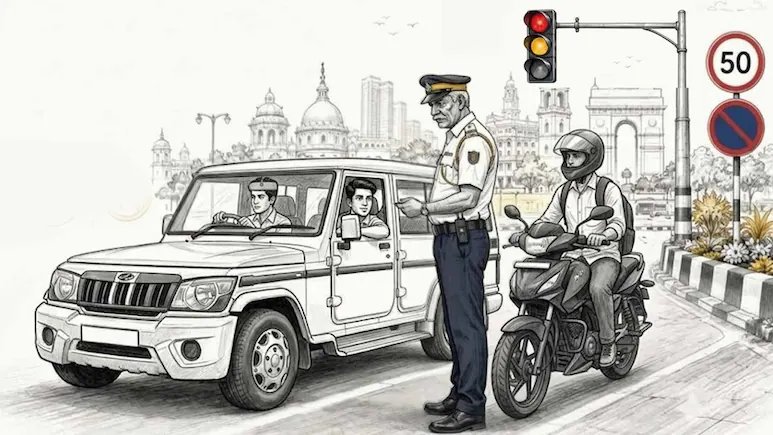
India has recorded a sharp increase in traffic challans over the past few years, but the recovery of penalties has not kept pace. The growing difference between fines issued and payments received has brought the country’s traffic enforcement system under fresh scrutiny, with the Supreme Court recently emphasising that issuing electronic challans alone cannot ensure compliance.
According to data from the Ministry of Road Transport and Highways, the number of traffic challans rose from 4.2 crore in 2021 to 9.6 crore in 2025. During the first nine months of 2026, authorities issued another 7.8 crore challans. The figures point to expanding enforcement through digital systems, but also reveal a significant challenge: a large proportion of penalties remain unpaid.
Unpaid Challans Account for 82% in 2026
The share of unpaid challans has increased consistently over the years. In 2022, around 48% of issued challans remained pending. This proportion rose to 55% in 2023, 63% in 2024 and 70% in 2025.
The situation became more pronounced in 2026, when approximately 82% of challans remained unpaid during the reported period.
The trend raises questions about the effectiveness of existing recovery mechanisms. Digital cameras and automated enforcement can identify violations and generate penalties, but collecting the amount requires follow-up systems that are efficient, accessible and enforceable.
Uttar Pradesh Leads in Challan Numbers
State-level figures show considerable differences in the volume of traffic enforcement. Uttar Pradesh recorded nearly nine crore challans, the highest among the states listed. Telangana followed with 8.2 crore, while Kerala reported 4.7 crore and Haryana around 2.4 crore.
Uttar Pradesh also had the highest amount of unpaid traffic challans, followed by Delhi, Kerala, Haryana and Odisha.
These figures reflect the number of recorded penalties and should not be interpreted as a direct comparison of driving behaviour across states. Differences in population, vehicle numbers, enforcement coverage and digital monitoring can influence the totals.
Court Backlog Adds to the Challenge
A further concern is the large number of challans referred to courts. Of nearly 70 lakh challans sent to courts in 2021, only 28% had been disposed of even after five years.
The disposal rate was lower for more recent cases. In 2025, around 2.9 crore challans were referred to courts, but only 8.6% had been resolved, according to the reported data.
The backlog can make it difficult for authorities to close cases promptly and recover outstanding penalties.
Supreme Court Suggests Stronger Recovery Measures
The Supreme Court has called for more effective ways to recover unpaid traffic fines. During a recent hearing, it suggested exploring measures such as linking outstanding challans to electricity bills.
Other proposals discussed included restricting certain vehicle-related services, blocking ownership transfers and taking action against vehicles with pending penalties. These were suggestions made during court proceedings, not measures that should be treated as universally implemented rules.
The broader concern is that penalties must have a credible recovery process if electronic enforcement is to achieve its intended purpose.
A System That Needs Both Enforcement and Resolution
India’s challan data highlights two connected tasks: improving road-rule compliance and ensuring that legitimate penalties are settled efficiently. Authorities may need to strengthen digital notifications, simplify payment and dispute processes, and address delays in court-referred cases.
The success of e-challan systems will ultimately depend not only on how many violations they detect, but also on whether cases are resolved fairly and outstanding fines are recovered.