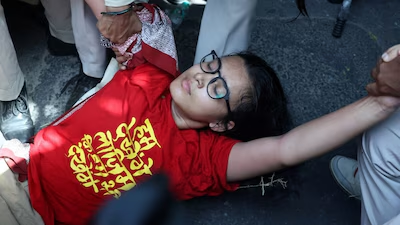
The Delhi High Court on October 22 heard arguments from both sides in a petition filed by All India Students' Association (AISA) president Neha Bora challenging a police notice requiring her to furnish a personal bond of ₹10,000 with one surety to maintain peace during an ongoing inquiry. During the hearing, Bora's counsel argued that seeking a change of government was legitimate in a democracy, while the government maintained that political change must take place through voting.
Justice Subramonium Prasad reserved the court's decision after hearing arguments for more than two hours. The order was scheduled to be pronounced on October 23 at 6 pm.
The case raises questions about the limits of preventive police action, the rights of citizens to participate in protests and the legal safeguards that must be followed when authorities seek assurances of public order.
Dispute Over Political Protest and Regime Change
The hearing featured contrasting arguments over remarks allegedly made during a gathering attended by Bora, leaders associated with the Cockroach Janta Party (CJP) protest movement and activist Prashant Bhushan.
Additional Solicitor General Chetan Sharma, representing the Delhi Police and the government, referred to the gathering while defending the action taken against Bora. He argued that the authorities had grounds to believe that public order could be disturbed and maintained that a change of government should occur through the electoral process.
Bora's counsel, senior advocate Gopal Sankaranarayanan, countered that advocating a change in government was not inherently unlawful in a democratic system. He also argued that Bora had not personally made the alleged statement calling for regime change.
The court's proceedings focused primarily on the legality of the notice and whether the authorities had followed the required legal procedures before initiating preventive action.
Why Neha Bora Challenged the Police Notice
The dispute followed Bora's detention on October 16, when she attended a gathering in the Mandi House area of New Delhi. She was released the following morning.
A subsequent notice from a Special Executive Magistrate directed her to furnish a personal bond of ₹10,000, supported by one surety, to maintain peace while the inquiry continued.
The notice referred to allegations involving slogans at Mandi House, participation in protests despite restrictions and efforts to encourage attendance at a demonstration in Connaught Place.
Bora challenged the notice before the High Court, arguing that the proceedings were legally flawed and could interfere with her fundamental rights, including freedom of expression and peaceful assembly.
Her counsel questioned whether the magistrate had independently assessed the available information before issuing the notice. He argued that preventive proceedings must comply with established legal safeguards rather than rely mechanically on allegations contained in police records.
Court Examines Legal Safeguards Under BNSS
An important aspect of the hearing concerned Sections 126 and 130 of the Bharatiya Nagarik Suraksha Sanhita (BNSS), 2023. These provisions govern preventive proceedings intended to address situations where authorities believe a breach of peace may occur.
Bora's legal team argued that officials must provide adequate reasons and assess the available material before requiring an individual to furnish a bond. The defence also questioned whether the magistrate had applied independent judgment when issuing the notice.
The government defended the proceedings as preventive rather than punitive. Its position was that authorities could take action when information indicated a potential threat to public tranquillity, without necessarily waiting for a conventional criminal offence to occur.
The court examined the legal basis for the action and the extent to which judicial intervention was appropriate at the notice stage.
Verdict Expected to Clarify the Dispute
The High Court's decision will determine the immediate outcome of Bora's challenge to the peace-bond notice. The proceedings also bring attention to the balance between maintaining public order and protecting citizens' rights to political expression and peaceful protest.
Until the court delivers its order, the competing claims remain arguments presented by the parties rather than final judicial findings.