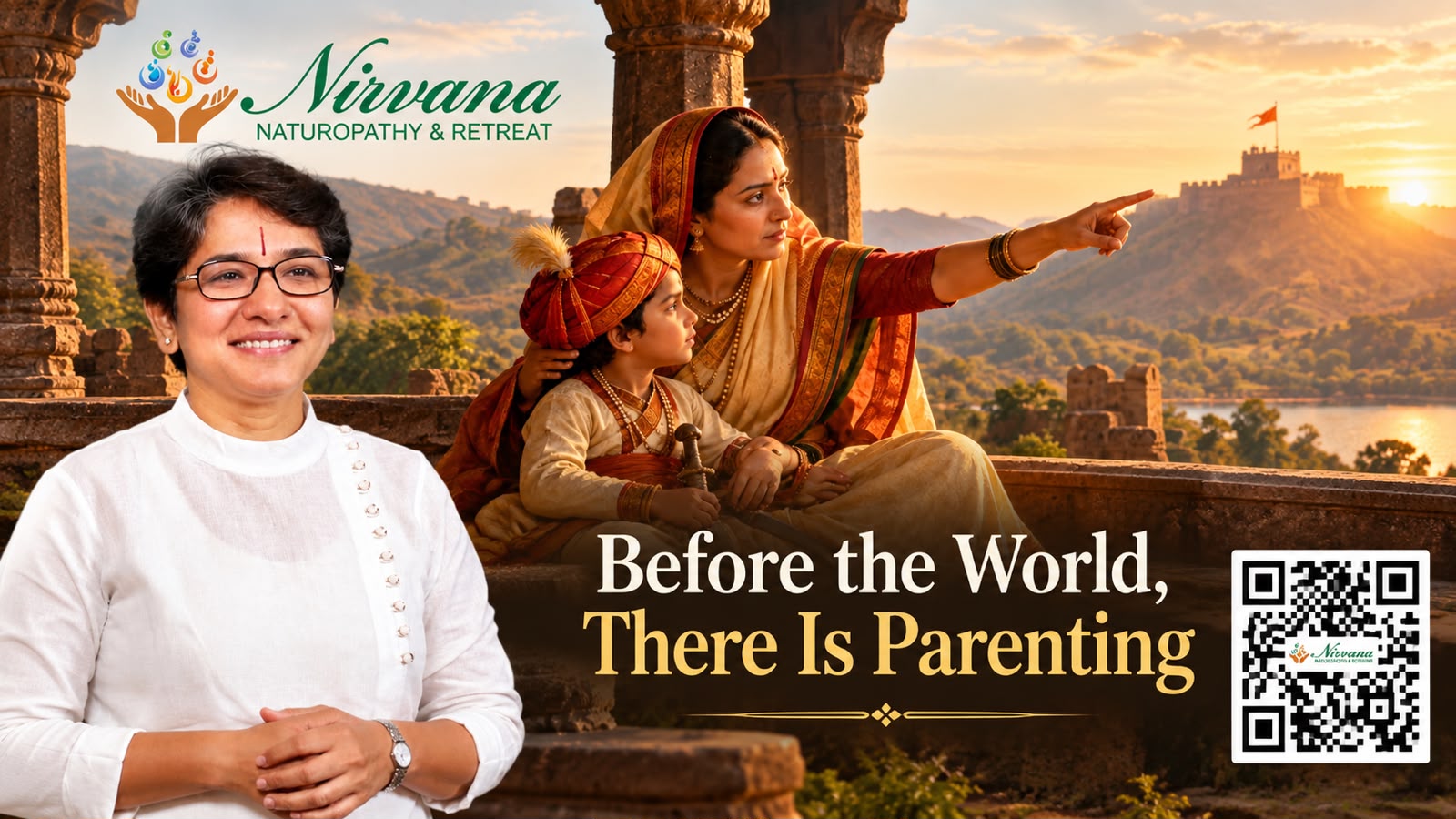
The story of Jijamata and Shivaji Maharaj offers a timeless reflection on how values are shaped at home, long before a child is old enough to understand the world around him.
There is something deeply moving about the image of a mother speaking to the child in her womb. She cannot know what the child will become. She cannot predict his choices, his struggles or the circumstances he will face. Yet she speaks, dreams and hopes.
The traditional accounts of Jijamata’s influence on her son, Shivaji Maharaj, have survived for generations for precisely this reason. They portray a mother who did not merely dream of her son’s personal success. She wanted him to grow into a man of courage, self-respect, justice and responsibility.
That raises an uncomfortable but necessary question for parents today: What are we trying to give our children beyond education and material success?
I have often found that this question becomes clearer when we observe ordinary family life.
A parent may spend years worrying about a child’s marks, career and financial security. Another may be concerned about whether the child will get into the right college or secure a prestigious job. These concerns are understandable. But somewhere between school examinations, coaching classes, smartphones and career planning, the quieter work of building character can receive less attention.
Jijamata’s story reminds us that this work begins much earlier.
Historical and cultural accounts of Jijabai have long recognised her influence on the upbringing of Shivaji Maharaj. His later association with the idea of Hindavi Swarajya occupies an important place in the history and collective memory of Maharashtra. But the relevance of Jijamata’s example need not be limited to a discussion of kings, battles or political history.
For a parent, there is another lesson here.
A child learns values first by observing them.
If we want children to respect others, they must see respect at home. If we want them to be responsible, responsibility cannot always be replaced by instructions. If we expect courage from them, they need to see adults who can acknowledge mistakes, face difficulties and stand by what they believe is right.
This is where parenting becomes more demanding than providing comfort.
I remember asking a parent during a conversation, “What do you most want your child to become?”
The answer came quickly: “Successful.”
I asked, “And what does success mean to you?”
The conversation slowed after that.
It is an important question because success means different things to different families. For some, it means a high-paying profession. For others, social recognition or financial independence. There is nothing wrong with aspiring to these things. But they cannot, by themselves, tell us whether a young person has developed judgement, empathy, discipline or the ability to take responsibility for his actions.
These qualities are not taught in a single lecture.
They are absorbed through everyday life.
Children notice how parents speak to one another when they disagree. They notice how adults behave with people who have less money or social status. They notice whether failure is treated as a disaster or as something from which one can learn. They notice whether the family speaks about responsibility only when it concerns the child, or whether adults accept it themselves.
These small observations often leave a deeper impression than a carefully prepared speech on values.
This is also why the story of Jijamata continues to have emotional relevance. It is not simply the story of a mother and a famous son. It invites us to think about the environment in which character is formed.
At Nirvana Naturopathy & Retreat in Igatpuri, my work in naturopathy and wellness has repeatedly brought me into conversations with families about health and lifestyle. We naturally discuss food, physical activity, sleep, stress and daily routines. But a person's wellbeing is also connected with the environment in which he or she lives, the habits cultivated at home and the emotional patterns that become normal over time.
Preventive healthcare, therefore, cannot be reduced to what we eat or how much we exercise. The way a family lives together matters too.
The same principle applies to values.
We cannot expect children to develop qualities that they rarely see around them.
Perhaps that is why the idea of speaking to an unborn child has such enduring appeal. It symbolises something larger than a literal conversation. It represents the belief that motherhood and fatherhood carry a responsibility to shape the values that a child will eventually carry into society.
That responsibility does not belong to mothers alone. Fathers, grandparents, teachers and the wider community all contribute to the formation of a young mind.
And there is another lesson worth remembering.
Raising a child with courage does not mean raising a child without compassion. Teaching self-respect does not require disrespecting others. Speaking about one's cultural identity need not mean teaching hostility towards someone else's identity.
A strong character can accommodate conviction and compassion at the same time.
For Indian families, this may be one of the most relevant lessons we can draw from the enduring memory of Jijamata. Our children do not need only information. They need examples. They need boundaries, affection, responsibility and the freedom to question. They need adults who understand that character is built quietly, often in moments that never appear in a school certificate or professional résumé.
The question, then, is not simply what our children will become.
It is what they will believe, how they will behave when nobody is watching, and what they will do with the opportunities they receive.
Jijamata could not have known the full story that awaited her son.
But she could shape the values with which he entered that story.
Perhaps that is the enduring responsibility of every parent.
Not to decide a child's destiny, but to give the child the character, courage and values with which to meet it.
Gurumaa Yogita Khatri is Founder and Director of Nirvana Naturopathy & Retreat, Igatpuri, Nashik; a Yoga and Naturopathy Professional, Motivational Speaker and Social Wellness Advocate, and Member, CCRYN, Ministry of AYUSH.
9769735554