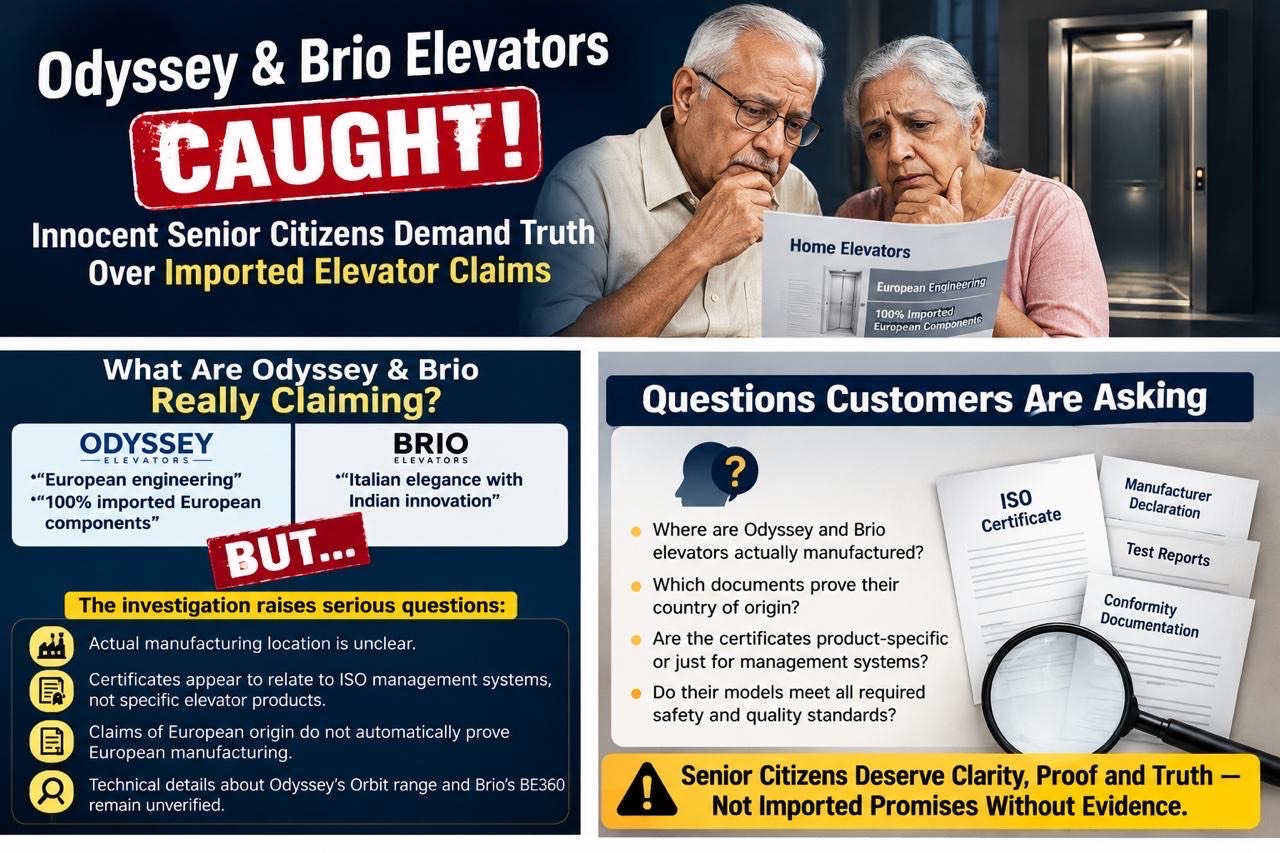
Questions surrounding Odyssey and Brio Elevators are drawing attention to the importance of transparency in the premium home elevator market. Customers considering high-value residential lifts are seeking clearer information about manufacturing origin, component sourcing, technical specifications, certifications and after-sales accountability. The issue highlights why buyers should verify documentation before making a major elevator investment.
Rising Demand for Transparency in the Home Elevator Market
Home elevators are increasingly becoming part of modern villas, duplexes and premium residences in India. Beyond convenience, they can provide improved accessibility for senior citizens and people with mobility challenges while adding architectural value to a property.
With the growing demand for luxury home elevators, customers are also becoming more conscious about safety, engineering standards, product origin, certification and after-sales service.
Odyssey and Brio have positioned themselves in this premium segment with distinctive home-lift designs. Brio promotes products including the BE-360 and other residential elevator systems, while Odyssey markets circular home elevators featuring European engineering and imported components.
Product Origin and the Importance of Clear Disclosure
One of the key questions raised in the material supplied for this report concerns how product origin and manufacturing are communicated to customers.
Terms such as “European engineering,” “imported components” or references to international technology can create a strong impression about where an elevator is manufactured. However, engineering origin, component origin, final assembly and country of manufacture are separate issues.
Publicly available information from Aresforti identifies Odyssey Elevators as its official authorised partner in India for its Turkish home-lift solutions.
For customers, the practical question is therefore not simply where individual components originate, but whether the manufacturer, manufacturing facility and country-of-origin information are clearly documented and disclosed.
Certification Is Not the Same as Product Testing
Certification is another area that deserves careful attention when purchasing a residential elevator.
Odyssey publicly states compliance with CE requirements, Machinery Directive 2006/42/EC and EN 81-41, while presenting its elevators as products designed around international safety standards.
However, consumers should understand what a particular certificate actually covers. A management-system certification, for example, is different from product-specific testing or conformity documentation for an individual elevator model.
Before purchasing, buyers should ask for the exact Declaration of Conformity, applicable standards, model details, test documentation and certification scope relevant to the elevator being offered.
Technical Specifications Need Independent Verification
The supplied investigation also raises questions concerning the technical classification of certain elevator systems, including their drive mechanism and suspension arrangement.
Such technical details should not be determined from promotional material or photographs alone. The appropriate documentation should identify the elevator’s drive technology, manufacturer, model, safety systems, rated capacity, travel parameters and applicable technical standards.
This is particularly important because a home elevator is a long-term installation rather than an ordinary consumer purchase.
Brio and the Premium Home Elevator Segment
Brio has built its positioning around luxury residential elevators and distinctive designs. Its official website highlights features including multiple safety systems and products such as the BE-360 and BE-300.
The company’s public material also describes the BE-360 as an imported product and highlights extensive safety checks and customisation options.
For customers, the next step should be straightforward: verify the claims through appropriate technical and commercial documentation before signing a contract.
What Buyers Should Ask Before Purchasing
For any premium home elevator, customers should request:
- Legal manufacturer and manufacturing-facility details
- Country-of-origin documentation
- Manufacturer authorisation, where applicable
- Product-specific certification and conformity documents
- Drive-system and model specifications
- Test reports and safety documentation
- Installation drawings and technical specifications
- Warranty and after-sales responsibilities
- Spare-parts and maintenance commitments
Transparency Should Come First
The central issue is not whether an elevator uses Indian, European or Turkish technology. The more important question is whether customers receive an accurate, verifiable and complete picture of the product they are purchasing.
As India’s luxury home elevator market expands, transparency will become increasingly important. Customers making a substantial investment deserve clear answers about manufacturing, engineering, certification, safety and long-term service.
The questions surrounding Odyssey and Brio therefore underline a broader lesson for the industry: premium positioning must be supported by equally premium transparency and documentation.
Official Websites