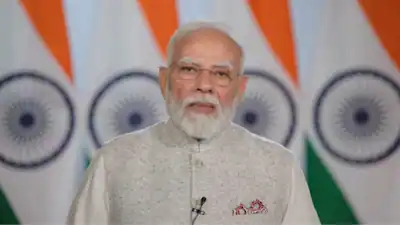
Prime Minister Narendra Modi on Saturday highlighted India’s position in the global climate debate, saying the country’s per capita carbon emissions remain less than half the global average. Speaking at an international conference on environment and climate in New Delhi, Modi also argued that developing countries are often held responsible for emissions without adequately considering differences in historical and per-person contributions.
The remarks came during the inauguration of the two-day International Conference on “The Future of Environment and Climate Dynamics”, organised by the National Green Tribunal (NGT). The event is bringing together judges, environmental experts, government officials and judicial representatives from 17 countries to discuss climate challenges and environmental governance.
India’s Per Capita Emissions Remain Low
Addressing the gathering, PM Modi said India’s per capita carbon emissions are below half the global average. He contrasted this with developed countries, saying their per capita emissions are substantially higher than India’s.
Independent emissions data supports the broader point about the difference in per-person emissions. The International Energy Agency reported that India’s per capita CO₂ emissions were around 2 tonnes in 2023, remaining below half the global average. The IEA also noted that India had become the world’s third-largest source of total CO₂ emissions in 2023, highlighting the difference between absolute emissions and emissions measured per person.
Data compiled by PRS India similarly shows that India’s per capita CO₂ emissions were about 2.1 tonnes in 2024, compared with 13.4 tonnes for the United States and 8.9 tonnes for China.
PM Modi Highlights Renewable Energy Push
The Prime Minister also pointed to India’s expansion of renewable energy as an important part of its climate strategy. He said the country has made significant progress across environmental sectors over the past 12 years, with clean energy becoming a major area of focus.
Modi highlighted several initiatives and developments, including the expansion of solar power, electric mobility, metro networks and other clean-energy technologies. He also referred to efforts to promote rooftop solar through the PM Surya Ghar programme and said India is simultaneously exploring nuclear energy as part of its future energy mix.
Paris Agreement Commitments Also Mentioned
During his address, PM Modi said India had achieved the commitments it made under the Paris Agreement ahead of schedule. He presented this as part of India's broader approach to combining economic development with environmental protection.
India's climate position has frequently focused on the principle that global climate responsibility should consider both historical emissions and present-day per capita emissions. This remains an important issue in international climate negotiations, particularly for developing economies.
Climate Governance Takes Centre Stage
The conference provides a wider platform for discussions on climate resilience, biodiversity, sustainable energy, environmental regulation and implementation gaps. According to the Prime Minister's Office, the event is intended to facilitate exchanges on scientific knowledge, judicial approaches and environmental governance between participating countries.
PM Modi's latest remarks have therefore placed India's per capita carbon emissions, renewable-energy expansion and climate responsibility at the centre of the ongoing environmental discussion. The figures also underline an important distinction in climate debates: a country's total emissions and its emissions per person can present very different pictures of its contribution to global greenhouse-gas emissions.