Poland has entered a fresh phase of political confrontation after the president of its Constitutional Tribunal, Bogdan Święczkowski, was suspended for one month, triggering protests outside the court and a sharp dispute between the government and opposition.
The development has intensified tensions between Prime Minister Donald Tusk's pro-European administration and the nationalist Law and Justice (PiS) party. Polish President Karol Nawrocki also cut short his trip to Senegal and returned to Warsaw, saying the situation required his presence in the country.
Police Secure Constitutional Tribunal
The suspension was announced on Friday, October 30, by senior judge Anna Korwin-Piotrowska, who said she would take charge of the tribunal during the one-month period. The announcement appeared on the court's website before the site became unavailable.
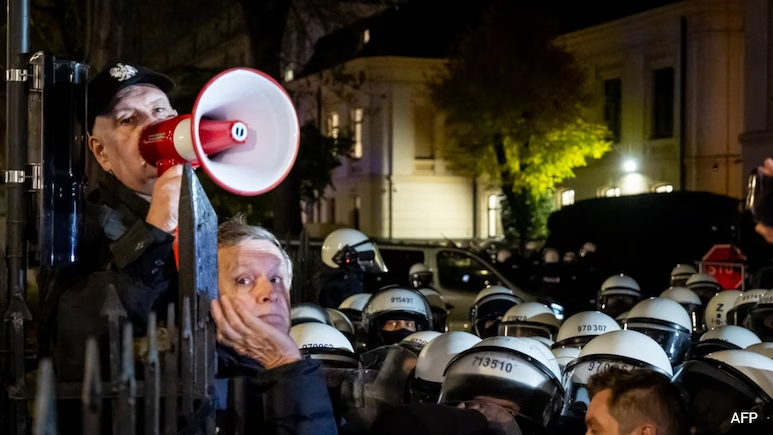
Police officers were deployed around the tribunal's headquarters in Warsaw as demonstrators gathered to oppose the decision. Some protesters attempted to breach the court's perimeter, while objects were reportedly thrown at police personnel. Authorities detained three people following the disturbances.
The court's official social media account rejected the change in leadership, maintaining that Święczkowski remained its president and describing the actions as an attempted coup. The dispute has therefore raised questions not only about the suspension but also about which authority can legitimately exercise control over the institution.
Nawrocki Cuts Short Senegal Visit
President Karol Nawrocki was travelling to Senegal when news of the suspension emerged. He ordered his flight to return to Poland, explaining that the country's political situation required him to be present in Warsaw.
His decision added another dimension to the confrontation, as Nawrocki has repeatedly opposed the government's attempts to restructure the judiciary.
The president is politically aligned with the Law and Justice camp, which governed Poland from 2015 to 2023. His position has frequently placed him at odds with Tusk's administration over judicial appointments and institutional reforms.
Why the Judiciary Has Become a Political Flashpoint
The conflict over Poland's Constitutional Tribunal has roots in changes introduced during the previous Law and Justice government. Critics in Poland and the European Union argued that those reforms weakened judicial independence and increased political influence over important institutions.
The European Union's Court of Justice ruled in 2021 that Poland's Constitutional Tribunal did not meet the required standards of independence and impartiality. The dispute also contributed to financial penalties and prolonged disagreements between Warsaw and European institutions.
Donald Tusk returned to power in 2023 promising to restore the rule of law. His government has since attempted to change the tribunal's composition and recognise judges elected by the current parliamentary majority.
However, Nawrocki and other figures associated with PiS have resisted several of these measures. Święczkowski, who became tribunal president under the previous administration, has also been accused by Tusk of preventing newly elected judges from taking their positions.
Government and Opposition Exchange Accusations
Tusk defended the government's actions, arguing that restoring the rule of law required decisive measures after years of institutional conflict. His administration maintains that changes are necessary to allow the tribunal to operate effectively and recognise appointments made through the current parliamentary process.
PiS leaders strongly rejected the suspension. Former Justice Minister Zbigniew Ziobro described the move as an attack on Poland's constitutional order and called for resistance. Opposition figures have portrayed the government's actions as an unlawful attempt to take control of the court.
The competing claims reflect a deeper disagreement over the legitimacy of judicial appointments and the authority to reform state institutions.
Political Tensions Continue
The latest confrontation comes ahead of Poland's next parliamentary election, expected next year. The dispute over the Constitutional Tribunal is likely to remain a major issue in relations between the government, the presidency and the opposition.
For now, the immediate challenge is determining who has legitimate authority to lead the court while the suspension remains in effect. The episode has exposed the continuing difficulty of resolving Poland's judicial crisis through institutions that remain deeply divided over their own legitimacy.