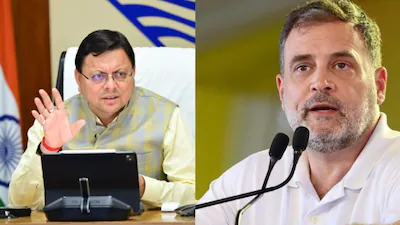
Uttarakhand Chief Minister Pushkar Singh Dhami has accused Congress leader Rahul Gandhi of undermining the interests of Indian businesses by supporting Elon Musk amid a dispute over the proposed launch of Starlink’s satellite internet services in India.
Dhami’s remarks, made on October 10, have added a new political dimension to the controversy surrounding the regulatory approvals required for Musk’s satellite broadband company to begin commercial operations in the country.
The chief minister argued that overseas companies seeking to operate in India must comply with domestic laws and regulatory requirements. He also maintained that national security and public safety must remain central to decisions involving foreign businesses.
Dhami Questions Rahul Gandhi’s Position
Reacting to Gandhi’s recent exchange with Musk on social media, Dhami alleged that the Congress leader was acting against the interests of Indian industry by appearing to support a foreign business figure in a dispute with the government.
He said the process of establishing a business in India requires the necessary licences, permissions and compliance with applicable laws. According to Dhami, these obligations apply regardless of a company’s international standing or the influence of its leadership.
The chief minister’s comments reflect the ruling BJP’s broader criticism of Gandhi’s response to Musk. BJP leaders have questioned why the Congress leader appeared sympathetic to the billionaire’s allegations while the government maintains that satellite communications companies must meet the same regulatory and security requirements.
Dhami also referred to the debate over electoral rolls, urging Gandhi to examine the record of earlier Congress-led governments rather than make allegations about the current administration.
How the Musk-Rahul Gandhi Dispute Began
The political exchange began after Musk publicly questioned why Starlink had not yet received all the approvals needed to begin commercial services in India.
Musk said the company had spent years complying with Indian government requirements and alleged that powerful business interests were obstructing its entry to protect their market positions. He subsequently questioned whether Reliance Industries chairman Mukesh Ambani held excessive influence over the country’s business environment.
Gandhi responded with a pointed message referring to another influential figure, without naming that person in his post. Musk thanked the Congress leader for his response, and the exchange quickly became a subject of political debate.
The BJP criticised Gandhi for engaging with Musk’s allegations, arguing that the interaction risked giving credibility to claims against India’s regulatory system. Congress leaders, meanwhile, have framed the issue around fair competition and concerns about the influence of powerful corporate groups.
Government Rejects Allegations of Unfair Treatment
The central government has rejected claims that Starlink is being deliberately held back to protect domestic competitors. The Ministry of Communications has maintained that India’s framework for satellite communication services is fair and non-discriminatory.
Starlink has received a licence to provide satellite communications services, but it cannot begin commercial operations until the remaining requirements, including security assessments and spectrum-related approvals, are completed.
The government has also said that other satellite communications providers are subject to the same process. These include Reliance Jio’s satellite venture and Eutelsat OneWeb, backed by Bharti Enterprises.
Officials have emphasised that security checks are a necessary part of the authorisation process and are not intended to single out one company. The government’s position is that regulatory compliance must be completed before any operator can launch services.
Starlink Debate Raises Questions About Competition
The dispute highlights the challenge of balancing competition in the telecommunications sector with national security and regulatory oversight.
Satellite internet could expand connectivity in remote areas where conventional broadband infrastructure is difficult to deploy. However, providers must also meet requirements governing spectrum use, security and operations within India.
Musk’s criticism has focused on the time taken to secure approvals and his concerns about market competition. The government, by contrast, says the process applies equally to all eligible operators.
Dhami’s intervention underscores how a regulatory question has evolved into a wider political confrontation involving the BJP, Congress and one of the world’s most prominent technology entrepreneurs.
The immediate question remains when Starlink will receive the outstanding clearances required to begin commercial operations. Until then, the debate over corporate competition, government oversight and national security is likely to remain part of the wider discussion around satellite internet in India.