GENEVA | 31 AUGUST 2026
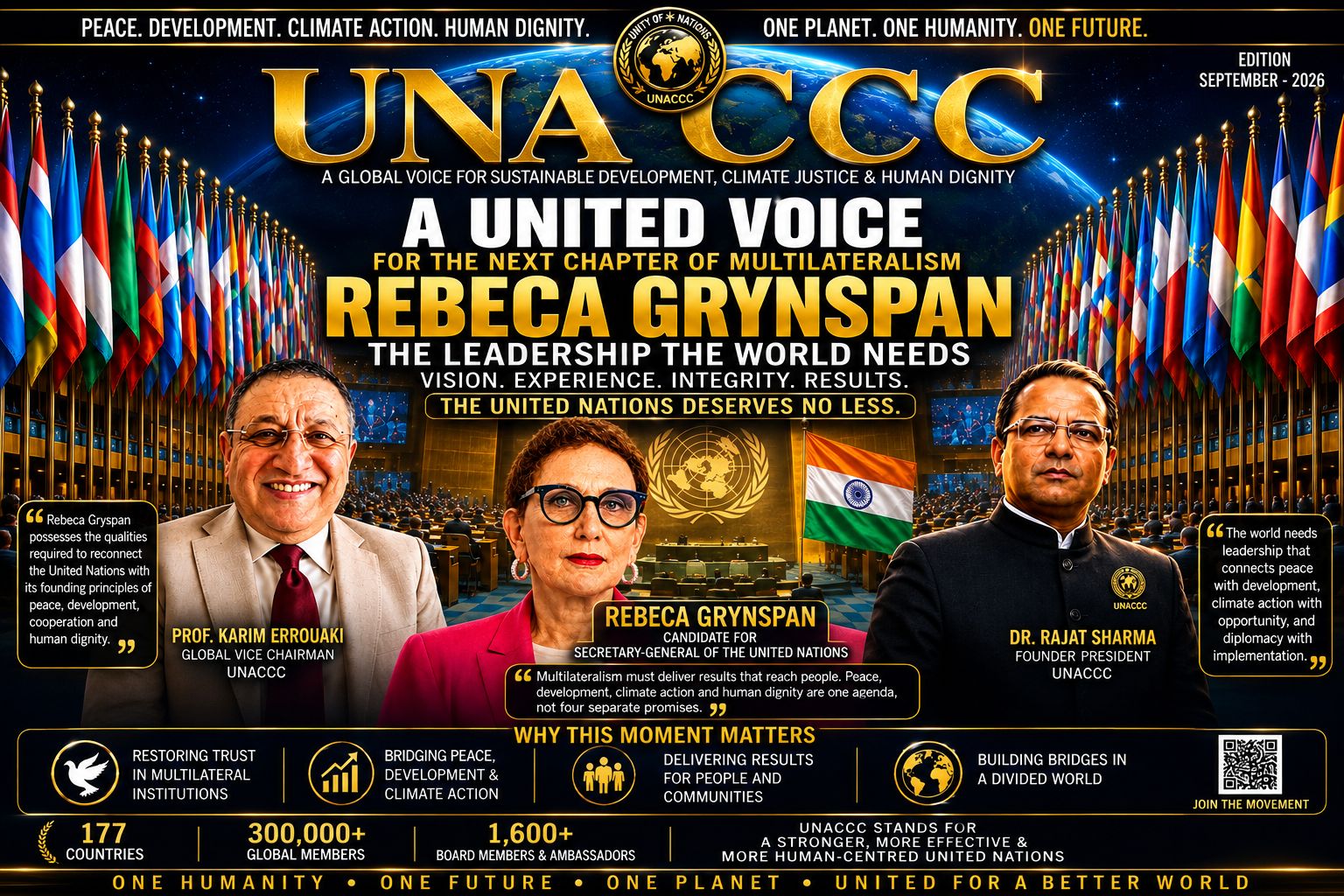
As the international community considers the future leadership of the United Nations, the debate is increasingly focused on what kind of leadership multilateralism requires in a deeply interconnected and divided world. The Unity of Nations Action for Climate Change Council (UNACCC) has expressed strong support for Rebeca Grynspan’s candidacy for Secretary-General of the United Nations, highlighting her experience across government, international development, economics and the UN system.
A Moment That Demands Stronger Multilateral Leadership
The UN faces a complex global environment shaped by armed conflicts, inequality, climate disruption, food and energy insecurity, economic fragmentation, development-financing challenges and declining confidence in international institutions. These issues are closely connected and require leadership capable of bringing countries together while translating international commitments into practical outcomes.
For UNACCC, the candidacy of Grynspan represents an opportunity to consider a leadership approach centred on peace, sustainable development, climate action, cooperation and human dignity.
Three Decades of International Experience
Ambassador Professor Karim Errouaki, Global Vice Chairman and High Representative for Foreign Affairs and Human Rights of UNACCC to the European Union and the United Nations Office at Geneva, has offered his strong support for Grynspan. According to the organisation, Professor Errouaki first met her in 1996 through Professor Federico Mayor Zaragoza, when she was serving as Vice President of Costa Rica.
He has since followed her professional journey through national politics, international development and multilateral leadership. His assessment places particular emphasis on her institutional experience, economic understanding and commitment to international cooperation.
Professor Errouaki previously served as Special Advisor to former UN Secretary-General Professor Boutros Boutros-Ghali and former UNESCO Director-General Professor Federico Mayor Zaragoza, adding significant international-policy experience to his perspective on the candidacy.
Dr. Rajat Sharma Highlights the Need to Build Bridges
Dr. Rajat Sharma, Founder President of UNACCC, has also expressed appreciation and support for Grynspan’s candidacy. He argues that the next UN Secretary-General must be capable of connecting major global priorities rather than addressing them separately.
From peace and development to climate action, economic opportunity and diplomacy, the challenge is to build stronger connections between international commitments and the realities faced by communities.
For UNACCC, this approach reflects the organisation’s broader emphasis on sustainable development, climate action, human dignity and international cooperation.
A Career Across Government, Development and the UN
Grynspan’s career includes senior responsibilities in Costa Rica, leadership roles within the United Nations Development Programme and service as Secretary-General of the Ibero-American Conference. According to the supplied profile, she later became the first woman to serve as Secretary-General of UNCTAD, taking office in 2021.
Her background in economics and development is particularly relevant to a global environment where debt pressures, development-financing gaps, inequality, climate investment and trade fragmentation increasingly intersect with international stability.
Her supporters argue that this combination of economic and multilateral experience could help connect diplomatic discussions with the practical requirements of developing countries.
From Global Commitments to Practical Action
UNACCC’s own vision places considerable emphasis on moving global priorities beyond declarations and into implementation. Its areas of focus include climate action, sustainable development, climate resilience, renewable energy and inclusive development, with an emphasis on cooperation among governments, academia, business, civil society and youth.
The organisation believes that sustainable development should create tangible opportunities, climate commitments should translate into projects and international cooperation should ultimately deliver measurable benefits for communities.
This perspective forms an important part of UNACCC’s support for leadership that can connect international diplomacy with real-world implementation.
The Future of a More Human-Centred United Nations
The selection of the next Secretary-General remains a matter for the established United Nations process and its Member States. UNACCC’s position is presented as a contribution to the wider international discussion rather than a replacement for that institutional process.
Its message is that leadership should be assessed through experience, integrity, diplomatic judgment, economic understanding, institutional competence and the ability to rebuild confidence in multilateral cooperation.
As the UN approaches another consequential moment, UNACCC believes Rebeca Grynspan’s record deserves serious consideration. The organisation’s broader vision is for a stronger, more effective and more human-centred multilateral system—one where peace, development, climate action and human dignity are treated as interconnected priorities.
Official Website: https://www.unaccc.org/