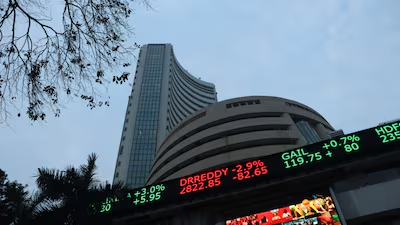
Indian stock markets ended lower on Friday, October 23, as selling pressure persisted across sectors and investors remained cautious amid rising crude oil prices and global uncertainties. The BSE Sensex declined 125.56 points, or 0.17%, to settle at 73,123.83, while the NSE Nifty 50 fell 87.65 points, or 0.39%, to close at 22,600.
The benchmark indices recovered part of their losses towards the end of the session but failed to return to positive territory. The broader market performed considerably worse, with midcap and smallcap stocks experiencing heavy selling as investors reduced exposure to riskier segments.
The decline extended the market's losing streak to four consecutive trading sessions, reflecting continued pressure on investor sentiment.
Smallcap and Midcap Stocks Face Heavy Selling
The sharpest weakness was visible beyond the benchmark indices. The Nifty Midcap 100 declined 2.21%, closing at 55,800.65, while the Nifty Smallcap 100 dropped 2.94% to finish at 17,739.45.
The performance indicated that smaller companies were facing substantially greater selling pressure than large-cap stocks. Investors appeared increasingly cautious about valuations and the outlook for businesses that could be more vulnerable to higher borrowing costs, rising input expenses and weaker market sentiment.
Among sectoral indices, metals, consumer durables, real estate and public sector banks recorded notable declines. The Nifty Metal index fell 2.71%, while consumer durables lost 2.63%. Realty stocks declined 2.38%, and the PSU Bank index slipped 2.26%.
The widespread weakness suggested that selling was not restricted to a handful of companies but extended across several parts of the market.
Rising Crude Oil Prices Add to Market Concerns
Higher international crude oil prices remained a key concern for investors. Brent crude traded above $110 per barrel amid geopolitical tensions and worries about possible disruptions to global energy supplies.
For India, which imports a substantial portion of its crude oil requirements, a sustained rise in oil prices can increase the country's import bill and place pressure on inflation. Higher energy costs can also affect companies in sectors such as aviation, transportation, manufacturing and consumer goods.
Investors were also monitoring global market movements and the possibility that prolonged geopolitical uncertainty could keep financial markets volatile.
These concerns contributed to a cautious approach towards equities, particularly shares whose valuations leave limited room for disappointing earnings or higher operating costs.
Top Gainers and Losers on the Nifty 50
Despite the overall decline, a small group of heavyweight stocks managed to finish higher.
Eternal, Apollo Hospitals, ONGC, Asian Paints and Tata Consultancy Services were among the notable gainers in the benchmark index. Their gains provided some support to the market and helped limit the decline in the headline indices.
On the losing side, Shriram Finance fell approximately 3.98%, making it one of the weakest performers among Nifty 50 constituents. Adani Enterprises, JSW Steel, Jio Financial Services and Tata Steel also recorded losses.
Metal stocks faced particular pressure, with concerns about global economic conditions and commodity prices weighing on the sector.
Market Breadth Remains Weak
Trading data highlighted the extent of the selling pressure. Of the 3,724 stocks traded on the National Stock Exchange, 3,011 declined, 624 advanced and 89 remained unchanged.
The India VIX, which measures expected market volatility, rose by around 6.3% to approximately 16.76, signalling increased nervousness among market participants.
The divergence between benchmark and broader indices remained an important feature of the session. Although the Sensex lost less than 1%, the decline in smallcap and midcap shares was considerably steeper.
What Investors Will Watch Next
Market participants are likely to monitor crude oil prices, geopolitical developments, corporate earnings and foreign investment flows in the coming sessions. The ability of benchmark indices to stabilise will also depend on whether selling pressure in broader markets begins to ease.
For investors, Friday's session highlighted the risks of assuming that a relatively modest decline in headline indices reflects conditions across the entire market. Smallcap and midcap stocks experienced much sharper losses, demonstrating how differently individual segments can perform during periods of uncertainty.
Tighten repetitive market commentaryLead with the broader-market selloff