Shreyas Iyer’s long wait for a T20 International century finally ended in spectacular fashion, but the innings was preceded by a period of technical reflection and a crucial conversation with former India batting coach Abhishek Nayar.
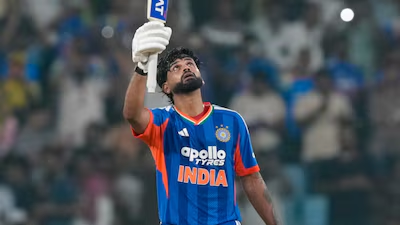
Iyer produced an unbeaten 102 from 43 balls against the West Indies in the opening T20I in Lucknow on October 6. His innings, featuring 10 fours and six sixes, powered India to an eight-wicket victory while chasing 172. The performance also ended a 67-match wait for his first hundred in T20I cricket.
The century was particularly significant because Iyer had been searching for consistency in the format. Before the West Indies game, he had struggled to cross 30 in his previous 10 T20I innings after making an unbeaten 80 against England. His return to form therefore arrived at an important moment, with Iyer also leading India in the series.
Nayar’s technical input made a difference
According to details that emerged after the match, Iyer had identified concerns with his batting during India’s recent Asian Games campaign. One of the issues involved his ability to generate power while playing attacking shots.
That prompted him to seek the guidance of Nayar. The two spent an extended session discussing and working through aspects of Iyer’s technique. Their work focused on elements including his grip, initial movement and backlift, along with tactical approaches for dealing with different types of bowling.
The objective was not simply to make Iyer swing harder. Instead, the changes were aimed at improving his setup and allowing his movements to flow more naturally into his shots.
Iyer later explained that getting his body positioned correctly before the ball was delivered helped him establish better momentum and rhythm at the beginning of his innings. That adjustment became one of the most important elements of his successful return to form.
A difficult start turned into a dominant chase
India did not begin the run chase comfortably. Abhishek Sharma and Sanju Samson were dismissed early, leaving the hosts at 35 for two inside the powerplay.
Iyer entered the contest with pressure on him, but instead of immediately attacking every delivery, he built his innings before accelerating dramatically. He reached his half-century from 28 balls and then shifted gears to finish the job in extraordinary fashion.
His acceleration was especially damaging in the latter stages. Iyer struck three sixes and a four in one over before completing his hundred by clearing the boundary. India eventually reached the target in only 14.4 overs, winning by eight wickets and taking a 1-0 lead in the five-match series.
More than just a century
The knock was not merely a personal milestone. It provided Iyer with a timely response after a difficult stretch in T20I cricket and strengthened India's position at the beginning of the series.
It also highlighted the value of small technical adjustments in elite batting. Iyer did not need a complete overhaul of his game. Instead, changes to his setup and movement helped him regain the timing, confidence and freedom required to attack international bowling.
Nayar’s intervention therefore became an important part of the story behind the century. The former India coach’s role was less about changing Iyer into a different batter and more about helping him rediscover the mechanics that allowed his existing strengths to come through.
For Iyer, the result was emphatic: a maiden T20I hundred, a match-winning performance and a strong response to the questions surrounding his recent form. India will now carry their 1-0 advantage into the second T20I in Ranchi on October 9.