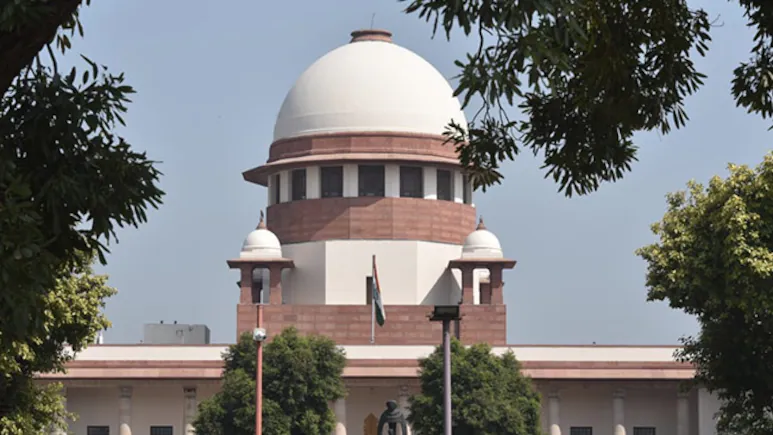
The Supreme Court’s hearing on security restrictions imposed ahead of a major protest in Delhi took a new turn after the Centre raised allegations that a woman police officer had faced sexual harassment during an earlier demonstration in the national capital. The government cited the incident while defending extensive security measures introduced ahead of the Cockroach Janta Party (CJP) protest scheduled for October 10.
Solicitor General Tushar Mehta, representing the Centre, told the court that a female police personnel had allegedly faced inappropriate conduct during a protest linked to the Congress. He said video footage was available to support the allegation and argued that demonstrations conducted without permission could create serious law-and-order challenges.
The submission came amid a broader legal debate over restrictions on public transport and movement in Delhi, with the court examining whether the security arrangements were proportionate to the potential risks.
Centre Defends Security Measures Ahead of CJP Demonstration
During the hearing, Mehta argued that the authorities had legitimate reasons to prepare for the CJP demonstration, pointing to incidents during previous protests. He alleged that more than 200 police personnel had been injured during the party’s demonstrations in July.
The government also highlighted concerns about compliance with protest conditions. Mehta told the court that organisers had received permission for a demonstration lasting one day and had provided a written undertaking to follow the stipulated conditions. However, he alleged that the agitation continued for 17 days.
The Centre referred to these circumstances to explain why the police had imposed restrictions ahead of the latest gathering. The allegations concerning the woman officer formed part of its broader argument about the difficulties faced by law-enforcement personnel during demonstrations.
The claims presented in court remain allegations and should not be treated as established findings of wrongdoing.
Supreme Court Questions Restrictions on Public Transport
The hearing also focused on the impact of the security arrangements on ordinary commuters. The authorities had ordered the closure of 57 Delhi Metro stations and cancelled trains scheduled to arrive at New Delhi and Hazrat Nizamuddin railway stations on October 10.
CPI(M) General Secretary MA Baby approached the Supreme Court, challenging the restrictions as arbitrary, disproportionate and lacking legal authority.
The court expressed concern that security precautions should not effectively prevent residents from accessing essential transport services. It observed that a complete prohibition on Metro and other train services could not be justified simply by citing security requirements.
The judges stressed the importance of distinguishing between reasonable restrictions and a blanket shutdown. They also asked the Centre to consider reducing the number of closed Metro stations and ensuring that commuters, including elderly passengers and young people, could continue travelling.
Following the court’s observations, Mehta agreed to convey the need for reconsideration to the relevant authorities. The court emphasised that security planning must protect the public without causing unnecessary disruption to daily life.
Women's Safety Remains a Central Concern
The discussion took place against the backdrop of separate allegations involving women at recent demonstrations. Three women journalists had alleged sexual harassment by police personnel, while protesters had raised similar complaints following earlier CJP demonstrations.
These competing allegations have added another dimension to the controversy surrounding protest management in Delhi. The latest hearing highlighted concerns about the safety of both police personnel and demonstrators, alongside questions about accountability and the use of public infrastructure during political gatherings.
Joint Commissioner of Police Nupur Prasad said the safety of women police personnel should be treated with the same seriousness as the safety of civilians. She stressed that alleged misconduct against officers should be condemned and said appropriate legal action was being taken.
The developments underline the challenge facing authorities as they balance public safety, the right to protest and access to essential transport. The Supreme Court’s observations indicate that security measures must remain proportionate, while allegations of harassment involving either police personnel or protesters require appropriate scrutiny.