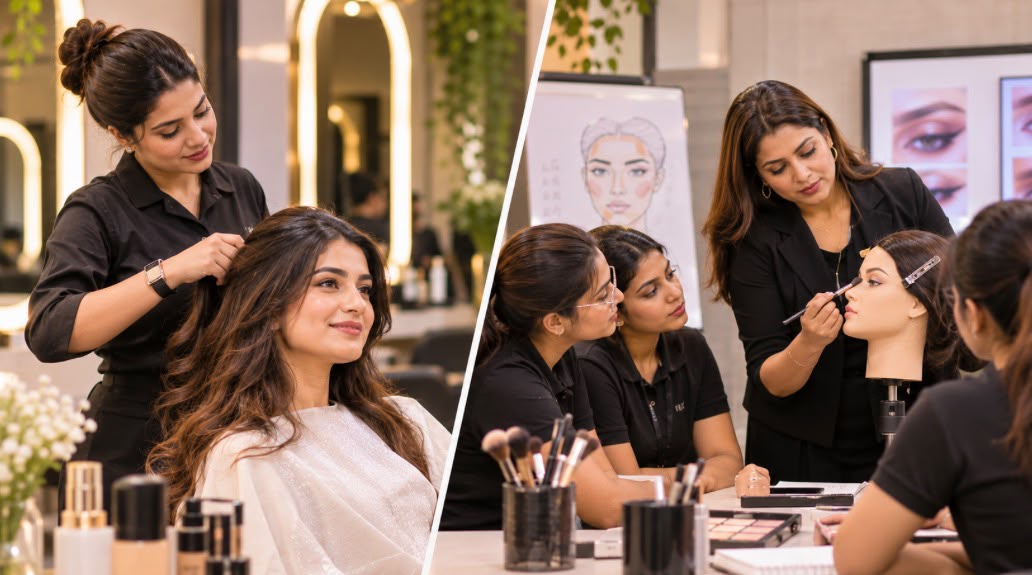
A person visiting a salon pays for a professional beauty service and the experience that comes with it. Someone enrolling in a beauty academy pays to acquire the skills needed to provide such services professionally. Both transactions belong to the same industry, but the businesses behind them operate differently.
One depends on consumer demand, appointments and customer retention. The other relies on educational programmes, practical training and professional skill development.
Understanding this distinction offers a more complete perspective on the beauty business in India. The industry includes not only the services customers purchase but also the education and professional skills that make those services possible.
That’s how, She N Me in Varanasi operates across these two business models through She N Me Salon and She N Me Beauty Academy. While both share a broader beauty-industry identity, they serve different audiences and address distinct commercial needs.
India's Beauty Industry: Two Different Business Opportunities
India's beauty and wellness services market represents a significant consumer-services sector. According to Redseer research included in Urban Company's 2025 Draft Red Herring Prospectus, the market was estimated at approximately ₹56,500–58,500 crore in CY2024, with projected annual growth of around 9–10% through CY2029.
The market includes female beauty, male grooming, spa services and specialised treatments.
Within this market, female beauty accounted for approximately ₹25,000–25,500 crore, while male grooming represented ₹24,000–24,500 crore. Spa services were estimated at ₹5,300–5,500 crore, and treatments at ₹2,400–2,600 crore.
The research also identified growth opportunities in specialised categories, with treatments and spa services projected to grow faster than the overall market.
For a business such as She N Me Salon, these segments create opportunities across skin, hair, nails, spa and bridal makeover services.
However, expanding consumer demand also highlights another requirement: trained professionals capable of delivering these services. This connects the service side of the industry with beauty education.
The Salon Business: Revenue Is Not the Same as Profit
A salon operates primarily as a consumer-service business. Its revenue comes from appointments, individual services, packages and related offerings.
At She N Me Salon, customers can access services across skin, hair, nails, spa and bridal makeovers. These categories serve different needs and have different purchasing patterns. While some services generate repeat bookings, others are driven by occasions or specific customer requirements.
A diversified service portfolio can help a salon reach different customer groups. But offering more services does not automatically mean greater profitability.
A 2025 analysis by Marcellus Investment Managers, New Kings & Queens: India's Beauty & Wellness Entrepreneurs, examines salon economics using MoSPI's unincorporated enterprise data.
According to the analysis, a small salon generated approximately ₹2.89 lakh in annual turnover during 2023–24, while an urban salon employing staff generated around ₹8.3 lakh in annual revenue.
These figures relate to specific categories of unincorporated businesses and should not be treated as representative of every salon in India.
More importantly, turnover is not profit.
A salon must manage several expenses, including staff salaries, rent, products, consumables, equipment, electricity, maintenance and marketing. Even with regular bookings, inefficient scheduling or underused infrastructure can affect financial performance.
Customer retention also plays an important role. Repeat appointments, referrals and trust can reduce the pressure of continuously acquiring new customers.
For She N Me Salon, as with any professional service business, long-term sustainability depends on balancing service quality, pricing, customer experience and operating costs.
Beauty Education: Investing in Professional Skills
While a salon sells services, a beauty academy sells education and skill development.
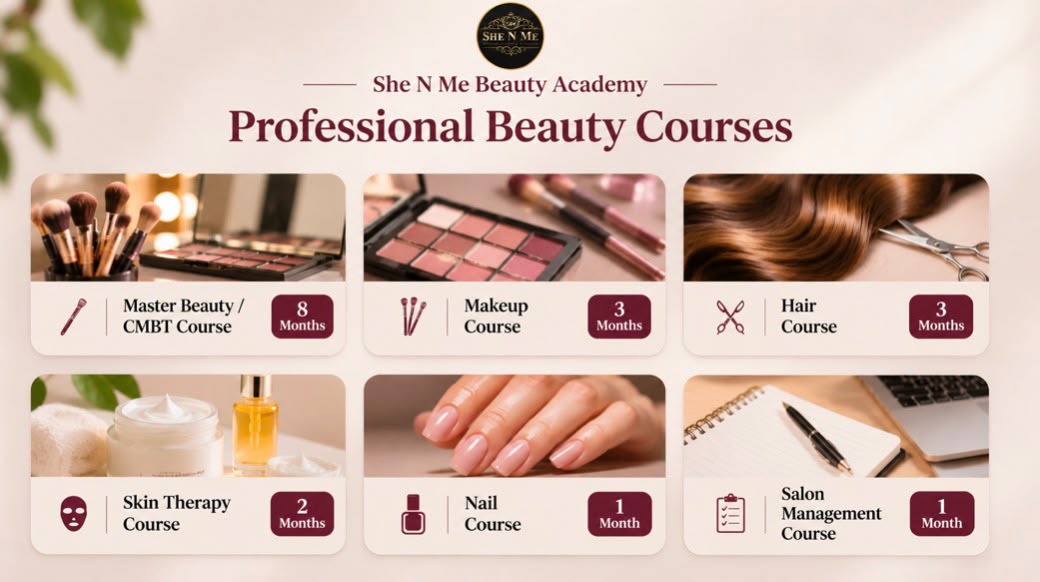
She N Me Beauty Academy represents this second side of the business. Its programmes cover makeup, hair, skin therapy, nails and salon management, with different durations designed around specific learning requirements.
Its listed courses include:
The academy follows a course-based revenue model, where income generally comes through student enrolments and educational programmes.
Its operating requirements differ from those of a salon. Trainers, training equipment, practical learning facilities, products, consumables, curriculum development and student support all require investment.
The quality of education is central to its value proposition. In beauty training, theoretical knowledge alone is insufficient. Students need opportunities to practise techniques, understand products, work with professional equipment and develop the discipline required in real service environments.
The relevance of courses also matters. Beauty techniques, products and professional expectations continue to evolve, making curriculum updates and practical learning important responsibilities for training institutions.
The wider skilling ecosystem reflects the growing importance of this sector.
The Institute for Competitiveness report Skills for the Future: Transforming India's Workforce Landscape (June 2025) records an increase in beauty and wellness vocational training participation from approximately 3.54 lakh in 2017–18 to 11.03 lakh in 2023–24.
Its analysis of PMKVY 4.0 data for the Beauty and Wellness Sector Skill Council records 1,19,903 candidates assessed, 1,13,418 certified and 8,140 placed. Approximately 73.1% of the trainees were below 35 years of age.
Professional Makeup Artist, Beauty Therapist and Bridal, Fashion and Portfolio Makeup Artist were among the leading training categories.
These figures relate to government skilling programmes, not the entire private beauty-academy market. Certification also does not guarantee employment.
Nevertheless, they demonstrate the relevance of beauty and wellness within India's vocational education landscape.
For She N Me Beauty Academy, the opportunity lies in delivering relevant training that helps individuals develop practical professional capabilities.
Their revenue cycles also differ.
A salon generally earns through individual transactions and repeat bookings. Its financial planning depends on appointment frequency, service pricing, staff productivity and customer retention.
An academy operates around structured programmes. Its planning involves course duration, enrolment cycles, training capacity and programme delivery.
Customer acquisition strategies differ as well. A salon builds its reputation through local visibility, referrals and service experiences. An academy needs to establish educational credibility through relevant courses, practical learning and student confidence.
These differences explain why the two businesses require separate operational and commercial strategies, even when they operate under one broader brand.
One Brand, Two Distinct Business Functions
Operating multiple verticals within one brand identity presents an interesting business opportunity, but it also requires clarity.
She N Me Salon communicates with customers seeking professional beauty services, while She N Me Beauty Academy addresses individuals interested in professional education.
Both serve the beauty industry, but their value propositions are not interchangeable.
From a business perspective, operating across different offerings within one industry can create opportunities for diversification. However, diversification does not automatically guarantee profitability or financial stability.
Each vertical needs its own planning, cost management and performance evaluation.
The salon must focus on service utilisation, customer retention, pricing and staff productivity. The academy must focus on enrolments, training capacity, teaching quality and course relevance.
Their broader industry association does not mean they necessarily share staff, infrastructure or operational systems.
The strength of this brand structure lies in maintaining a consistent identity while giving each business a clearly defined purpose.
The Challenges Behind the Opportunity
Both business models face commercial challenges.
For salons, managing fixed and variable expenses while maintaining service quality is a constant responsibility. Skilled employees, equipment maintenance, product standards and customer expectations all influence performance.
For academies, the challenge lies in maintaining educational relevance, investing in practical training infrastructure and finding capable trainers. Balancing course duration, fees and learning outcomes is equally important.
Both businesses must adapt to changing preferences and professional expectations.
A salon needs to understand what its customers want. An academy needs to understand what future beauty professionals need to learn.
Neither business becomes sustainable simply because the beauty industry offers commercial opportunities. Both require operational discipline and a clear understanding of their customers.
The Larger Opportunity: Services and Skills Must Grow Together
The beauty and wellness ecosystem extends beyond businesses that directly serve consumers. It includes professionals, trainers, product suppliers, equipment providers, educational institutions and entrepreneurs.
A salon represents one part of this ecosystem. A beauty academy represents another.
As demand for professional beauty services expands, the need for capable professionals becomes increasingly relevant. This creates opportunities for both consumer-facing businesses and institutions focused on developing professional skills.
She N Me's two verticals illustrate this distinction. One creates value through beauty services and customer experiences. The other creates value through education and skill development.
Both require investment, skilled people, business planning and a clear understanding of their audiences.
The beauty business, therefore, should not be viewed only through the services customers purchase. Behind those services is another business ecosystem built around education, training and professional capabilities.
Understanding both sides offers a more complete picture of the business behind India's beauty and wellness industry.