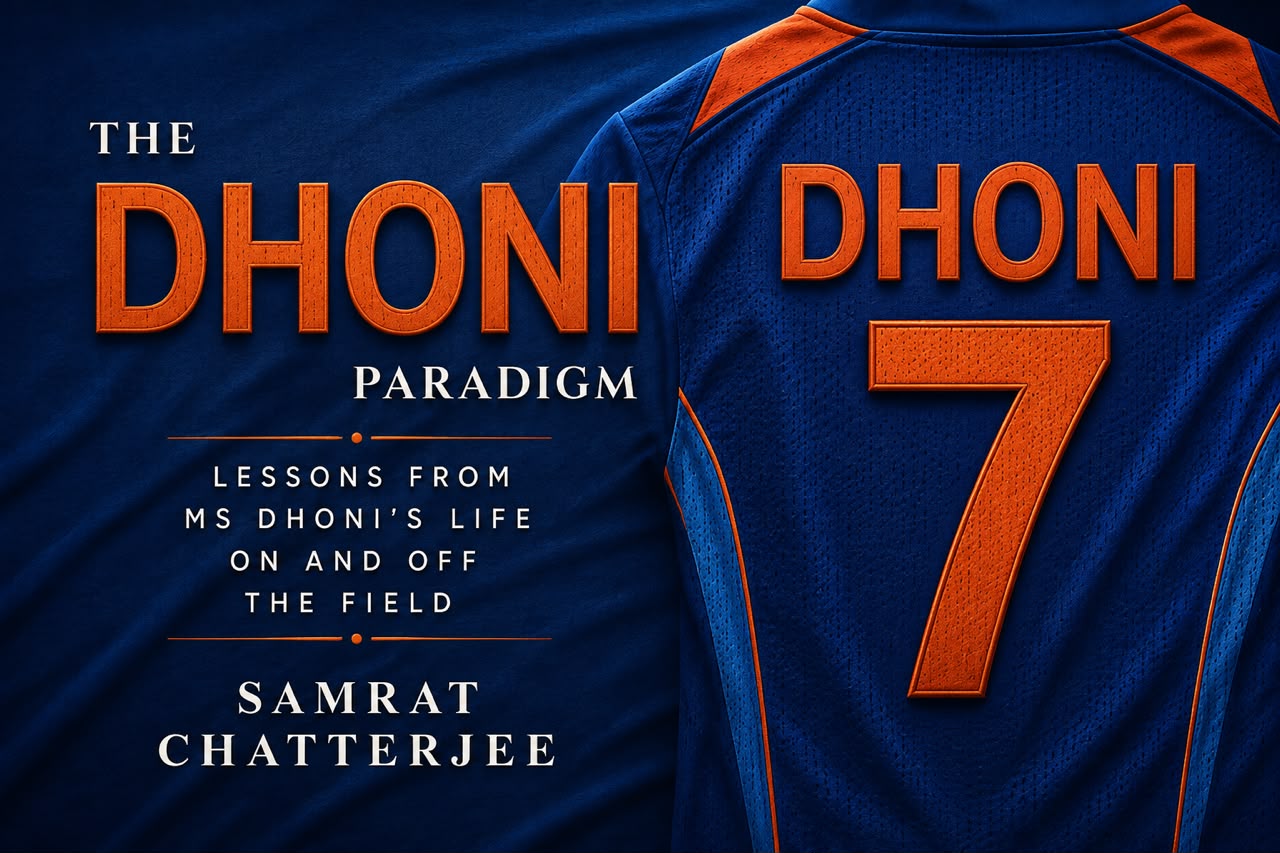
In an era where leadership is often associated with visibility, constant communication and quick reactions, The Dhoni Paradigm presents a contrasting idea: sometimes, the most effective leadership is found in restraint.
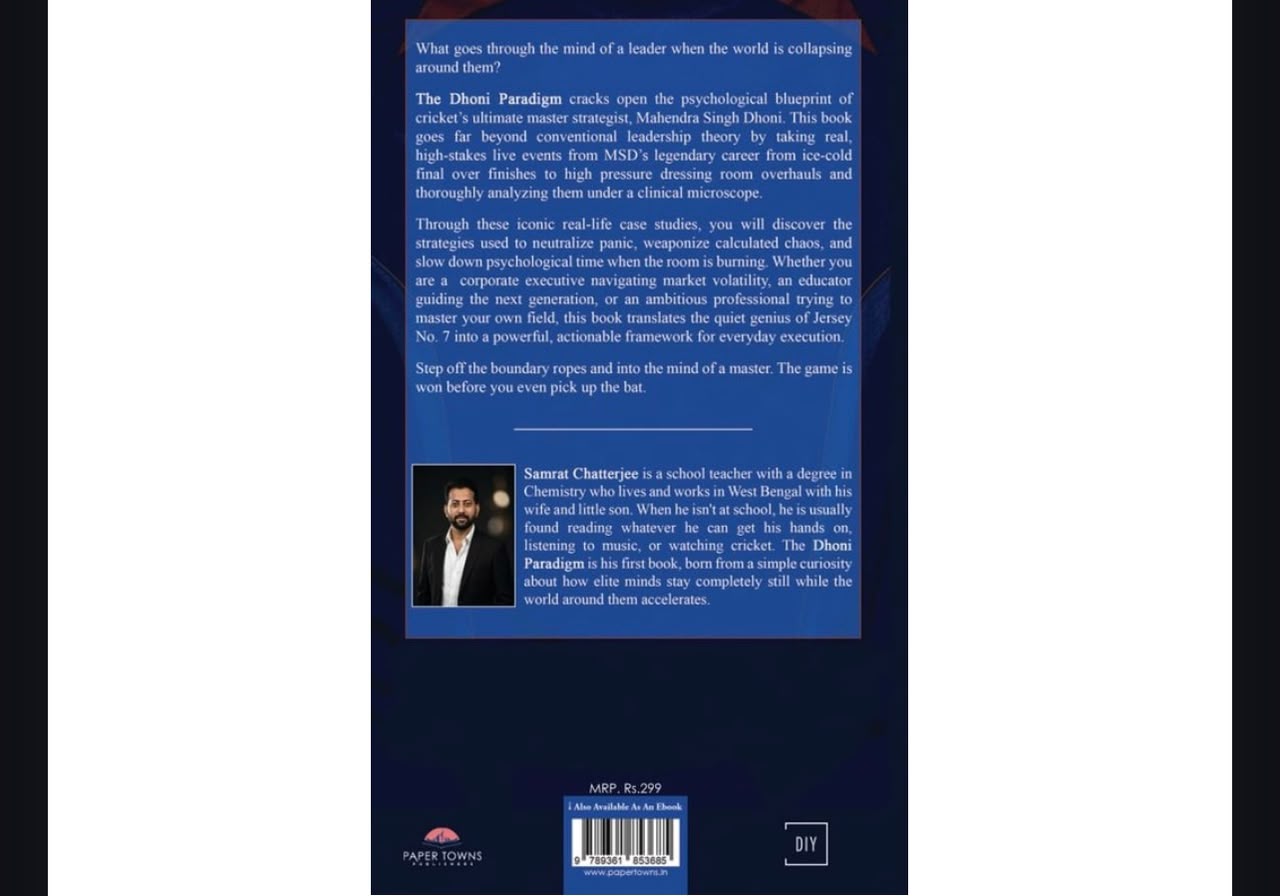
Authored by educator Samrat Chatterjee, the 113-page book examines the leadership philosophy and decision-making style associated with former Indian cricket captain Mahendra Singh Dhoni. Rather than presenting a conventional sports biography, the book uses key moments from Dhoni’s career to explore broader lessons in leadership, performance psychology, emotional control and personal development.
Published by Dreambook Publishing, The Dhoni Paradigm introduces what Chatterjee describes as the “Strategy of Silence”—an approach centred on composure, acceptance, disciplined decision-making and the ability to remain focused under pressure.
From Cricket to Corporate Leadership
Dhoni’s career has frequently been associated with calmness during high-pressure situations. Chatterjee takes this familiar characteristic and examines it through the lens of modern performance psychology and leadership.
The book argues that remaining composed does not necessarily mean remaining passive. Instead, silence can create space for observation, analysis and deliberate action.
This concept becomes particularly relevant beyond sport. Corporate executives, entrepreneurs, students and professionals regularly face situations where emotional reactions can influence important decisions. According to the book’s framework, developing the ability to separate emotion from execution can help individuals respond more effectively when circumstances become uncertain.
Connecting Ancient Philosophy With Modern Psychology
One of the distinctive elements of The Dhoni Paradigm is its attempt to connect contemporary performance science with ideas drawn from ancient philosophy.
The book’s seven chapters begin with verses from the Bhagavad Gita, using concepts such as Seva and Anicca alongside psychological frameworks including cognitive reframing, the Pygmalion Effect and Identity Fusion.
Through this combination, Chatterjee attempts to explore a broader question: how can individuals maintain clarity when outcomes are uncertain?
Rather than treating success simply as the result of talent, the book focuses on mindset, systems, identity and behaviour under pressure.
Lessons From High-Pressure Moments
Several examples in the book examine moments associated with Dhoni’s cricket career and place them alongside situations from business and other high-stakes environments.
One such comparison looks at a dramatic batting collapse against Pakistan alongside the Apollo 13 crisis and the turnaround of the LEGO Group. The purpose is to illustrate the concept of “de-catastrophising”—the ability to avoid allowing an immediate setback to become a larger psychological or strategic crisis.
The book also examines Dhoni’s persistence in backing players, including Rohit Sharma, Ravichandran Ashwin and Ravindra Jadeja, connecting this approach with the strategic patience demonstrated by business leaders such as Satya Nadella and Steve Jobs in their respective organisational environments.
Leadership Beyond Individual Recognition
Another central theme of the book is the distinction between personal achievement and systemic leadership.
Chatterjee’s analysis suggests that effective leaders should not build organisations that depend entirely on their own presence. Instead, they should develop systems, teams and decision-making structures capable of functioning beyond the individual leader.
This perspective has particular relevance for startups and corporate organisations, where founders and executives can sometimes become overly central to operations.
The book therefore encourages readers to think about leadership not simply in terms of authority, but in terms of team empowerment, accountability and organisational stability.
Managing Failure, Praise and Identity
The Dhoni Paradigm also explores the relationship between personal identity and professional outcomes.
One of its key arguments is that individuals should learn to separate their identity from immediate success or failure. Winning can create excessive attachment to achievement, while failure can unnecessarily damage confidence and decision-making.
The book proposes a different approach: accept outcomes, learn from them and continue executing.
It also examines the idea of deflecting excessive praise while accepting responsibility when things go wrong—an approach that can help leaders maintain perspective during both success and adversity.
A Leadership Framework for the Modern Workplace
Although the book is rooted in cricket, its intended lessons extend far beyond the sporting arena.
For students, the principles can offer perspectives on discipline, pressure management and personal development. For corporate professionals, they can provide a framework for handling uncertainty and making decisions without excessive emotional interference. For entrepreneurs and organisational leaders, the emphasis on systems, delegation and collective performance offers another way to think about sustainable leadership.
The book’s central proposition is that leadership does not always need to be loud to be influential.
As Chatterjee writes in the epilogue, “Silence, in the Dhoni paradigm, was never a passive state of inaction; it was an aggressive, structural weapon.”
That idea captures the broader philosophy explored throughout the book: composure can be a form of strength, restraint can improve decision-making, and leadership can be measured by the stability and capability a leader creates around them.
A Different Perspective on MS Dhoni and Leadership
The Dhoni Paradigm ultimately uses cricket as a starting point for a wider discussion about leadership, emotional intelligence, decision-making, resilience and performance psychology.
By bringing together examples from MS Dhoni’s career, corporate leadership, modern psychology and ancient philosophy, Samrat Chatterjee attempts to present a practical interpretation of what quiet leadership can mean in an increasingly noisy world.
Published by Dreambook Publishing, The Dhoni Paradigm is positioned for readers interested in MS Dhoni, leadership lessons, performance psychology, personal development, corporate leadership and the relationship between mindset and success.