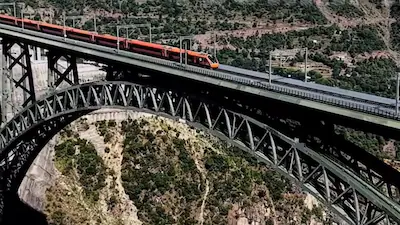
Indian Railways has achieved a major operational milestone in Jammu and Kashmir after a Vande Bharat Express successfully crossed the iconic Chenab Railway Bridge and Anji Khad Bridge at 100 kilometres per hour. The development follows the increase in the maximum permissible speed on the 111-kilometre Katra-Banihal railway section from 75 kmph to 100 kmph, marking another important step towards improving rail connectivity with the Kashmir Valley.
The successful trial was conducted on October 2, 2026, under the Udhampur-Srinagar-Baramulla Railway Link (USBRL) project. Railway Minister Ashwini Vaishnaw also shared a video of the train operating at the upgraded speed, highlighting the achievement.
Vande Bharat Crosses Two Major Railway Structures at Higher Speed
The latest trial involved Vande Bharat Express trains operating on the Jammu-Srinagar route. During the run, the train crossed two significant railway structures, the Chenab Bridge and Anji Khad Bridge, at 100 kmph.
The Chenab Railway Bridge is recognised as the world's highest railway arch bridge, while the Anji Khad Bridge holds the distinction of being India's first cable-stayed railway bridge.
The successful operation demonstrates the progress made in railway infrastructure and safety arrangements across the challenging Himalayan landscape.
According to railway officials, the revised speed limit became possible after the required safety conditions were fulfilled and the Railway Ministry approved the enhancement.
Katra-Banihal Speed Limit Increased From 75 to 100 Kmph
The 111-kilometre Katra-Banihal section previously had different speed restrictions across its stretches.
Trains were permitted to operate at up to 85 kmph between Katra and Sangaldan, while the Sangaldan-Banihal section had a maximum permissible speed of 75 kmph.
With the latest approval, the maximum permitted speed across the section has been raised to 100 kmph.
Railway authorities expect the improvement to support smoother operations, reduce journey times and provide passengers with a more comfortable travel experience.
However, the actual time savings will depend on train schedules, operational conditions and other factors along the route.
Chenab Bridge: A Major Achievement in Indian Engineering
Located in Jammu and Kashmir's Reasi district, the Chenab Railway Bridge stands approximately 359 metres above the riverbed.
The structure is around 1,315 metres long and forms a critical component of the USBRL project.
Its construction required advanced engineering techniques because of the difficult mountainous terrain, changing weather conditions and geographical challenges.
The bridge has become an important landmark in India's railway infrastructure development and plays a central role in connecting remote areas with the national railway network.
Anji Khad Bridge Adds Another Engineering Milestone
The Anji Khad Bridge is another important structure along the Katra-Banihal railway corridor.
Unlike the Chenab Bridge, which uses an arch-based design, the Anji structure uses a cable-stayed configuration to support the railway alignment across a deep valley.
Its successful integration into the railway network represents a significant engineering achievement, particularly given the region's difficult geographical conditions.
The recent Vande Bharat trial at 100 kmph highlights the operational capabilities of both bridges.
USBRL Project Strengthens Kashmir Connectivity
The Udhampur-Srinagar-Baramulla Railway Link is designed to provide an all-weather railway connection between the Kashmir Valley and the wider Indian railway network.
The project includes numerous tunnels and bridges built across challenging mountainous terrain.
Its completion has improved transportation options for residents, tourists and pilgrims travelling through Jammu and Kashmir.
Vande Bharat services between Katra and Srinagar were introduced in June 2025, while the service was subsequently extended towards Jammu Tawi in 2026.
Faster Rail Operations Mark a New Chapter
The increase in the Katra-Banihal speed limit represents an important development for railway transportation in the region.
With the successful 100 kmph trial across the Chenab and Anji bridges, Indian Railways has demonstrated progress in operating modern trains across complex infrastructure.
The improvement is expected to support better connectivity, more efficient railway operations and improved passenger convenience along one of India's most technically challenging railway corridors.