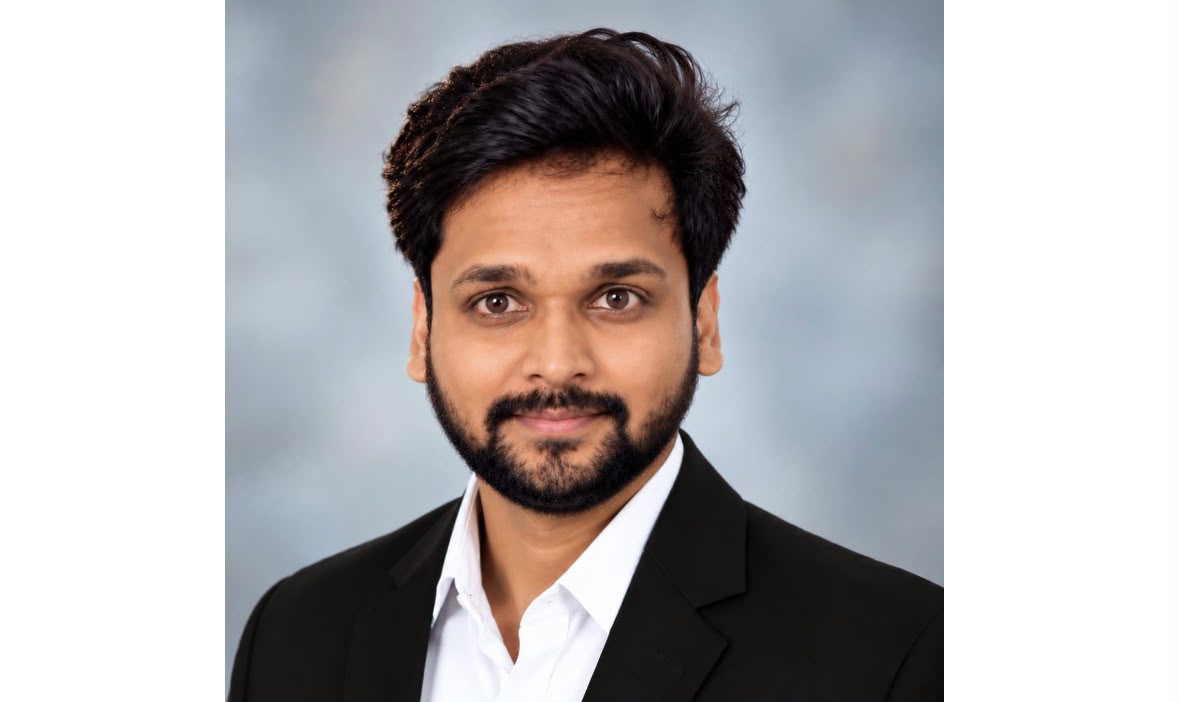
With 70+ patent contributions, 40+ Scopus-indexed research publications, and recognition across science, education and literature, Anvesh Roy is building a career where technology, creativity and compassion meet.
What happens when a scientist refuses to stay inside the boundaries of science?
The answer can be found in the unusual journey of Anvesh Perada, widely known professionally as Anvesh Roy—an engineer, scientist, independent researcher, author, writer, poet, innovator and aspiring entrepreneur whose work crosses technology, psychology, education, creativity and community service.
At the center of that journey is a simple question: What is knowledge worth if it does not improve human life?
That question has shaped a professional path that rarely fits into a single category.
His academic journey spans Engineering, Power Systems and Automation, Management, Clinical Psychology, Journalism and Mass Communication, Political Science, Economics and Law. His research interests extend across artificial intelligence, machine learning, electric mobility, renewable energy, quantum computing, IoT, behavioural analysis, educational technology and human-centered innovation.
Rather than viewing these fields as separate pursuits, he sees them as connected ways of understanding the world.
Engineering teaches how systems work. Psychology explores how people behave. Research tests what is possible. Writing communicates ideas. Poetry explores experiences that cannot always be measured.
Together, they have shaped an interdisciplinary approach to innovation.
He has contributed to 70+ patent filings across India, the United Kingdom and Canada, alongside 40+ Scopus-indexed research publications. His work has addressed emerging challenges across energy, electric mobility, artificial intelligence, healthcare, education and human wellbeing.
His recent research reflects this human-centered direction.
In 2026, his academic work included research involving wearable IoT sensor data for real-time stress and emotion detection, along with machine-learning approaches for academic stress prediction and behavioural analysis among students in higher education.
The technology may be sophisticated, but the underlying concern is simple: Can innovation help us understand people better and respond to their needs more intelligently?
That question becomes increasingly relevant as artificial intelligence enters classrooms, workplaces, healthcare systems, transportation and everyday life.
Technology can process enormous amounts of information.
But information is not the same as understanding.
An algorithm can identify a pattern. A human being still has to decide what that pattern means, how it should be used and whether using it is ethically responsible.
This is where his interest in psychology and human behaviour intersects with his scientific work.
It is also where his philosophy of leadership begins.
In an environment that often rewards speed, visibility and constant communication, he believes there is value in something quieter: listening.
Good leadership, in his view, is not always about having the fastest answer. Sometimes it is about creating enough space to understand the real problem before responding.
That perspective extends beyond professional life.
For nearly 17 years, he has been involved in community service and social-impact initiatives, including support for vulnerable communities, disaster-relief efforts, mental-health awareness and community assistance. He currently serves as General Secretary (South India), Human Rights Council for India.
His understanding of compassion also extends to animals.
Among the most personal expressions of his values is feeding and caring for stray dogs and supporting animals in vulnerable situations.
There is no professional title attached to such an act. No research metric measures it. No patent protects it.
It is simply a choice to care.
And perhaps that is precisely why it matters.
For him, service is not something that begins when recognition arrives. It is part of how success should be understood in the first place.
That same perspective appears in his creative work.
As an author, writer and poet, he explores kindness, relationships, resilience, vulnerability, leadership and purpose. Through his articles, poetry and Relatable Realities newsletter, he writes about the human experiences that exist beneath professional identities.
The scientist and the poet may appear to live in different worlds.
But both begin with curiosity.
One asks how something works.
The other asks what it means.
Both require observation.
Both require patience.
And both can change the way people see the world.
His growing recognition in 2026 reflects the breadth of this journey.
He received the Outstanding Scientist & Best Researcher Award 2026 through TheCconnects and its Global C-Suite Community Platform. He was also recognized with the Grand Laureate for Educational Excellence 2026 by the International Council for Education, Research and Training. His literary work received the Shakespeare Poetry Award 2026 from Inkfetish Publications.
These recognitions follow earlier distinctions for research, scientific achievement, innovation and leadership.
But awards are milestones, not the destination.
The larger ambition is to build a life in which different forms of knowledge strengthen one another.
A scientist can be curious about emotions.
An engineer can care about ethics.
A researcher can write poetry.
An entrepreneur can value compassion.
A leader can listen.
And someone pursuing technological progress can still remember the individual human being behind the data.
That matters because the next generation of challenges will not belong to one discipline.
Climate and energy require engineering, economics, policy and human behaviour.
Healthcare requires science, technology, psychology and ethics.
Artificial intelligence requires computing, law, philosophy and human judgment.
Education requires technology, creativity, behavioural understanding and empathy.
The world's most difficult problems are interconnected because human life is interconnected.
This is why interdisciplinary thinking has become more than an academic preference for him. It has become a way of approaching the future.
His philosophy can be expressed in one sentence:
“Knowledge becomes meaningful only when it serves humanity.”
It is a principle that connects his research with his writing, technology with psychology, ambition with compassion, and professional achievement with community service.
Ultimately, his journey raises a question larger than any individual patent, publication or award:
What should progress look like when technology becomes more powerful than ever before?
Perhaps progress is not simply creating smarter machines.
Perhaps it is creating smarter systems while becoming wiser human beings.
Perhaps innovation is not only about moving faster.
Perhaps it is about knowing where we should go.
And perhaps the most valuable people in the future will be those who can bridge worlds that have traditionally been kept apart—science and creativity, technology and empathy, ambition and kindness, intelligence and wisdom.
That is the space Anvesh Roy continues to explore.
Not simply what humanity can invent.
But what humanity can become through what it invents.