Every generation quietly assumes it is watching tradition fade away.
Parents worry that customs are becoming shorter. Grandparents notice fewer rituals than they remember. Newspapers regularly suggest that technology is changing not only the way people communicate, but also the way they celebrate life’s most important moments.
Spend enough time at Indian weddings, however, and a different picture begins to emerge.
Tradition isn’t disappearing.
It’s learning a new language.
Over the past two decades, weddings have changed dramatically. Invitations now arrive through messaging apps instead of handwritten envelopes. Families plan ceremonies across video calls connecting relatives on different continents. Couples create digital playlists instead of distributing CDs, while celebrations are livestreamed so loved ones thousands of kilometres away can still feel part of the occasion.
On the surface, almost everything looks different. Look a little closer, and remarkably little has changed.
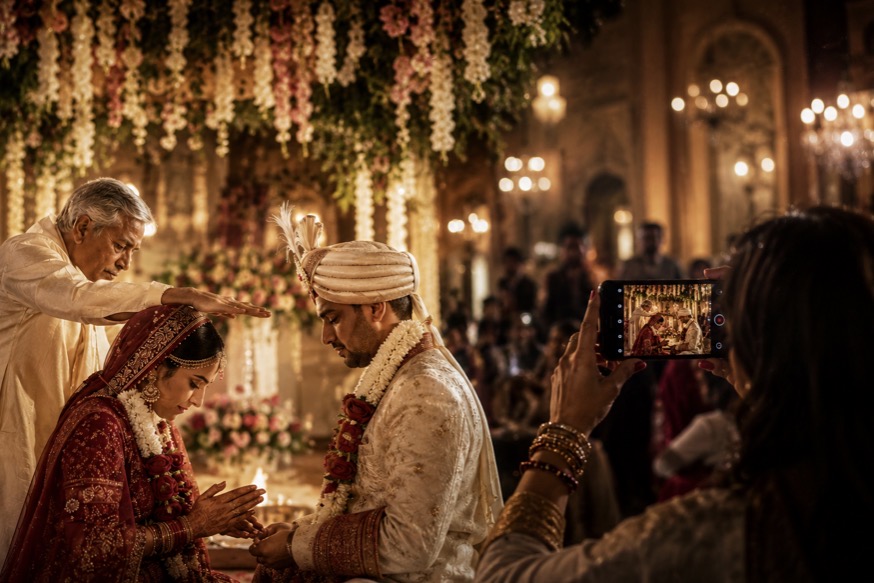
A father still pauses before his daughter leaves home. Grandparents still become the emotional centre of many ceremonies. Siblings still tease one another to soften moments that feel overwhelming. Friends still gather not simply to attend a wedding, but to witness the beginning of a new chapter in someone’s life.
Technology has transformed how weddings are organised. It has not changed why weddings matter.
After documenting weddings across India and internationally for more than two decades through Photosynthesis Photography Services, one lesson has remained remarkably consistent.
Every family edits tradition in its own way. Some rituals become shorter. Others quietly disappear. New customs emerge without anyone formally deciding they are traditions. Yet the values beneath them remain surprisingly constant: respect, belonging, family and continuity.
Perhaps that is why Indian weddings remain so resilient in an increasingly digital world. They do not survive because every ritual remains untouched. They survive because every generation keeps what continues to carry meaning.
Today, a cousin attending through a video call feels perfectly natural. A digital invitation can still carry a family’s warmth. A wedding film shared online allows relatives who could not travel to become part of the family’s collective memory.
These developments do not replace tradition. They extend it.
This becomes especially apparent when observing weddings across different cities, cultures and family traditions. Whether documenting intimate celebrations or large destination weddings as a wedding photographer in Faridabad or working with families elsewhere in India, the ceremonies often look different, but the emotions rarely do.
Every wedding negotiates a balance between heritage and modern life. Ancient rituals unfold beneath contemporary lighting. Sacred verses are followed by spontaneous dance reels. Centuries-old ceremonies are photographed by drones and shared instantly with relatives living across the world.
Rather than competing, tradition and technology quietly learn to coexist.
The strongest traditions are rarely the most elaborate ones. They are the simplest acts of care. An elder placing a reassuring hand on someone’s shoulder. A family making space for every generation to feel included. Children observing customs they do not yet fully understand. Parents remembering their own wedding day. Grandparents recognising rituals they witnessed decades earlier.
These moments existed long before smartphones. They will almost certainly exist long after today’s technology has been replaced by something new.
That is also why the most meaningful wedding stories are rarely defined by decorations or trends. They are defined by relationships. The celebrations featured in the Real Wedding Stories collection (https://photosynthesis.in/stories/) demonstrate that while every family celebrates differently, the emotions that connect generations remain remarkably universal.
Tradition survives not because people refuse to change. It survives because every generation discovers a new way to carry timeless values forward.
The ceremonies evolve. The emotions rarely do.
About the Author
Asad Ansari is the Founder and Creative Director of Photosynthesis Photography Services (https://photosynthesis.in). Since 2005, he has documented more than 800 weddings, cultural festivals and visual storytelling projects across India, Australia, Singapore, Thailand, the UAE and the United States. His work focuses on documentary wedding photography, preserving authentic human moments and creating visual stories that remain meaningful across generations.