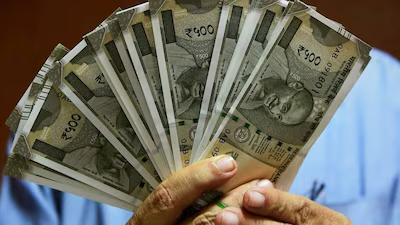
New Delhi, October 3, 2026: The portrait of Mahatma Gandhi printed on Indian currency is one of the country’s most recognisable images. Seen on banknotes across denominations, the smiling face has become closely associated with the Indian rupee. Yet the photograph behind it has a lesser-known history: it was taken in 1946, decades before Gandhi became a permanent feature on Indian banknotes.
The image is not an illustration created specifically for currency. It is based on a photograph showing Gandhi standing beside British politician Lord Frederick William Pethick-Lawrence during a visit to Delhi. The picture was later adapted into the familiar portrait used on banknotes.
Interestingly, the photographer who captured this particular image has not been identified with certainty. The person responsible for selecting it for currency use is also not publicly known.
Why Was This Photograph Chosen?
The photograph was considered suitable because Gandhi appears in a natural pose with a gentle expression. The portrait used on banknotes is a cropped and reversed version of the original image.
Although several renowned photographers documented Gandhi during his lifetime, including Henri Cartier-Bresson, Margaret Bourke-White and Max Desfor, this 1946 photograph became the source of the image seen on Indian currency.
Its widespread use has made it familiar to generations, even though many people may not know when or where the original photograph was taken.
Gandhi Was Not on India’s First Post-Independence Notes
Despite Gandhi’s central role in India’s freedom movement, his portrait did not immediately appear on the country’s currency after Independence in 1947.
For a short period after Independence, banknotes continued to carry the portrait of British monarch King George VI. In 1949, the Government of India introduced a redesigned one-rupee note, replacing the monarch’s image with the Lion Capital of Ashoka.
When the first banknotes of the Republic of India were issued in 1950, the Lion Capital remained a key national symbol. The notes also featured different designs representing India’s wildlife, agriculture, science and cultural heritage.
Gandhi’s First Appearance on Indian Currency
Gandhi first appeared on Indian banknotes in 1969, when a special series was issued to mark his birth centenary. The notes featured his portrait along with the Sevagram Ashram.
A further change came in October 1987, when the Reserve Bank of India introduced a ₹500 note featuring Gandhi. However, his portrait became a regular feature across denominations only in 1996, with the launch of the Mahatma Gandhi Series.
The RBI introduced the new series partly in response to concerns that advances in printing and reproduction technology had made older security features less effective. The redesigned notes included additional security elements, such as a windowed security thread and a latent image.
How the Portrait Became a Permanent Feature
The decision to use Gandhi’s portrait across banknotes was part of a broader effort to modernise currency design while retaining a widely recognised national figure.
Under the RBI Act, the design and material of banknotes require approval from the Central Government after consideration of recommendations from the RBI’s Central Board.
In 2016, the RBI introduced the Mahatma Gandhi New Series. The notes retained Gandhi’s portrait while adding updated security features and designs on the reverse side.
A Photograph That Became a National Symbol
The journey of Gandhi’s portrait—from a photograph taken in Delhi in 1946 to its place on modern Indian currency—reflects how national symbols evolve over time.
What began as an image captured during a meeting became one of the most familiar features of everyday life in India. Although the photographer remains unidentified, the photograph continues to connect the country’s currency with a defining figure in its history.