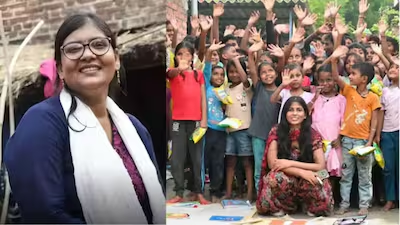
Archana Jaiswal, an Economics graduate and postgraduate from Banaras Hindu University (BHU), is working to make affordable academic support accessible to children in rural Uttar Pradesh. Through her education initiative, Shiksha Saathi, she has helped establish 78 learning centres across six districts, reaching more than 7,650 students while creating teaching opportunities for hundreds of rural women.
The initiative offers after-school coaching for students from Classes 1 to 12, with monthly fees starting at ₹100 for younger children. Students from families facing financial difficulties can also receive support without paying fees.
Jaiswal's work focuses on two challenges in rural communities: children who need additional academic guidance and educated women who have limited access to employment opportunities close to home.
How Her Father's Journey Shaped Her Approach to Education
Jaiswal's interest in education is closely connected to her family's experiences. Her father, Jagdish Ram, began pulling a rickshaw at the age of 17 to support his family while continuing his studies. Despite the financial difficulties, he completed his graduation and eventually secured a job with the Indian Railways.
After moving to Varanasi, he took up additional work, including painting signboards and making portraits, to support his family. His efforts reflected the role education could play in improving a family's circumstances.
However, his death when Jaiswal was still young brought fresh financial pressure. Her elder sister helped support the household and contributed towards the education of her siblings.
Jaiswal continued her studies and completed both graduation and postgraduate studies in Economics at BHU. She had hoped to become a professor, but limited guidance and resources affected her plans. Her own experiences later influenced the way she approached educational access for children in rural areas.
A Learning Gap Inspired the Launch of Shiksha Saathi
Jaiswal's initiative took shape after she noticed that some children in villages struggled with basic academic concepts despite attending school. In one instance, she encountered students in Class 7 who found it difficult to answer fundamental questions about what they had studied.
The experience highlighted a gap between school attendance and the level of understanding children were developing. Many families could not afford private tuition or send their children to cities for additional academic support.
At the same time, educated girls and women in villages often lacked suitable opportunities to earn an income.
In 2022, Jaiswal began an initiative called Your Coaching to address these issues. It was formally registered as Shiksha Saathi in 2023. The model brings learning support closer to children's homes instead of requiring families to travel long distances or pay expensive coaching fees.
Coaching Fees Start at ₹100
Shiksha Saathi's village-based learning centres provide supplementary classes after regular school hours. The programme covers students from Class 1 through Class 12, with fees ranging from ₹100 a month for younger students to ₹600 for those in Class 12.
Children from financially disadvantaged households can attend without fees, helping families access additional educational support according to their circumstances.
The initiative currently operates across six Uttar Pradesh districts: Bhadohi, Varanasi, Mirzapur, Prayagraj, Mau and Ghazipur. Its reported network includes 78 centres and serves more than 7,650 students.
Training Rural Women to Become Teachers
A central part of the initiative is its teacher-training programme for rural girls and women. More than 740 women have reportedly completed the training, creating opportunities to teach children in their own communities.
This arrangement allows local women to develop teaching skills and earn an income without necessarily having to relocate for work. It also helps learning centres draw on people who understand the local environment and the challenges faced by families.
For Shiksha Saathi, expanding educational access and supporting women's livelihoods are connected goals. The model aims to make academic assistance more affordable for parents while building employment opportunities within rural communities.
The Challenge of Expanding Affordable Education
As the network grows, maintaining teaching quality, supporting educators and ensuring that children make measurable academic progress will remain important. Low fees can reduce financial barriers, but sustained learning also depends on consistent instruction and individual attention.
Jaiswal's initiative offers a local approach to these challenges by placing supplementary education within reach of families. Its continued development will depend on keeping the centres accessible while ensuring that students receive the support they need to strengthen their understanding and progress through school.