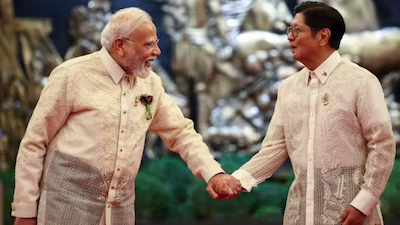
Prime Minister Narendra Modi attracted attention during his visit to Manila after setting aside his familiar kurta-pyjama for the Barong Tagalog, the traditional formal attire worn by Filipino men. He wore the distinctive embroidered garment at a gala dinner hosted by Philippine President Ferdinand R. Marcos Jr. on November 16, 2026, for leaders and dignitaries attending the 49th ASEAN Summit and related meetings.
Modi’s choice of clothing reflected the cultural setting of the diplomatic gathering, where Philippine traditions were an important part of the programme. President Marcos also wore a Barong Tagalog, highlighting the garment’s place in the country’s formal and ceremonial life.
The dinner took place at the Philippine International Convention Centre in Manila under the summit theme, “Navigating the Future”. Alongside diplomatic engagements, the event featured Filipino cultural presentations and cuisine.
What Is the Barong Tagalog?
The Barong Tagalog is a lightweight, embroidered formal garment widely recognised as the Philippines’ national attire for men. Often referred to simply as the barong, it is commonly worn at weddings, official ceremonies, state functions and other important occasions.
Unlike a conventional formal shirt, the Barong Tagalog is traditionally worn untucked over trousers. Its design typically features a collar, a buttoned front, long sleeves and intricate embroidery across the chest.
The garment’s lightweight construction makes it particularly suitable for the Philippines’ warm, humid climate. Many traditional versions are slightly transparent and are worn over an undershirt.
Modi’s outfit featured detailed tonal embroidery with floral and swirling motifs. He complemented the garment with a gold-toned brooch and a colourful, rose-shaped lapel pin with green detailing. The combination gave the traditional attire a formal appearance suited to an international diplomatic event.
Traditional Fabrics and Intricate Craftsmanship
One of the most distinctive features of the Barong Tagalog is the fabric used to create it. Traditional garments may be made from piña, a fine textile woven from pineapple-leaf fibres, or jusi, a lightweight fabric historically associated with silk and other fibres.
These materials allow the garment to remain breathable while providing a refined finish. Contemporary versions also use cotton, linen and other fabrics, making the attire available in different styles and price ranges.
Embroidery is central to the barong’s identity. Designs often incorporate floral patterns, geometric shapes and nature-inspired motifs. Depending on the garment, the embroidery may be subtle and tonal or more elaborate and decorative.
The quality of the fabric and the precision of the stitching can distinguish everyday versions from garments designed for formal ceremonies. Traditional weaving and embroidery techniques also connect the attire to Filipino craftsmanship and cultural heritage.
A Garment Shaped by Philippine History
The Barong Tagalog evolved from the traditional Filipino baro, a garment worn before Spanish colonisation. Over centuries, its design developed through local traditions and influences from other cultures, including Chinese, Malay and European styles.
During the Spanish colonial period, the garment underwent several changes. Different versions emerged, reflecting changing social customs and preferences in clothing.
A frequently repeated explanation claims that colonial authorities required Filipinos to wear the garment untucked and made it transparent to prevent weapons from being concealed. However, historical accounts do not firmly support this popular story, and the development of the barong was more complex.
The garment gained renewed prominence when Philippine President Ramón Magsaysay wore it during his inauguration in 1953. In 1975, President Ferdinand Marcos formally designated it as the country’s national attire through Proclamation No. 1374, further strengthening its official status.
Why the Barong Tagalog Remains Important Today
The Barong Tagalog continues to be worn at presidential inaugurations, weddings, official receptions and other significant events. It represents a distinctive expression of Filipino identity, combining traditional materials, skilled embroidery and a design adapted to the local climate.
Although Western suits remain common in international business settings, the barong provides a formal alternative rooted in Philippine heritage. More casual versions, including short-sleeved styles, are also worn in workplaces and everyday settings.
Modi’s decision to wear the attire during his Manila visit brought renewed attention to this cultural symbol. His appearance alongside President Marcos at the gala dinner illustrated how traditional clothing can contribute to the atmosphere of diplomatic events.
The Prime Minister was in the Philippines to attend the 23rd ASEAN-India Summit and the 21st East Asia Summit. His visit also included cultural engagements, including a special theatrical presentation of the Ramayana titled Sita: The Ramayana Revisited.
The Barong Tagalog’s appearance at the gathering served as a reminder that diplomatic occasions involve more than formal discussions. Through traditional attire, host countries can showcase their history and craftsmanship while welcoming international leaders.