The ongoing civil war in Myanmar is intensifying the trafficking of synthetic drugs into India’s northeastern states, with authorities reporting record seizures of amphetamine-type stimulants in 2025. The crisis is placing additional pressure on border security agencies as drug networks exploit political instability, difficult terrain and gaps in law enforcement to move narcotics across international borders.
Official data from India’s Narcotics Control Bureau (NCB) shows that enforcement agencies seized 4,626 kg of synthetic drugs and 2,652 kg of heroin across the northeastern region between 2021 and 2025. The figures underline a significant shift towards synthetic narcotics, particularly methamphetamine, which is increasingly entering India through Manipur, Mizoram and Nagaland.
Myanmar’s prolonged conflict has created conditions in which organised criminal networks can operate with greater freedom, making the illegal drug trade harder to disrupt.
Synthetic Drugs Now Outweigh Heroin in the Northeast
The volume of synthetic drugs seized across the northeastern states during the five-year period was nearly twice the quantity of heroin recovered, according to official figures.
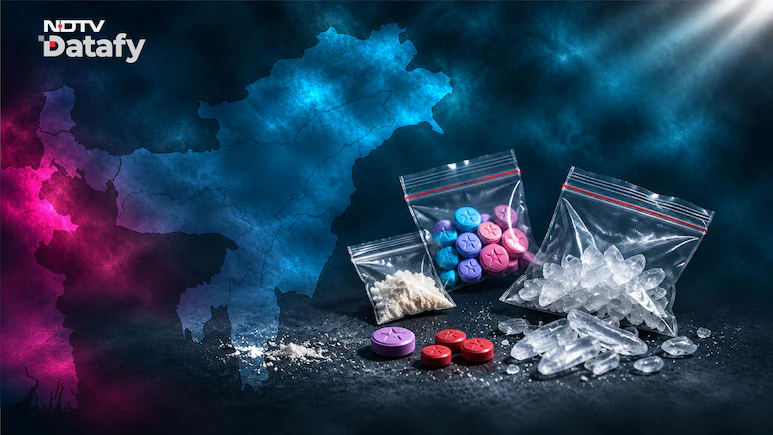
Methamphetamine is commonly encountered in forms such as crystal meth and Yaba tablets. Its production can take place in industrial-scale clandestine laboratories, allowing criminal groups to manufacture large quantities for regional and international markets.
India’s Ministry of Home Affairs told the Rajya Sabha in July 2026 that trafficking patterns in the Northeast had changed considerably, with a marked increase in synthetic drugs arriving from Myanmar.
The Moreh-Tamu border crossing, connecting Manipur with Myanmar, has emerged as a major transit point for heroin and methamphetamine. Traffickers also use remote forest routes, footpaths and hilly terrain to avoid detection along vulnerable sections of the international border.
Authorities have warned that smuggling networks increasingly conceal narcotics in legitimate cargo, passenger vehicles and goods carriers. Social media platforms, courier services and encrypted communication applications are also being used to coordinate illicit shipments.
Myanmar’s Conflict Creates Space for Drug Networks
The roots of the growing crisis lie partly in Myanmar, where a military coup in February 2021 triggered a prolonged conflict involving the military junta, resistance groups and other armed organisations.
The breakdown of central authority across large parts of the country has made it difficult to monitor illegal manufacturing facilities and disrupt supply chains. Different regions are controlled by competing armed actors, complicating efforts to coordinate enforcement operations.
The United Nations Office on Drugs and Crime (UNODC) has identified organised crime groups and non-state armed organisations as important factors behind the expansion of synthetic drug production in Myanmar.
According to the UN agency’s 2026 report on synthetic drugs in East and Southeast Asia, Myanmar remained the largest source of methamphetamine detected across the region during 2025 and early 2026.
Myanmar reported seizures of 3.7 crore methamphetamine tablets in 2025, a 66 per cent increase from the previous year. The scale of these seizures illustrates the growing importance of the country in the regional synthetic drug trade.
In January 2026, Myanmar’s military announced the dismantling of 14 illegal drug manufacturing and chemical storage sites in northern Shan State. Authorities reported recovering nearly 2.5 tonnes of crystal methamphetamine, 500 litres of liquid methamphetamine and 93 tonnes of chemicals.
The operation offered a glimpse into the industrial scale of illicit drug production in areas affected by the conflict.
Mizoram Emerges as a Major Concern
Although Manipur has attracted considerable attention because of the relationship between narcotics trafficking and its prolonged ethnic conflict, Mizoram has become one of the region’s most affected states.
Official figures indicate that synthetic drug seizures in Mizoram increased approximately eightfold between 2021 and 2025.
Its location along the Myanmar border makes the state vulnerable to trafficking networks operating across remote and difficult-to-monitor terrain. Manipur and Nagaland also remain important routes for drugs entering India from Myanmar.
Manipur’s seizure figures fell sharply in 2023 before recovering by 2025. The decline coincided with the ethnic violence that erupted in May 2023, which disrupted normal policing and security arrangements along parts of the border.
The changing figures highlight how conflict and instability can affect both trafficking activity and the capacity of authorities to detect illegal shipments.
Arrests of Myanmar Nationals Rise
Indian law enforcement data also points to an increase in Myanmar nationals arrested in connection with narcotics offences.
National Crime Records Bureau figures show that the number of Myanmar nationals arrested under the Narcotic Drugs and Psychotropic Substances Act rose from nine in 2021 to 37 in 2022.
Subsequent NCB annual reports recorded 25 arrests in 2024 and 97 in 2025.
These figures reflect arrests rather than the overall scale of trafficking and do not establish the nationality or identity of the wider networks involved. Authorities continue to investigate cross-border supply chains involving multiple actors and routes.
Myanmar has also become the leading source of opium supply in South Asia, replacing Afghanistan. UN estimates show that opium poppy cultivation in the country increased from 30,160 hectares in 2021 to 53,100 hectares in 2025.
India Faces a Complex Border Security Challenge
The growing flow of methamphetamine presents a challenge that extends beyond routine drug seizures. Investigators must disrupt manufacturing, transport, financing and distribution networks that operate across several countries.
India has stepped up coordination between central agencies and state police forces, while authorities have highlighted the vulnerability of unfenced border stretches and remote smuggling corridors.
The government has also warned about precursor chemicals being moved from India into Myanmar for the manufacture of synthetic drugs, adding another dimension to the problem.
Ultimately, tackling the crisis will require more than intercepting individual consignments. Strengthening border surveillance, improving intelligence-sharing, tracking illicit financial flows and disrupting the supply of manufacturing chemicals will be essential.
As Myanmar’s conflict continues, the northeastern states remain exposed to a drug trade that is becoming more industrialised and increasingly difficult to control.