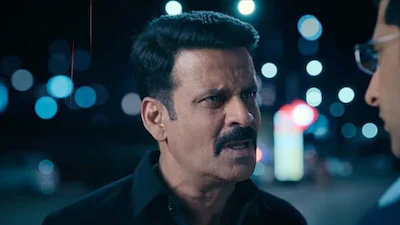
Manoj Bajpayee’s latest crime thriller, Gajab Raat, follows a corrupt Delhi police officer whose routine night duty turns into a complicated investigation involving an unidentified injured woman, rival investigative agencies and influential people. Released on October 23, 2026, the film combines dark humour, institutional corruption and a race to uncover the truth, with Bajpayee’s performance emerging as one of its strongest elements.
Directed by Ritesh Shah and written with Neeraj Pandey and Deepak Venkateshan involved in the screenplay, the Hindi-language thriller unfolds over a single night. Its central premise creates an atmosphere of urgency, although the increasingly tangled investigation sometimes weakens the suspense.
A Corrupt Officer at the Centre of the Mystery
Bajpayee plays Ajay Nirvet, a Delhi Police sub-inspector who has spent years using his position for personal gain. Rather than treating every case as a matter of duty, he often views police operations as opportunities to collect bribes and strengthen his own interests.
His carefully managed routine changes when a severely injured woman is found on a Delhi street after apparently being thrown from a moving vehicle. Ajay becomes involved in determining her identity and discovering what happened to her.
The case soon attracts attention from officials claiming to represent different investigative agencies. A man identifying himself as a Central Bureau of Investigation officer arrives, while a National Investigation Agency officer also becomes involved. Their competing demands raise questions about who is genuinely interested in solving the case and who may be trying to control its outcome.
What begins as an investigation into one woman’s circumstances gradually expands into a wider web of political influence, corruption and concealed interests.
Manoj Bajpayee Gives the Film Its Strongest Performance
Ajay is not a conventional heroic police officer. He is manipulative, opportunistic and comfortable operating within a system where money and influence frequently determine decisions.
Bajpayee uses restrained expressions, sharp dialogue delivery and an understated sense of humour to portray the character. He makes Ajay entertaining without completely removing the moral compromises that define him.
The performance also gives the story an important point of tension. Viewers are left wondering whether Ajay will continue protecting himself or begin taking his responsibilities seriously as the investigation becomes more dangerous.
However, the character’s changing attitude towards honesty and justice is not always developed convincingly. His shift from habitual corruption to moral reflection arrives without enough exploration of the experiences that bring about the change.
A Strong Premise Meets an Uneven Investigation
The film's examination of institutional corruption provides its central theme. As more powerful figures become connected to the case, the investigation suggests that wrongdoing can extend beyond individual officers to people capable of influencing entire systems.
The single-night structure adds pressure to the narrative, while the involvement of multiple agencies introduces competing explanations and shifting loyalties.
Yet the screenplay sometimes struggles to manage its growing number of developments. New revelations arrive quickly, but not all of them produce the suspense or dramatic impact the story requires. Some twists are predictable, and the final stretch does not fully capitalise on the mystery established earlier.
The film also raises questions about how public institutions respond when influential people become entangled in criminal investigations. These themes are relevant, although the story occasionally explains its ideas more directly than necessary.
Supporting Cast Adds Variety
The supporting cast includes Divya Dutta, Akshay Oberoi, Saqib Saleem, Shraddha Das, Nushrratt Bharuccha, Kiku Sharda and Rajiv Gupta.
Dutta makes an impression in her role as a political leader, while Gupta brings lighter moments through his exchanges with Bajpayee. Oberoi and Saleem contribute to the uncertainty surrounding the rival agencies, though several supporting characters receive limited development.
The balance between crime, political drama and comedy is not always consistent, but the ensemble helps sustain the film as the investigation expands.
Final Verdict: A Watchable Thriller With Writing Flaws
Gajab Raat benefits from Bajpayee’s layered portrayal of a compromised police officer and a premise built around a mysterious case in Delhi. Its focus on corruption, institutional power and personal accountability gives the story substance beyond the central investigation.
However, uneven character development, predictable revelations and a less satisfying conclusion prevent the thriller from reaching its full potential. It remains an option for viewers interested in police dramas and political conspiracies, particularly those who value strong performances even when the screenplay falls short of its ambitions.