
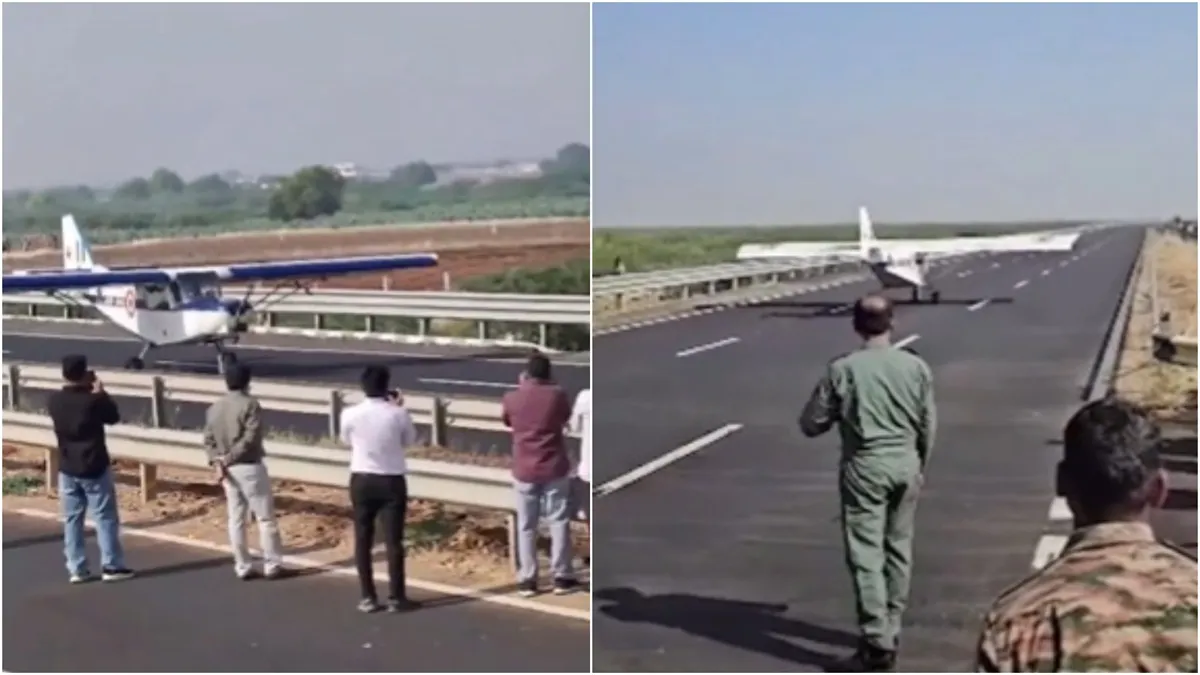
In a significant demonstration of military preparedness and infrastructure capability, four aircraft belonging to the Indian Army successfully landed and took off from a section of the Amritsar-Jamnagar Economic Corridor in Gujarat. The exercise demonstrated how carefully designed national highways could potentially support specialised aviation operations during emergencies and meet certain strategic requirements.
The operation took place on November 24, 2026, on National Highway 754A in Patan district, Gujarat. The aircraft were part of the Indian Army's Wings of Valour and Unity Expedition 2026, an initiative organised to promote aviation adventure and showcase the capabilities of Army personnel.
The successful manoeuvre highlighted coordination between the Indian Army and the National Highways Authority of India (NHAI), which worked together to prepare the designated road stretch for the operation.
Four Army Aircraft Complete Highway Landing and Take-Off
The participating formation comprised two fixed-wing microlight aircraft and two powered hang gliders operated by the Army's Team Mountain Eagles. The aircraft had taken off from Kandla Airport before reaching the designated section of the economic corridor.
The landing and take-off exercise was conducted along a stretch between kilometre markers 946 and 949. The operation also involved ground refuelling and aircraft turnaround procedures, demonstrating the coordination required to conduct aviation activities outside conventional airport facilities.
The exercise was carried out with support from Army personnel, highway officials, local authorities and police. Traffic management and safety arrangements were put in place to ensure that the operation could be completed under controlled conditions.
Why the Amritsar-Jamnagar Corridor Is Important
The successful operation has drawn attention to the engineering standards of India's expanding national highway network. The selected section of NH-754A was designed to withstand substantial traffic loads, with a pavement structure comprising a 550-millimetre pavement crust and a 500-millimetre subgrade.
Its engineering specifications helped demonstrate the potential suitability of selected highway stretches for specialised uses beyond ordinary road transportation.
However, not every highway can function as an aircraft landing strip. Such operations require appropriate road geometry, surface conditions, sufficient clear space, traffic restrictions and coordination with relevant authorities. Technical assessments and necessary safety clearances remain essential before any highway is used for aviation purposes.
Nitin Gadkari Highlights Civil-Military Coordination
Union Road Transport and Highways Minister Nitin Gadkari welcomed the achievement, praising Team Mountain Eagles, NHAI and the agencies involved in organising the exercise.
He highlighted the importance of developing highways that can contribute not only to economic growth and connectivity but also to the operational needs of the armed forces.
The demonstration also illustrated the potential for suitable highway infrastructure to support emergency response, specialised logistics and other activities, including aero-adventure and tourism, wherever conditions permit.
The collaboration between military aviators and highway authorities was a key element of the exercise, with careful planning needed to ensure that the designated stretch met the operational requirements.
Wings of Valour and Unity Expedition 2026
The highway landing formed part of the Indian Army's Wings of Valour and Unity Expedition, organised by the Army Adventure Nodal Centre at the Military College of Telecommunication Engineering in Mhow, Madhya Pradesh.
The expedition began on November 14 and is scheduled to conclude in Mhow on November 28 after travelling through Madhya Pradesh, Gujarat and Rajasthan.
The initiative combines aviation adventure with an opportunity to demonstrate the skills of Army personnel and the versatility of specialised aircraft.
What the Exercise Means for India's Infrastructure
The successful landing and take-off underline the potential value of infrastructure designed with multiple operational needs in mind. While national highways primarily serve civilian transport and freight movement, selected stretches could offer additional capabilities during emergencies or specific strategic situations.
The exercise does not mean that highways can routinely replace airports or military airfields. Instead, it demonstrates that suitably designed road infrastructure may provide an additional option when supported by careful technical evaluation, operational planning and safety arrangements.
As India continues to expand its transport network, the integration of infrastructure planning with emergency preparedness and defence requirements .could become an increasingly important consideration