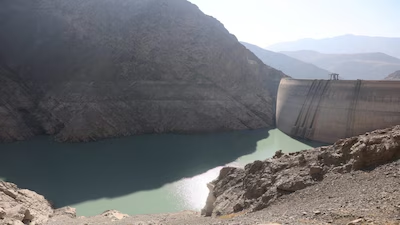
Iran’s extensive network of dams, pipelines and water-transfer projects has come under renewed scrutiny after the locations of suspected underground missile facilities appeared to overlap with major water infrastructure targeted during the ongoing war involving the United States, Israel and Iran.
The geographical pattern has prompted water-security specialists and military analysts to examine whether some of Iran’s large infrastructure projects may have served purposes beyond supplying water and supporting agriculture. One possibility is that the facilities could help sustain underground military installations with reliable access to essential resources, including water and electricity.
However, experts have cautioned that the apparent overlap does not establish that Iran deliberately built its dams to support its missile programme. The relationship between the country’s civilian infrastructure and its military network remains unproven.
Mapping Iran’s Dams Reveals a Potential Connection
Nima Shokri, a water-security specialist at Hamburg University of Technology in Germany, has spent years examining Iran’s extensive dam network. His research has documented at least 533 dams across the country, including projects in areas where their economic or agricultural justification has raised questions among environmental specialists.
The issue gained fresh attention when Shokri compared the locations of dams with maps showing suspected Iranian missile facilities targeted in recent US and Israeli airstrikes.
The comparison revealed a geographical pattern in which several missile-related targets appeared close to water infrastructure, forming a broad arc across parts of Iran.
The findings prompted questions about whether certain water projects might also provide strategic advantages to military installations. Experts have suggested that dependable water and power supplies could help underground facilities continue operating even if the country’s wider civilian infrastructure were disrupted.
Iranian authorities have not publicly established such a connection, and the available evidence does not prove that the dam-building programme was coordinated with military planning.
Underground ‘Missile Cities’ at the Centre of the Debate
Iran operates an extensive network of underground military complexes commonly described as “missile cities”. These heavily fortified facilities contain tunnels and chambers used to store, manufacture and deploy ballistic missiles and drones.
Farzin Nadimi, an Iranian military affairs specialist and senior fellow at the Washington Institute, has estimated that the country possesses at least 30 underground missile complexes.
Such installations can provide protection against airstrikes and make it more difficult for adversaries to determine the extent of a country’s military capabilities. Their continued operation, however, depends on access to essential services and supporting infrastructure.
Military analysts say that independent or backup supplies of water and electricity would offer these facilities an operational advantage. If nearby dams and water-transfer systems were connected to underground complexes, they could potentially reduce dependence on vulnerable national networks.
Danny Citrinowicz, a former Iran analyst with Israel’s military intelligence agency, has highlighted the potential value of such arrangements in maintaining operational continuity.
Nevertheless, proximity alone is insufficient to establish that a dam was constructed for military purposes.
Environmentalists’ Concerns Resurface
The investigation has also revived questions surrounding the detention of Iranian environmentalists in 2018.
Members of the Persian Wildlife Heritage Foundation were arrested by Iran’s Islamic Revolutionary Guard Corps intelligence wing on espionage allegations. Authorities accused them of using wildlife-monitoring equipment to gather intelligence for foreign governments.
Kavous Seyed-Emami, one of the foundation’s founders, died in custody. Other detained conservationists later reported mistreatment, allegations that Iranian officials said they would examine.
The arrests have attracted renewed attention because some conservationists and analysts now question whether environmental fieldwork may have brought researchers close to sensitive military locations.
Morad Tahbaz, another foundation member, spent more than five years in prison. He recalled that interrogators showed particular interest in his team’s work involving the protection of wildlife in southern Iran.
However, no conclusive evidence has established that the conservationists discovered secret missile facilities or that their research directly contributed to their arrests.
Water Projects in Yazd and Hormozgan Draw Attention
Two areas have featured prominently in the wider debate: Yazd province in central Iran and Hormozgan province in the south.
Water specialists have questioned the rationale behind certain large-scale projects designed to transfer water from the Zagros Mountains towards central Iran. The proximity of suspected military installations to some of these projects has led analysts to consider whether security requirements could have influenced infrastructure planning.
Hormozgan has also attracted attention because of the presence of military facilities and protected wildlife areas. Recent strikes in the region have added to concerns about the relationship between civilian, environmental and military sites.
Experts stress that these geographical connections require further investigation before firm conclusions can be drawn.
Questions Remain Over Iran’s Infrastructure Strategy
The apparent proximity of missile facilities and major water projects has opened a new line of inquiry into Iran’s infrastructure development and military planning.
For now, the central question remains unresolved: whether the country’s extensive dam network was built primarily to address water and development needs or whether some projects also provide strategic support to underground military installations.
While analysts consider the possibility plausible, publicly available evidence has not demonstrated a coordinated programme linking the two.
The issue is likely to remain under scrutiny as experts assess the damage caused by airstrikes and examine Iran’s underground military infrastructure.