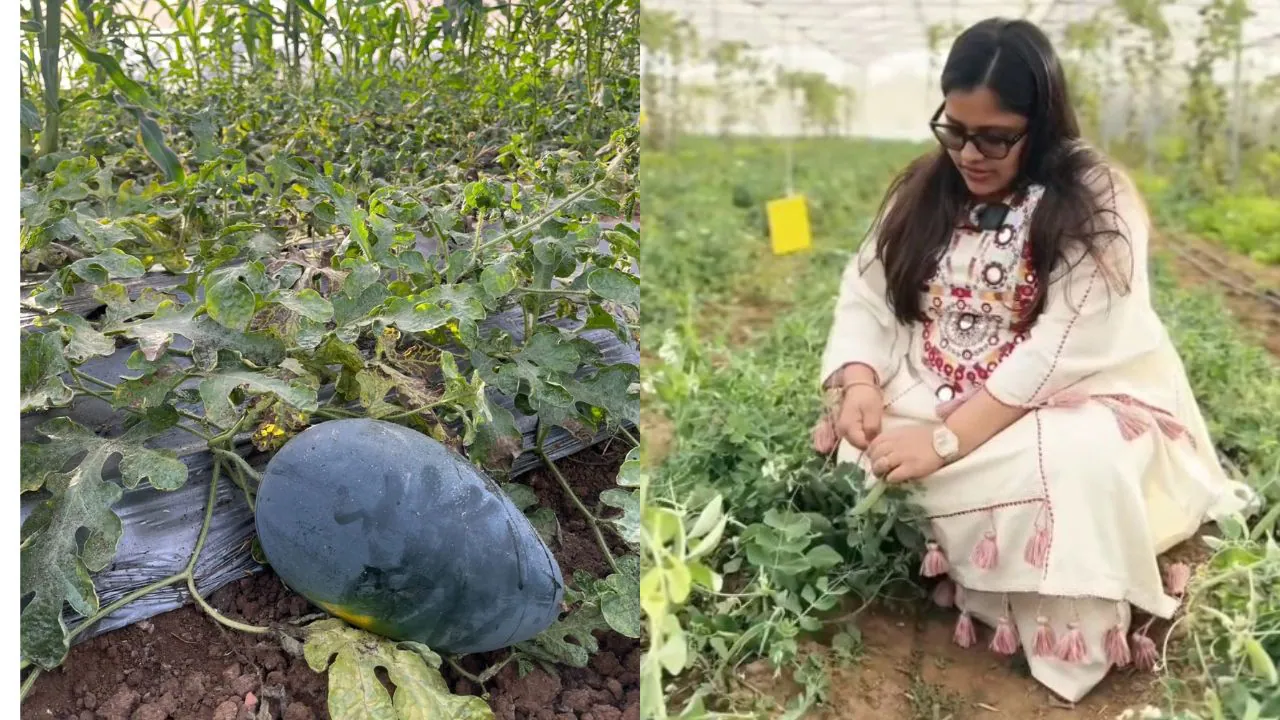
A rocky, barren plot of land may appear unsuitable for cultivation, but Rajasthan-based entrepreneur Purva Jindal saw an opportunity where others might have seen a challenge. An MBA graduate, she has transformed 10 acres of difficult land near Bhilwara into a productive organic farm that now records an annual vegetable turnover of around ₹25 lakh.
Her journey reflects a growing interest among young professionals in exploring agriculture as a business. Instead of following a conventional corporate path, Purva entered farming and gradually built a venture focused on growing fresh produce and supplying it directly to customers.
The farm, developed under the name Saakhi Organic, has become an example of how business planning, agricultural guidance and consistent effort can be combined to create a farm-based enterprise. <Cite refs={["turn305842search0","turn305842search1"]}/>
Why She Chose Organic Farming
Purva completed her MBA from Mumbai’s SP Jain Institute of Management and Research in 2017 before joining her family’s textile business. When the COVID-19 pandemic disrupted business activity in 2020, the family began considering other opportunities.
Organic farming emerged as a possible new direction. Purva started exploring the sector, studying farming methods and consulting experts to understand how to establish a viable operation.
In 2021, she began working on the 10-acre property near Bhilwara. The land was covered with rocks, stones and wild vegetation, making it a challenging starting point for cultivation. With little prior farming experience, she approached the project step by step rather than attempting to develop the entire property at once. <Cite refs={["turn305842search0","turn305842search1"]}/>
Turning Difficult Soil Into Productive Farmland
Improving the condition of the land was one of the first major tasks. Purva used cow dung, vermicompost and natural preparations such as jeevamrit and neemastra to support soil health and manage pests.
She also introduced drip irrigation to deliver water more efficiently to plants. Mulching was used to help retain moisture and control weed growth. These methods formed part of a broader effort to develop the farm using organic and resource-conscious practices.
The farm’s development took place in phases, allowing the team to learn from early cultivation and gradually expand production. <Cite refs={["turn305842search1","turn305842search0"]}/>
A Diverse Range of Crops and a Direct-Sales Model
Today, the farm grows a variety of vegetables, including broccoli, carrots, radishes, cauliflower, cabbage, tomatoes, peas, watermelon and okra. Strawberries are also part of its produce range.
Rather than relying only on conventional distribution channels, Purva developed Saakhi Organic as a farm-to-fork business. The model connects the farm with customers in and around Bhilwara, helping bring fresh produce directly to households.
According to reported figures, vegetable sales generate approximately ₹25 lakh in annual turnover. The business has also expanded into organic grocery products, with reported monthly sales of around ₹1 lakh. <Cite refs={["turn305842search0","turn305842search1"]}/>
What Her Journey Shows About Modern Farming
Purva’s experience highlights that agriculture can involve more than growing crops. It also requires planning, market understanding, resource management and the ability to adapt when challenges arise.
Her story does not suggest that every barren plot can be transformed in the same way; soil conditions, water availability, investment and local demand all influence farming outcomes. However, it demonstrates how professional skills can be applied to agriculture when supported by practical expertise.
From a rocky landscape to a diversified organic farm, Purva Jindal’s journey offers a fresh perspective on entrepreneurship—one rooted in the land and connected directly to consumers.