
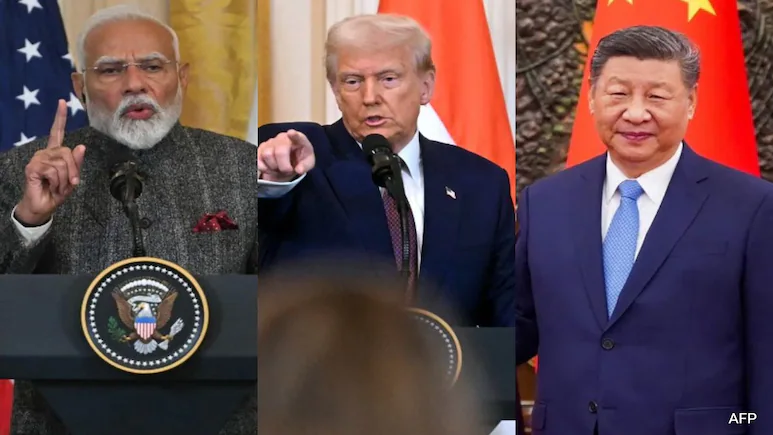
The United States’ latest restrictions on advanced artificial intelligence chips are intensifying pressure on China’s technology industry while creating potential opportunities for India to expand its AI infrastructure and data centre business. As Washington moves to prevent Chinese companies from accessing powerful processors through overseas data centres, Beijing faces renewed urgency to develop domestic alternatives to American technology.
The developments have also raised questions about how quickly China can reduce its dependence on Nvidia, whose graphics processing units (GPUs) have become central to training and running advanced AI models.
India, meanwhile, is investing in computing infrastructure, encouraging private-sector participation and expanding access to AI resources for startups and researchers. However, converting geopolitical changes into a lasting advantage will depend on the country’s ability to build a strong domestic AI ecosystem.
Why Nvidia Remains Critical to China’s AI Industry
Nvidia has established a leading position in the global AI market through its powerful processors and the software ecosystem that supports them. Its GPUs are widely used to train large language models, develop AI applications and operate large-scale computing systems.
One of Nvidia’s biggest advantages is CUDA, its established software platform that allows developers to build and optimise applications for its hardware. This combination of processors, software and networking technology makes replacing Nvidia considerably more difficult than simply producing another chip with comparable computing power.
China has been working to reduce its dependence on American semiconductor technology, particularly as Washington has expanded export controls over advanced processors and related equipment.
Domestic companies, including Huawei, Cambricon, Alibaba’s T-Head and Baidu’s Kunlunxin, are developing AI chips to serve China’s growing computing needs. The government has also encouraged public institutions and state-linked enterprises to adopt domestically developed technology.
Market figures indicate that these efforts are beginning to change the competitive landscape. According to data from research firm IDC cited in reporting on the Chinese AI chip market, Nvidia accounted for 34% of China’s data centre AI chip market in the first half of 2026. Huawei’s share rose to 28%, with the company shipping 572,000 AI accelerators during that period.
Although these figures point to growing competition, China still faces challenges involving advanced manufacturing, high-bandwidth memory, chip packaging and the software needed to operate large computing clusters efficiently.
Washington Tightens Restrictions on Overseas Computing Access
The latest US measures extend beyond direct chip exports. They are also intended to prevent Chinese companies from accessing restricted computing power through data centres located in third countries.
Countries such as Malaysia, Thailand and Singapore have become important locations for international data centre operations. Chinese AI companies have sought access to computing resources outside mainland China, making overseas infrastructure an important part of the broader technology debate.
The new restrictions could make these arrangements more difficult by requiring affected overseas data centres to obtain US export licences when providing significant computing capacity to companies headquartered in China.
The measures reflect Washington’s concern that restrictions on physical chip shipments could be circumvented through remote access to advanced processors.
For Chinese AI developers, reduced access to powerful GPUs could increase computing costs, complicate the training of large models and slow some research projects. However, the restrictions could also accelerate Beijing’s efforts to develop independent chip manufacturing and AI infrastructure.
Can China Build an AI Industry Without Nvidia?
China has several potential routes towards greater technological independence. Domestic chipmakers are expanding production, while AI developers are exploring methods to improve model performance with fewer computing resources.
Techniques such as model distillation can help developers train smaller systems using outputs generated by more capable models. This can reduce the resources needed for particular tasks, although it cannot completely eliminate the need for advanced computing infrastructure.
China’s large technology market, engineering workforce and government-backed investment provide important advantages. Its companies may also develop alternative software platforms and computing architectures suited to domestic hardware.
Nevertheless, achieving full independence from Nvidia will require progress across several interconnected areas. Advanced processors must work efficiently with memory, networking systems, manufacturing capabilities and software tools. A shortage or weakness in any one of these areas can affect the performance of an entire AI computing system.
China may therefore become more self-reliant without immediately matching Nvidia’s complete technological ecosystem.
How India Could Benefit From the US-China Technology Rivalry
India is seeking to establish itself as a major destination for AI computing, cloud services and data centre investment. The government’s IndiaAI Mission, backed by an allocation of approximately ₹10,372 crore, is a central part of this strategy.
By June 2026, the government had said its shared computing infrastructure had expanded to more than 45,000 GPUs, giving startups, researchers and developers greater access to computing resources.
Private companies are also investing in AI infrastructure. Businesses including Yotta, L&T and E2E Networks are expanding their computing capabilities, while Greenko-backed AM Intelligence has announced plans involving 20,000 Nvidia GPUs across India and Malaysia, with a proposed investment of around $4 billion.
As international companies reassess their exposure to China-related technology operations, India could attract additional investment in cloud infrastructure, AI computing and digital services.
The country’s established IT services industry, expanding digital economy and large pool of technical professionals could further strengthen its position.
However, the opportunity is not automatic. Indian data centre operators will need to comply with applicable US export-control requirements, including restrictions involving the identity of customers and the ultimate users of computing resources.
Building Domestic Demand Will Be Essential
India’s long-term prospects will depend on more than attracting foreign investment or hosting additional GPUs. The country must also create sustained domestic demand for AI computing.
Startups, universities, manufacturers and public institutions need affordable access to infrastructure that can support research, product development and commercial deployment. Stronger domestic demand would help ensure that investment translates into wider economic benefits rather than leaving capacity dependent primarily on overseas customers.
India must also address challenges involving electricity supply, infrastructure costs, advanced semiconductor capabilities and the development of competitive AI models.
The US-China technology dispute may give India an opening to strengthen its position in the global AI economy. But securing a lasting advantage will require coordinated investment, reliable infrastructure and an ecosystem capable of turning computing power into useful products, services and employment.