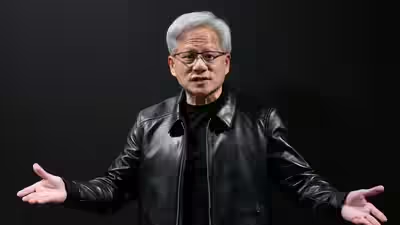
Nvidia CEO Jensen Huang has warned that US restrictions on advanced semiconductor exports have accelerated China’s efforts to develop its own chipmaking capabilities. Speaking during an interview on the sidelines of Nvidia’s GTC conference in Berlin, Huang said the measures intended to limit China’s access to American technology had encouraged the country to invest more aggressively in domestic alternatives.
Huang also expressed confidence in the technological strengths of the United States, arguing that American companies remain well positioned in advanced chips, computing systems and artificial intelligence infrastructure. His comments highlight the growing competition between the two countries over the technology underpinning the global AI industry.
US Export Restrictions Have Encouraged Domestic Development
Washington introduced restrictions on exports of advanced AI chips and related technologies to China over national security concerns. The measures have limited Chinese companies’ access to some of the most powerful processors used to train and operate advanced AI systems.
According to Huang, however, these restrictions have also provided an incentive for China to strengthen its domestic semiconductor industry. Rather than relying entirely on imported technology, Chinese companies have expanded efforts to develop alternative chips and supporting infrastructure.
Huang suggested that restrictions had significantly accelerated China's technological development, potentially shortening the time required to build domestic capabilities.
The longer-term impact remains uncertain, but the comments underscore a challenge facing policymakers: limiting access to foreign technology can also encourage investment in competing domestic products.
China Expands Its AI Chip Capabilities
China has been working to develop alternatives to advanced American processors, with domestic technology companies investing in chip design, manufacturing and AI computing infrastructure.
Huawei is among the companies seeking to strengthen China's position in the market. Other domestic suppliers are also expanding their presence as businesses look for alternatives amid uncertainty over access to imported processors.
Recent industry data indicates that Chinese chipmakers are gaining ground in their domestic market. Nvidia's share of China's data-centre AI accelerator market fell to 34% in the first half of 2026, while Huawei captured 28%, according to reported industry estimates.
The figures illustrate how export restrictions and China's domestic technology push are reshaping competition. However, market share alone does not establish that domestic chips match every capability of leading American processors.
Huang Maintains Confidence in American Technology
Despite acknowledging China's progress, Huang said the United States retains significant advantages in advanced computing and AI technology.
He highlighted American strengths in high-performance chips, computing systems, infrastructure and leading AI research laboratories. These capabilities are important because developing competitive AI hardware requires more than producing an individual processor.
Companies must also build reliable software ecosystems, manufacturing capacity, networking systems and data-centre infrastructure that work together at scale.
Huang's position is that American companies should continue competing internationally through innovation rather than assuming that restricting rivals will permanently protect their technological lead.
Manufacturing and Supply Chains Remain Important
Huang also pointed to China's broader industrial strengths, including its ability to manufacture products at scale and develop supporting technologies.
Semiconductor production depends on a complex network of suppliers, equipment manufacturers, materials producers and specialist engineering teams. Cooling systems, electricity infrastructure and advanced memory technologies are also essential to the operation of large AI data centres.
China's capabilities across several of these areas could support its efforts to expand domestic AI computing. At the same time, advanced semiconductor manufacturing remains technically demanding and depends on access to specialised equipment, materials and expertise.
The competition is therefore likely to involve entire technology ecosystems rather than chips alone.
Implications for the Global AI Industry
The growing US-China technology rivalry has consequences for chipmakers, AI developers and businesses investing in computing infrastructure.
Restrictions can affect sales opportunities for American companies while encouraging customers in China to consider domestic alternatives. Over time, this could contribute to the development of separate technology ecosystems with different suppliers and standards.
For Nvidia, China represents an important market, but the company's ability to sell particular products there depends on applicable US export rules and Chinese regulatory decisions.
What Happens Next?
Huang's remarks underline the difficulty of balancing national security objectives with commercial competition. US restrictions are intended to limit access to sensitive technologies, yet they may also encourage China to accelerate domestic development.
The next phase of the semiconductor race will depend on advances in chip design, manufacturing, software and infrastructure. While the United States retains important technological advantages, China's expanding capabilities indicate that competition in AI computing is likely to remain intense.