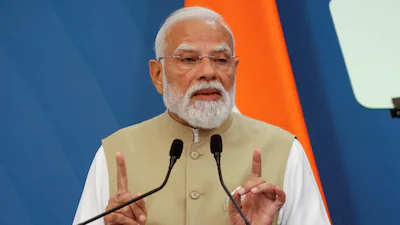
Prime Minister Narendra Modi will visit Manila, the capital of the Philippines, from November 16 to 17, 2026, to participate in two major regional diplomatic gatherings: the 23rd ASEAN-India Summit and the 21st East Asia Summit (EAS). The visit is expected to strengthen India’s strategic engagement with Southeast Asia, with maritime security, economic cooperation, defence ties and regional stability among the key priorities.
Philippine President Ferdinand R. Marcos Jr. has invited Modi for the visit. The Philippines, which holds the chairmanship of the Association of Southeast Asian Nations (ASEAN) for 2026, will host both summits on November 17.
The meetings come at an important time for India’s engagement with the Indo-Pacific region, where changing geopolitical dynamics have increased the importance of maritime cooperation, reliable trade routes and partnerships among regional countries.
Maritime Security to Be a Key Priority
Maritime cooperation is expected to feature prominently during Modi’s discussions with ASEAN leaders. India and ASEAN have designated 2026 as the ASEAN-India Year of Maritime Cooperation, reflecting their shared interest in improving maritime safety, strengthening security coordination and expanding cooperation across the region’s seas.
India is expected to push for closer collaboration in areas such as maritime domain awareness, freedom of navigation and efforts to address piracy and illegal fishing. The two sides are also looking to develop cooperation in the blue economy, which includes sustainable use of marine resources and economic activities connected to the oceans.
Several initiatives have already taken place during the year. The second ASEAN-India Maritime Exercise was conducted from September 28 to October 2, while naval representatives from nine ASEAN countries participated in maritime engagements hosted in India earlier in 2026.
These activities form part of broader efforts to improve operational coordination and build trust between India and Southeast Asian countries.
Trade and Economic Partnership in Focus
Economic relations are another important component of the summit agenda. India and ASEAN are expected to review progress under their Comprehensive Strategic Partnership and assess implementation of the ASEAN-India Plan of Action for 2026–2030.
Discussions are likely to cover trade and investment, regional connectivity, digital transformation, disaster resilience and development cooperation. Both sides are also seeking opportunities to strengthen supply chains and expand commercial engagement amid shifts in the global economy.
India has been pursuing trade facilitation initiatives with individual ASEAN members while seeking progress on the review of the ASEAN-India Trade in Goods Agreement. Improving market access and addressing trade-related concerns remain important objectives for New Delhi as it looks to deepen economic ties with Southeast Asia.
The partnership extends beyond commerce to technology, telecommunications, clean energy and digital public infrastructure. India is expected to explore ways to use its expertise in these areas to support stronger regional integration.
East Asia Summit to Address Regional Challenges
Modi will also attend the 21st East Asia Summit, a leaders-led forum that brings together ASEAN members and other key countries to discuss strategic, political and economic issues.
The meeting will provide an opportunity to exchange views on regional security, international developments and challenges affecting the wider Indo-Pacific. India is expected to reiterate its support for an open, inclusive and rules-based regional order, alongside respect for international law and freedom of navigation.
Cooperation against terrorism and transnational crime, including cyber-enabled fraud, human trafficking, drug trafficking and money laundering, is also an area in which India supports stronger regional coordination.
The East Asia Summit offers India a platform to engage with major regional powers and contribute to discussions on maintaining stability in a strategically significant part of the world.
Bilateral Meetings and Indian Diaspora Interaction
Alongside the multilateral engagements, Modi is scheduled to attend a dinner hosted by President Marcos for visiting leaders. Bilateral meetings with participating leaders are also being arranged, although the final schedule will determine which discussions take place.
An interaction with members of the Indian community in the Philippines is also being considered, reflecting interest among the diaspora in meeting the Prime Minister during his visit.
Questions have also arisen over whether Modi could meet US President Donald Trump in Manila or participate in a Quad leaders’ meeting on the sidelines. However, no such engagement had been officially confirmed at the time of the latest announcements.
Strengthening India’s Act East Policy
India’s relationship with ASEAN remains central to its Act East Policy and broader Indo-Pacific strategy. Dialogue relations began in 1992, the partnership was elevated to a strategic partnership in 2012, and it became a Comprehensive Strategic Partnership in 2022.
The upcoming visit also precedes significant milestones in 2027, when India and ASEAN will mark 35 years of dialogue relations and five years of their Comprehensive Strategic Partnership.
Modi’s participation in the Manila summits is therefore expected to provide an opportunity to review existing commitments, identify new areas of cooperation and reinforce India’s engagement with Southeast Asia. The outcomes could help shape the next phase of regional collaboration on maritime security, trade, connectivity and shared strategic challenges.