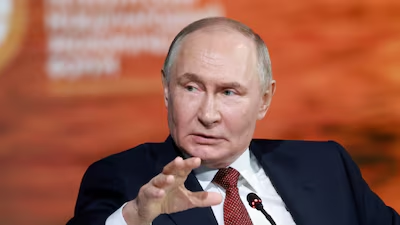
Russian President Vladimir Putin has agreed in principle to resume three-way negotiations with Ukraine and the United States, raising hopes of renewed diplomatic efforts to end the ongoing war. The development followed a meeting with US President Donald Trump’s special envoy, Steve Witkoff, in St Petersburg on October 21, 2026.
According to Kremlin foreign policy adviser Yuri Ushakov, the proposed discussions could resume after November 10, with a focus on establishing a post-war security framework for Russia and Ukraine. However, the announcement does not mean that a peace agreement is close, as major disagreements between Moscow and Kyiv remain unresolved.
The renewed diplomatic effort comes as Washington continues to push for a settlement and Ukrainian officials seek assurances that any agreement will protect their country’s sovereignty and long-term security.
St Petersburg Meeting Revives Diplomatic Efforts
The meeting between Putin and Witkoff lasted approximately three hours, according to the Kremlin. The discussions covered the possibility of restarting trilateral negotiations and broader issues concerning relations between Russia and the United States.
Witkoff has been working to bring the two sides back to negotiations under the Trump administration’s efforts to end the conflict. Before travelling to Russia, the US envoy held discussions with Ukrainian President Volodymyr Zelenskyy and European representatives in Oslo, Norway.
Those consultations focused on possible elements of a broader peace framework, including security guarantees for Ukraine, post-war reconstruction and European security arrangements.
The Kremlin indicated that Moscow was willing to consider renewed talks, although Russian officials expressed reservations about proposals presented by Ukraine and European partners.
Security Guarantees Remain a Central Issue
One of the principal subjects expected to feature in future negotiations is the security arrangement that would follow a possible end to hostilities.
Russia and Ukraine have sharply different positions on the conditions required for a lasting settlement. Moscow has maintained demands concerning territory and Ukraine’s future relationship with the North Atlantic Treaty Organization, while Kyiv has insisted that any agreement must prevent another Russian attack.
Ukrainian President Volodymyr Zelenskyy has argued that a ceasefire is a necessary first step towards ending the fighting. He has also stressed the importance of international security guarantees to ensure that a temporary halt does not simply allow the conflict to resume later.
The two countries have continued to exchange attacks despite diplomatic initiatives, underscoring the gap between negotiations and conditions on the battlefield.
Earlier Negotiations Failed to Deliver a Breakthrough
Representatives from Russia, Ukraine and the United States held several rounds of trilateral negotiations earlier in 2026, including meetings in Abu Dhabi and Geneva. Those discussions produced limited progress, with prisoner exchanges among the few tangible outcomes.
The parties remained divided over territorial questions, security arrangements and the political conditions required for a settlement. These disagreements have repeatedly complicated efforts to establish a lasting ceasefire.
The prospect of restarting talks therefore represents a diplomatic opening rather than confirmation that the war is nearing its end.
US Push for a Settlement Faces Major Challenges
The Trump administration has sought to accelerate efforts to bring the conflict to a close. Washington has engaged both Moscow and Kyiv while exploring proposals intended to create a framework for negotiations.
However, the success of the initiative will depend on whether Russia and Ukraine are prepared to make compromises on their core demands. European countries are also closely involved in discussions about Ukraine’s future security and the wider implications of any settlement.
For now, the Kremlin’s willingness to resume talks provides a potential route back to diplomacy. Whether that route leads to a ceasefire or a comprehensive peace agreement will depend on the substance of future negotiations and the willingness of all parties to reach an acceptable arrangement.