The leaders of India, the United States, Japan and Australia have renewed their commitment to strategic cooperation across the Indo-Pacific, placing artificial intelligence (AI), semiconductor manufacturing and critical mineral supply chains at the centre of their agenda. The latest push reflects growing concerns about dependence on China for technologies and materials essential to economic growth, industrial production and national security.
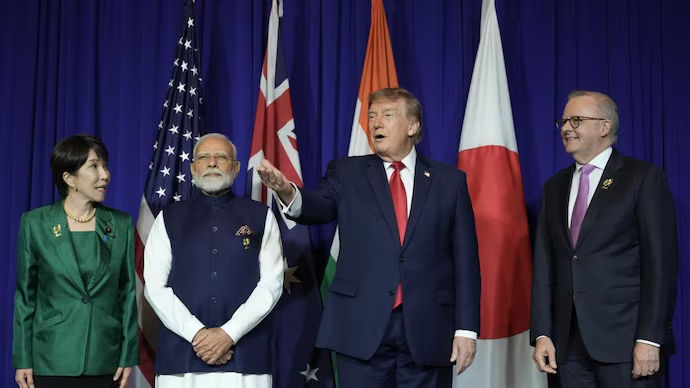
The four leaders — Indian Prime Minister Narendra Modi, US President Donald Trump, Japanese Prime Minister Sanae Takaichi and Australian Prime Minister Anthony Albanese — met in Manila on November 17, 2026, for the first in-person Quad leaders’ summit in more than two years. The meeting took place on the sidelines of the ASEAN summit in the Philippines.
Quad Puts Critical Technologies at the Heart of Its Strategy
Trump highlighted the scale of the technological transformation underway, arguing that advances in AI and other emerging technologies could have an impact greater than the Industrial Revolution and the arrival of the internet.
The four countries are seeking to strengthen their ability to develop, manufacture and deploy advanced technologies while reducing vulnerabilities created by concentrated supply chains.
Artificial intelligence and semiconductors have become increasingly important to the global economy. They underpin applications ranging from smartphones and electric vehicles to data centres, advanced manufacturing and defence systems.
China's dominant position in several technology-related supply chains has prompted governments to explore alternative sources of essential materials and components. For the Quad, closer coordination could help members diversify procurement, encourage investment and develop domestic industrial capabilities.
The countries have also highlighted the importance of ensuring that emerging technologies are developed and deployed through trusted partnerships.
More Than $85 Million for AI Cooperation
One of the central technology initiatives discussed at the summit was a commitment involving more than $85 million in technical and financial assistance to expand access to trusted AI technologies across the Indo-Pacific.
The funding commitment had been announced by Quad foreign ministers at their October 31 meeting in Atlanta. The initiative includes the Quad AI Accelerator, designed to encourage innovation, strengthen technical cooperation and support the adoption of AI across the region.
The initiative is intended to help regional partners benefit from technological advances while improving their ability to participate in the emerging digital economy.
The Quad countries are also examining potential weaknesses in semiconductor and AI supply chains. Identifying bottlenecks before they cause disruptions could help governments and businesses prepare for export restrictions, geopolitical tensions or sudden shortages.
Critical Minerals and Rare Earths Become a Strategic Priority
Critical minerals and rare earth elements formed another major part of the discussions.
These materials are essential for manufacturing semiconductors, electric vehicle batteries, renewable energy equipment, communication systems and advanced military hardware. Their importance has increased as countries compete to build secure technology and energy supply chains.
China holds a powerful position in the processing and refining of several critical minerals, creating concerns that restrictions on exports could disrupt production in other countries.
Trump said the Quad partners were advancing agreements to strengthen supplies and reduce the risk of any member becoming vulnerable to pressure from a single supplier.
The grouping had already announced a Quad Critical Minerals Framework in May 2026. A separate US commitment of $10 million for facilities in India and ASEAN countries to recover critical minerals from waste materials was also welcomed at the October foreign ministers' meeting.
For India, the initiative could support domestic manufacturing and reduce exposure to disruptions affecting strategically important industries.
China Remains a Major Factor in Quad Cooperation
Although the Quad does not describe itself as a formal military alliance directed against China, concerns about Beijing's expanding economic, technological and military influence remain a significant factor behind the partnership.
India has experienced direct military tensions with China along their disputed Himalayan border, including confrontations in Doklam and Galwan. At the same time, the two countries maintain substantial commercial ties, making their relationship strategically complicated.
The other Quad members also have concerns about maritime security, economic pressure and the concentration of critical technology supply chains.
Analysts argue that the grouping's effectiveness will depend on whether its members can translate shared concerns into concrete projects while managing their individual economic relationships with Beijing.
Business Cooperation and Maritime Security
The Manila meeting also highlighted plans to establish a Quad Business Leaders' Forum in early 2027, creating a platform for companies, government representatives and policy experts to explore investment and commercial partnerships. India is expected to host the inaugural forum.
Maritime cooperation remains another central pillar of the grouping. The leaders backed plans for a joint maritime exercise in 2027 involving P-8 and P-3C patrol aircraft from the four countries. The exercise is intended to strengthen information-sharing and maritime awareness across the Indo-Pacific.
The countries also reiterated concerns about economic coercion and arbitrary export restrictions, while reaffirming the importance of freedom of navigation and safe maritime transit.
A Test of the Quad's Long-Term Relevance
The summit came shortly before Trump's scheduled November 19 meeting with Chinese President Xi Jinping and Russian President Vladimir Putin in Shenzhen, adding a wider geopolitical dimension to the gathering.
Despite questions about Washington's commitment to the grouping during the previous two years, the Manila meeting signalled renewed political engagement among the four partners.
The Quad's next challenge will be implementation. Cooperation on AI, semiconductors, critical minerals and maritime security could strengthen the members' economic resilience and regional influence, but progress will depend on sustained investment, coordination and practical outcomes.
For India, the renewed focus offers an opportunity to deepen technology partnerships, strengthen manufacturing capacity and expand its strategic role in shaping the Indo-Pacific's economic and security future.