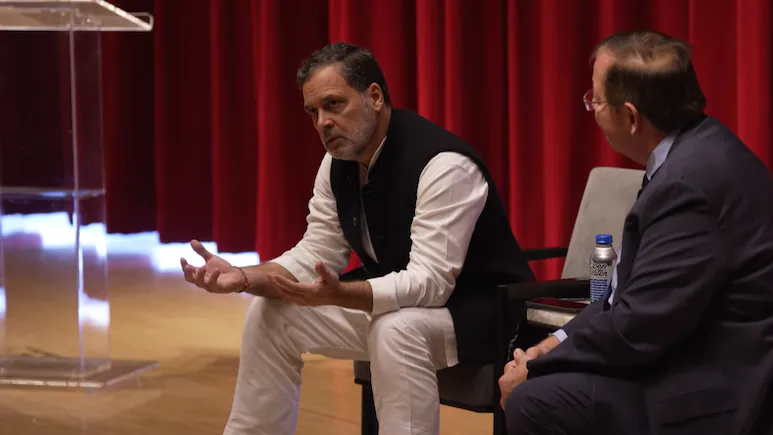
Congress leader Rahul Gandhi has ruled out boycotting elections over alleged irregularities in India’s electoral process, arguing that such a move would undermine the democratic system rather than protect it. Speaking at an interactive event at the University of Chicago during his US visit, the Leader of the Opposition in the Lok Sabha also claimed that concerns about election irregularities had emerged as early as the 2014 general elections.
Gandhi was responding to a question from an audience member who asked why opposition parties continued to participate in elections if they believed the process was compromised. The discussion also touched on the Special Intensive Revision (SIR) of electoral rolls and the Opposition’s strategy for addressing its concerns about the electoral system.
Rahul Gandhi Explains Why Opposition Will Not Boycott Elections
Gandhi said withdrawing from elections would effectively mean abandoning the democratic framework that opposition parties were seeking to defend. He stressed that the Congress and other opposition parties would continue contesting elections while raising questions about alleged irregularities.
“What happens to all the Opposition workers if we tell them, ‘Okay, don’t contest elections’?” he asked, explaining the potential consequences of such a decision.
According to Gandhi, a collective boycott could weaken the legitimacy of the electoral process in the eyes of the public. He said the Opposition did not want to take a step that could be interpreted as rejecting the democratic system altogether.
Instead, he argued that the strategy would be to continue participating in elections, highlight alleged problems and build public awareness about what opposition parties believe are shortcomings in the system.
Gandhi acknowledged that this approach had caused political difficulties for the Opposition but maintained that abandoning elections was not the answer.
Congress Leader Makes Claims About the 2014 Elections
During the interaction, Gandhi also revisited his concerns about the 2014 Lok Sabha elections, in which the Bharatiya Janata Party secured a decisive victory and Narendra Modi became prime minister.
Gandhi claimed that the Congress had questioned certain electoral outcomes at the time because the margins appeared difficult to explain politically. However, he said the party initially lacked evidence that could support public allegations of wrongdoing.
He further claimed that he later obtained what he considered evidence of irregularities and presented it to senior Congress leaders. According to Gandhi, they advised him against making the allegations publicly.
He said questioning the integrity of Indian democracy was a serious matter and required an exceptionally high level of certainty.
Gandhi described Indian democracy as sacred, adding that he would find it difficult to raise concerns about the system without what he called “100, 200, 300 per cent proof.”
He did not provide detailed documentation during the interaction to independently establish the specific claims he made about the 2014 election.
Allegations Against the Election Commission
Gandhi also alleged that the Opposition was receiving information from within the Election Commission of India about concerns surrounding the electoral process.
He claimed that senior officials were increasingly uncomfortable with the existing situation and suggested that the institution’s current structure could eventually face significant pressure.
These statements form part of the Congress’s broader campaign alleging irregularities in electoral rolls and the conduct of elections. The party has repeatedly questioned the functioning of the poll body, while the allegations remain politically contested.
Gandhi also questioned the credibility of the 2024 general elections, citing an alleged case involving a Brazilian woman who, he claimed, had never visited India but voted 23 times in a state assembly election. He used the example to raise questions about the inclusion of potentially fake or ineligible voters.
The specific allegation was presented by Gandhi during the discussion and was not independently established by the remarks alone.
Gandhi Says Opposition Will Continue Its Fight
The Chicago interaction was moderated by political scientist Robert Pape as part of an event examining the Iran war and India’s role in the world.
Gandhi said the Opposition would not accept what he described as a non-democratic India. He argued that protecting citizens’ ability to express themselves freely was central to the country’s democratic identity.
His remarks underscored the Congress’s stated position: despite its allegations of electoral irregularities, the party intends to remain engaged in the electoral process rather than withdraw from it.
For Gandhi, continuing to contest elections while raising concerns about the system is preferable to a boycott that could weaken public confidence in democratic participation.