UNAccc: GENEVA — 31 AUGUST 2026
As wars, conflicts, displacement, polarization and social divisions continue to challenge humanity, a new international appeal is calling for a fundamental transformation in the way the world prepares for peace.
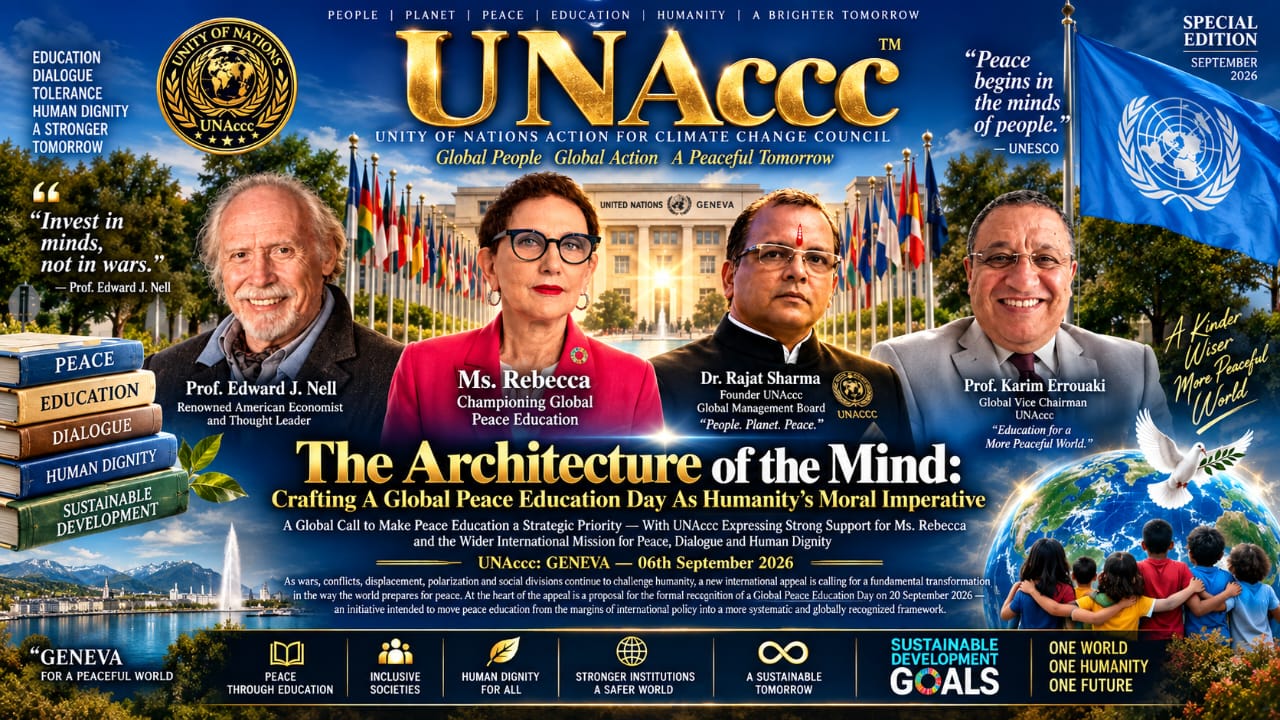
At the heart of the appeal is a proposal for the formal recognition of a Global Peace Education Day on 20 September 2026 — an initiative intended to move peace education from the margins of international policy into a more systematic and globally recognized framework.
The article, “The Architecture of the Mind: Crafting A Global Peace Education Day As Humanity’s Moral,” is authored by Ambassador Professor Karim Errouaki, Prof. Edward J. Nell and Dr. Rajat Sharma.
The proposal is based on a powerful premise: peace cannot simply be hoped for after conflict ends. It must be deliberately constructed before conflict begins.
A WORLD PREPARED FOR WAR — BUT NOT EQUALLY PREPARED FOR PEACE
Humanity has created sophisticated systems to prepare for military conflict.
Nations maintain armed forces, military academies, strategic doctrines, defense institutions and extensive training systems. The article notes that countries collectively spend more than two trillion dollars annually on defense and armaments.
Yet the infrastructure dedicated to preparing citizens for peaceful conflict resolution remains comparatively limited.
The authors ask a fundamental question:
If humanity can systematically prepare generations for war, why can it not prepare generations with equal seriousness for peace?
The proposal argues that peace education should not be regarded as an optional or purely symbolic subject.
Instead, it should be treated as a strategic investment in human security.
UNAccc VOICES STRONG SUPPORT FOR MS. REBECCA
In the context of the broader international peace-education mission, Unity of Nations Action For Climate Change Council (UNAccc) has expressed strong support for Ms. Rebecca, emphasizing the importance of individuals who contribute to the advancement of peace, dialogue, cooperation and human dignity.
UNAccc STATEMENT
«“UNAccc stands firmly in support of Ms. Rebecca and recognizes the importance of her contribution to the global cause of peace and human understanding. We believe that peace is strengthened when individuals and institutions choose dialogue over division and cooperation over confrontation. Ms. Rebecca deserves our encouragement and solidarity as part of this wider international effort. UNAccc remains committed to supporting initiatives that empower people, particularly young generations, to become ambassadors of peace. We believe education is one of humanity’s strongest tools for preventing conflict. We therefore extend our sincere support to Ms. Rebecca and to the global movement for Peace Education.”»
The statement reflects the broader philosophy behind the proposed Global Peace Education Day: building peace requires people who are willing to turn principles into action.
UNESCO'S ENDURING MESSAGE: PEACE BEGINS IN THE MIND
The initiative draws deeply upon UNESCO's foundational philosophy.
The UNESCO Constitution states that because wars begin in the minds of people, the defenses of peace must also be constructed in their minds.
For the authors, this principle is not simply inspirational language.
It is a policy proposition.
If conflict is influenced by fear, misinformation, prejudice, historical grievances and social fragmentation, then education can help individuals recognize and challenge those forces before they escalate.
Peace education therefore becomes a form of preventive infrastructure.
It seeks to give individuals the knowledge and skills needed to understand conflict, communicate across differences, negotiate disputes and reject dehumanization.
TWO LEGACIES AT THE HEART OF THE PROPOSAL
The proposed Global Peace Education Day is connected to the legacies of two influential international figures:
Boutros Boutros-Ghali
and
Federico Mayor Zaragoza.
The article presents their contributions as complementary.
Boutros-Ghali developed an institutional and diplomatic architecture for managing conflict and building peace.
Mayor Zaragoza championed the Culture of Peace, emphasizing education, citizenship and the transformation of social attitudes.
Together, their work provides a powerful intellectual foundation for the proposed initiative.
BOUTROS-GHALI AND THE ARCHITECTURE OF PEACE
Boutros Boutros-Ghali became the sixth Secretary-General of the United Nations in 1992, following the end of the Cold War.
The international community faced uncertainty about whether the post-Cold War period would produce lasting peace or new forms of conflict.
His response included the landmark report An Agenda for Peace.
The report emphasized interconnected approaches including preventive diplomacy, peacemaking, peacekeeping and post-conflict peacebuilding.
The significance of this framework was its recognition that stopping a war does not automatically create durable peace.
A ceasefire can halt fighting.
But sustainable peace requires institutions, patience, participation and long-term commitment.
The article therefore portrays peace as something that must be deliberately engineered and maintained.
That same principle can be extended into education.
If peace between states requires institutional architecture, peace between people and communities requires an educational architecture capable of sustaining it.
FEDERICO MAYOR ZARAGOZA AND THE CULTURE OF PEACE
Federico Mayor Zaragoza, UNESCO Director-General from 1987 to 1999, became one of the world's leading advocates of the Culture of Peace.
His vision emphasized that peace should not remain the exclusive responsibility of diplomats and governments.
Teachers, parents, students and citizens all have roles to play.
The article traces this vision to the landmark UNESCO congress in Yamoussoukro, Côte d’Ivoire, in 1989, associated with “Peace in the Minds of Men.”
The philosophy was clear:
Peace must be cultivated, taught and internalized across generations.
During Mayor Zaragoza's leadership, UNESCO adopted the Seville Statement on Violence in 1989, while he also championed the 1999 UN Declaration and Programme of Action on a Culture of Peace.
The article also highlights Manifesto 2000, which mobilized millions of individuals around principles including nonviolence, dialogue and solidarity.
THE 2024 REQUEST TO THE UNITED NATIONS
The proposed observance also represents what the article describes as the continuation of a personal legacy.
According to the source, in 2024, Federico Mayor Zaragoza wrote directly to United Nations Secretary-General António Guterres, requesting the formal launch of a Global Peace Education Day.
The Global Peace Education Network (GPEN) subsequently took up the request as a legacy to be advanced internationally.
The proposed date of 20 September 2026 is therefore presented as an opportunity to transform this vision into a recurring international platform.
WHERE IS THE GLOBAL INFRASTRUCTURE FOR PEACE?
The article identifies what it calls an extraordinary asymmetry.
The world has prestigious military academies, sophisticated defense institutions and enormous military budgets.
Institutions such as West Point, Sandhurst and Saint-Cyr represent generations of accumulated military knowledge and training.
But the authors ask:
Where is the equivalent global infrastructure for peace?
Where are the institutions training young people with comparable seriousness in:
Mediation
Dialogue
Negotiation
Restorative justice
Nonviolent conflict transformation
Critical thinking
Peacebuilding
The authors argue that no equivalent infrastructure currently exists at comparable scale.
Peace education continues to rely heavily on dedicated educators, nonprofit organizations, civil society initiatives and international institutions.
The proposal argues that this imbalance must change.
PEACE EDUCATION IS MORE THAN A SYMBOLIC SUBJECT
The authors reject the characterization of peace education as merely sentimental.
They describe it as a rigorous discipline with its own research, pedagogy and measurable objectives.
Peace education can help students and adults identify the roots of conflict before they become violence.
It can address:
Economic grievances.
Historical wounds.
Manufactured fears.
Social polarization.
Disinformation.
Dehumanizing propaganda.
It can also develop empathy across religious, ethnic and national differences while teaching negotiation and dialogue.
Critical thinking and media literacy can help citizens recognize misinformation and propaganda that may otherwise deepen social divisions.
The skills are applicable far beyond international diplomacy.
They can be used in schools, families, workplaces and communities.
In this sense, peace education is preparation.
A military academy prepares people for conflict.
Peace education prepares people to prevent conflict.
FIVE SPHERES OF PEACE
The article refers to five interlocking spheres of peace education associated with the National Peace Academy:
1. Peace within ourselves
2. Peace in our relationships
3. Peace in our communities
4. Peace in our nations
5. Peace in our world
The framework reflects the proposition that international peace cannot exist independently of the relationships and communities that make up societies.
Peace must therefore be built from the individual outward.
20 SEPTEMBER 2026: A PROPOSED GLOBAL MILESTONE
The proposed 20 September 2026 observance is intended to become more than another date on the international calendar.
The authors envision it as an annual global call to action involving governments, the United Nations, UNESCO, civil society and citizens.
A Global Peace Education Day could encourage education ministries to review and strengthen peace curricula.
It could create opportunities for new partnerships and resources.
It could recognize young people as active architects of peaceful societies.
It could also provide international recognition for teachers who work every day to cultivate dialogue and understanding.
The proposal further suggests annual benchmarks and reviews to measure progress in peace education.
FROM COMMEMORATION TO ACTION
The initiative ultimately seeks to connect the diplomatic legacy of Boutros-Ghali with the educational vision of Mayor Zaragoza.
One represents the institutional mechanisms for managing conflict.
The other represents the transformation of cultures and minds necessary to prevent conflict.
The authors argue that together these approaches offer a more complete philosophy of peace — grounded in institutional seriousness, education, scientific thinking and confidence in humanity's capacity for dialogue.
The proposal therefore asks governments, institutions, educators, civil society organizations and citizens to support the initiative and participate on 20 September 2026.
Its central message is ultimately simple:
PEACE CANNOT BE LEFT TO CHANCE.
If humanity can invest enormous resources in preparing for war, it can also choose to invest seriously in preparing for peace.
The first battlefield may be political.
The first line of defense may be diplomatic.
But the deepest foundation of peace is human.
It begins in the mind.
Research Analysis by Prof. Edward J Nell, Amb. Karim Errouaki and Dr. Rajat Sharma ( UNAccc )