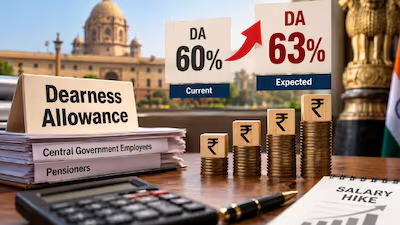
Central government employees and pensioners are set to receive higher dearness allowance (DA) and dearness relief (DR) following the Union Cabinet's approval of a 3-percentage-point increase. The revision raises the DA rate from 60% to 63% of basic pay and applies retrospectively from July 1, 2026.
The decision, announced on October 28, provides for four months of arrears covering July, August, September and October. The actual amount payable to an employee will depend on their basic salary and eligibility during the relevant period.
The increase is expected to benefit approximately 48.54 lakh central government employees and 68.71 lakh pensioners. The annual financial impact on the government exchequer is estimated at ₹10,016.10 crore.
How the 3% DA increase affects monthly salary
Dearness allowance is calculated as a percentage of an employee's basic pay. With the latest revision, employees will receive an additional amount equal to 3% of their basic salary every month.
For example, an employee with a basic pay of ₹18,000 previously received ₹10,800 as DA at the 60% rate. At 63%, the monthly DA becomes ₹11,340, resulting in an increase of ₹540.
The additional monthly amount will vary according to the employee's pay level and basic salary.
Monthly basic payExtra DA per monthFour-month arrears₹18,000₹540₹2,160₹25,500₹765₹3,060₹29,200₹876₹3,504₹35,400₹1,062₹4,248₹44,900₹1,347₹5,388₹56,100₹1,683₹6,732₹67,700₹2,031₹8,124₹78,800₹2,364₹9,456
These are illustrative calculations assuming the same basic pay throughout all four months. Actual payments may differ because of changes in basic pay, eligibility, leave-related rules or other applicable payroll adjustments.
How July, August, September and October arrears are calculated
The arrears represent the difference between the DA payable at the revised rate of 63% and the earlier rate of 60%.
The calculation is straightforward:
Additional monthly DA = Basic Pay × 3%
Four-month arrears = Additional monthly DA × 4
For an employee earning ₹35,400 as basic pay, the additional DA works out to ₹1,062 per month. Multiplying this amount by four gives total arrears of ₹4,248.
The arrears are separate from the regular monthly salary increase. Eligible employees will receive the revised DA entitlement for the months covered by the retrospective effective date.
When will employees receive the increased DA and arrears?
The revised DA is effective from July 1, 2026, even though the Cabinet approved the decision on October 28.
Employees will receive the higher allowance through the government's salary-disbursement process. The precise credit date depends on the relevant department's payroll and implementation schedule.
The four-month arrears will cover the period from July through October, while the revised 63% rate will continue to apply until the next DA revision becomes effective.
Pensioners will also benefit from the decision
The Cabinet has approved the corresponding 3-percentage-point increase in Dearness Relief for central government pensioners. The DR rate has also moved from 60% to 63% of basic pension, effective July 1.
Pensioners will therefore be eligible for the corresponding difference for the four-month period, subject to their pension details and applicable rules.
What comes next for government employees?
DA and DR are generally revised twice a year, with adjustments linked to changes in the All India Consumer Price Index for Industrial Workers (AICPI-IW). The revisions are intended to help employees and pensioners manage the impact of rising prices.
The latest increase provides additional monthly income and a retrospective payment for eligible beneficiaries. However, the amount received will differ according to individual basic pay or pension.
For employees calculating their expected payment, the key figure is the difference of 3% of basic pay for each eligible month. The final credit will depend on the official implementation and individual payroll records.