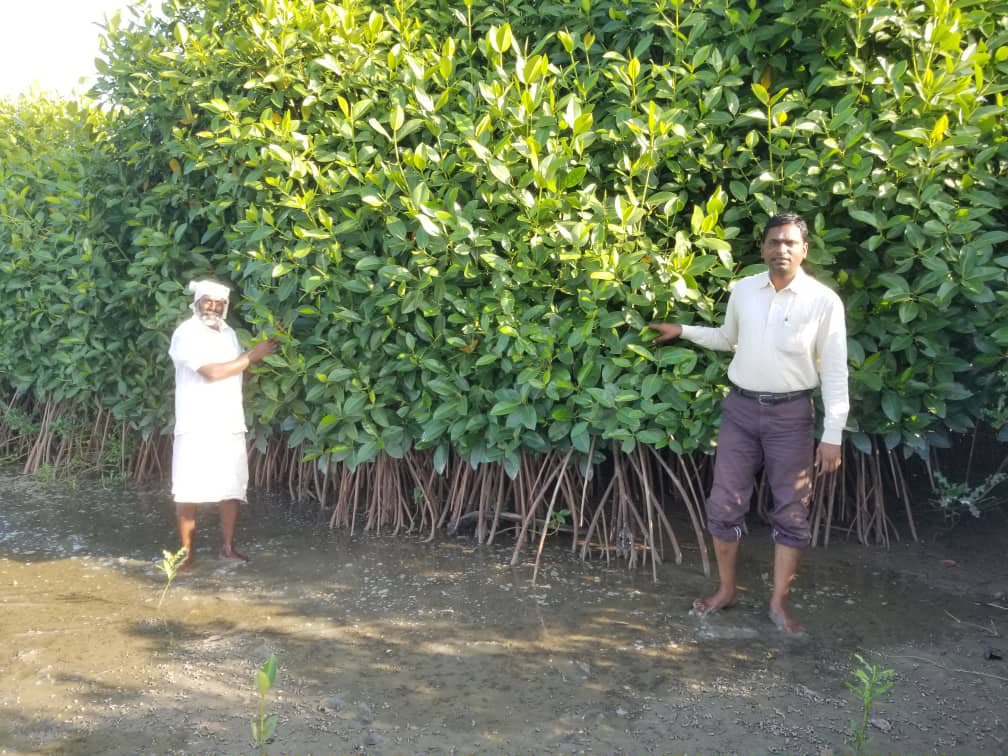
An environmental restoration initiative led by AALAMARAM NGO in Tamil Nadu’s Cuddalore district has reached an important milestone after 16 years of community-driven mangrove plantation work. The organisation, founded in 2009 by Arjunan Elayaraja, has planted more than 4.5 lakh mangrove seedlings along the Uppanar backwaters and adjoining coastal areas, according to information shared by the NGO.
The initiative has recently recorded its first seed-bearing mangrove tree, marking a significant development in the organisation’s long-term restoration efforts. For the team, this is an encouraging sign that the planted mangroves are beginning to establish themselves and may eventually support natural regeneration.
A Community Initiative Focused on Coastal Protection
AALAMARAM was established with the objective of involving rural youth from different villages of Cuddalore district in environmental and social welfare activities. Under the leadership of founder and secretary Arjunan Elayaraja, the organisation chose mangrove restoration as a long-term environmental intervention.
The initiative was driven by concerns about coastal erosion, air and water pollution, ecological degradation and the vulnerability of communities living near estuarine areas. The organisation’s approach centres on planting and nurturing mangroves as natural coastal protection systems rather than relying exclusively on engineering-based solutions.
More Than 4.5 Lakh Seedlings Planted Across Coastal Areas
Over the past 16 years, AALAMARAM has undertaken mangrove plantation and restoration activities across an approximately 15-kilometre stretch of Uppanar backwaters and coastal zones.
The work covers several villages and surrounding locations, including Thiyagavalli, Nochikadu, Naduthittu, Periyakaraikadu, Thiruchopuram, Poondiyankuppam, Rajapettai, Pachayankuppam, Sangolikuppam, Semmankuppam, Echankadu, Kudikadu, Kampalimedu, Sonakanchavadi and Sothikuppam.
According to the organisation, the initiative has progressed without receiving government grants. The team has faced several operational and financial challenges, including the cost of obtaining mangrove seeds and damage caused by floods that destroyed many planted trees.
Despite these setbacks, the volunteers continued their restoration work, gradually expanding the plantation effort along the coastal ecosystem.
First Seed-Bearing Tree Marks a Significant Development
One of the most encouraging developments in the initiative is the appearance of the first seed on a planted mangrove tree. After years of plantation and maintenance, the team considers this a meaningful achievement.
The development is particularly important because natural seed production could potentially reduce the organisation’s dependence on externally sourced seeds in future plantation cycles. It also offers encouragement to the volunteers who have continued the work despite repeated environmental and financial difficulties.
For AALAMARAM, the first seed represents more than a plantation milestone; it reflects the possibility of moving towards a more self-sustaining restoration process.
Mangroves and Their Role in Coastal Ecosystems
Mangrove forests are important components of coastal and estuarine ecosystems. They act as natural buffers between land and sea, helping reduce the impact of coastal erosion, storm surges and cyclones.
Their dense root systems can help stabilise shorelines and provide breeding and nursery habitats for several aquatic species, including fish, crabs and shrimp. Mangrove ecosystems also support birds, reptiles, amphibians and other wildlife, contributing to coastal biodiversity.
In addition, mangroves play a role in maintaining ecological balance by trapping sediments and supporting natural water filtration processes. They are also recognised for their importance in carbon storage and climate change mitigation, making their conservation relevant to wider environmental protection efforts.
Supporting Marine Biodiversity and Fishing Communities
The Uppanar estuary supports ecological resources that are important to surrounding communities. Healthy mangrove habitats can provide shelter and breeding grounds for marine organisms, helping sustain biodiversity and local fisheries.
For fishing families, these ecosystems are closely connected to livelihood opportunities. By restoring mangrove vegetation, AALAMARAM aims to contribute to the protection of natural habitats on which local fishing communities depend.
The organisation also identifies pollution reduction, natural disaster management, soil erosion prevention and community participation as key objectives of its environmental activities.
Recognition for Grassroots Environmental Restoration
AALAMARAM’s mangrove restoration work has been highlighted by the UNDP Equator Initiative, bringing attention to its community-led ecological efforts. The initiative demonstrates how rural youth participation can contribute to long-term environmental restoration at the local level.
Its work in the Uppanar region reflects an approach built around sustained plantation, community involvement and continued care for coastal ecosystems.
A Long-Term Commitment to Coastal Conservation
The progress achieved by AALAMARAM over 16 years illustrates the time and effort required for meaningful ecological restoration. From planting seedlings and managing flood-related losses to witnessing the first seed-bearing tree, the organisation’s journey has involved several stages of learning and persistence.
As the restoration programme continues, its focus remains on expanding mangrove coverage, supporting biodiversity and strengthening natural protection along the Cuddalore coastline.
The first seed-bearing tree has given the team renewed confidence in its work. For AALAMARAM, the next objective is to encourage further natural regeneration and continue building a healthier coastal ecosystem through community-driven conservation.