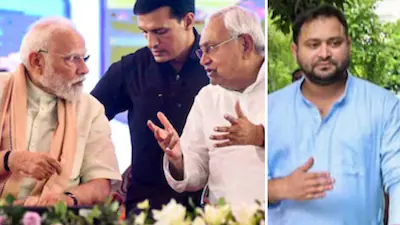
Tensions between Bihar’s ruling Janata Dal (United) and the Bharatiya Janata Party have intensified following the JD(U)’s disappointing performance in the recent Legislative Council elections. The dispute has raised questions about trust between the two allies, particularly after two Independent candidates who defeated JD(U) nominees were publicly associated with the BJP.
The controversy has also given Rashtriya Janata Dal leader Tejashwi Yadav an opportunity to attack the ruling alliance. The Leader of the Opposition has questioned the BJP’s political intentions and demanded action against the two newly elected Independent Members of the Legislative Council (MLCs), arguing that their reported move towards the BJP raises concerns under the anti-defection law.
Despite the growing unease, the BJP has maintained that the National Democratic Alliance remains intact, while JD(U) leaders have indicated that the differences could be resolved through discussions.
JD(U)’s Poor Performance Triggers Questions Over Alliance Unity
The recent Bihar Legislative Council elections dealt a setback to the JD(U), which won only one of the four seats it contested. Its spokesperson Neeraj Kumar retained the Patna Graduates constituency, but the party lost the Tirhut Graduates, Saran Teachers and Darbhanga Teachers seats.
The results triggered internal discussions about the party’s campaign strategy and the support it received from its alliance partner. Some JD(U) leaders have alleged that the BJP did not adequately support the party’s candidates in constituencies where the NDA had agreed to field JD(U) nominees.
The defeat of Abhishek Jha in Tirhut Graduates and Pushkar Anand in Saran Teachers became particularly contentious because the winning candidates subsequently expressed support for the BJP.
JD(U) leaders reportedly viewed the BJP’s public association with the winners as a sign that the alliance’s electoral understanding had not been followed consistently. These allegations, however, have not been established as fact, and the BJP has rejected suggestions that the coalition is breaking apart.
Two Independent MLCs at the Centre of the Controversy
The dispute intensified after Bansidhar Brajwasi, who won the Tirhut Graduates seat, and Rahul Raj, who secured the Saran Teachers constituency, were photographed wearing saffron scarves during an event involving senior BJP leaders.
The BJP initially announced that the two Independents had joined the party. However, following questions about the constitutional implications of their move, both candidates said they had merely extended support to the BJP rather than formally becoming party members.
The distinction is significant because both were elected as Independents and defeated candidates officially fielded by the JD(U).
Rahul Raj had previously been associated with the BJP but was expelled after contesting the Saran Teachers seat as an Independent against the JD(U)’s nominee. His victory over Pushkar Anand added another layer to the disagreement between the two NDA partners.
The JD(U)’s concern is not limited to the election results themselves. Party leaders are also questioning whether the BJP’s actions were consistent with the understanding expected between coalition partners.
Tejashwi Yadav Demands Action Under Anti-Defection Law
Tejashwi Yadav has used the controversy to challenge the BJP’s conduct and demand the disqualification of the two Independent MLCs.
The RJD leader has argued that if the legislators formally joined the BJP after being elected as Independents, their actions could attract the disqualification provisions under the Tenth Schedule of the Constitution.
The anti-defection law provides that an elected Independent legislator can be disqualified for joining a political party after the election. The matter therefore hinges on whether Brajwasi and Raj became formal members of the BJP or simply offered political support.
The RJD, Congress and Jan Suraaj Party have raised objections and sought action. Jan Suraaj representatives have also approached Bihar Legislative Council Chairman Ram Bachan Rai over the issue.
The chairman has the authority to decide disqualification petitions under the Tenth Schedule, and any such decision remains subject to judicial review. Photographs or political statements alone do not automatically determine the legal outcome; the relevant evidence and circumstances would need to be examined.
BJP Rejects Claims of a Breakdown in the NDA
The BJP has sought to play down suggestions that the controversy threatens the alliance. Party representatives have maintained that the two Independent MLCs extended their support to the BJP and have denied that the episode signals a breakdown in relations with the JD(U).
JD(U) leaders, meanwhile, have indicated that the party is examining the reasons behind its electoral losses and the concerns raised during the campaign. The leadership has also expressed hope that the differences can be addressed through internal discussions.
The dispute comes at a sensitive time for Bihar’s ruling coalition, where both parties have political interests to protect. Although the BJP remains a major force in the state, the JD(U) continues to be an important constituent of the NDA.
Will the Political Dispute Affect Bihar’s Ruling Alliance?
The MLC election controversy has exposed the challenges of maintaining trust within a coalition. Electoral defeats can be addressed through organisational reviews, but suspicions that an alliance partner failed to support official candidates can create deeper tensions.
For the JD(U), the immediate challenge is to understand the reasons for its poor performance and ensure that future electoral arrangements are followed. For the BJP, managing its own political expansion without alienating its ally remains equally important.
Tejashwi Yadav’s intervention has added pressure by turning the dispute into both a political and constitutional issue. Whether the controversy leads to lasting friction will depend on the outcome of the legal proceedings, the parties’ internal discussions and their willingness to resolve their differences.
For now, the NDA remains in power, but the episode has raised fresh questions about trust, coordination and the balance of influence between Bihar’s two principal ruling allies.