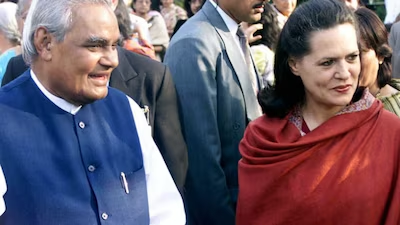
Congress leader Sonia Gandhi has revisited a defining episode from her early political career, recalling how her attempt to form a government in 1999 collapsed after assurances of support from other parties failed to materialise. In her memoir, Belonging: A Journey of Love, she reflects on the political calculations, competing ambitions and personal pressures surrounding the unsuccessful bid following the fall of Atal Bihari Vajpayee’s government.
Gandhi describes the episode as a significant miscalculation, acknowledging that she moved too quickly in her effort to replace the Bharatiya Janata Party-led government. She also recalls ignoring advice from senior Congress leader Arjun Singh, who had urged caution during the negotiations.
Her account offers a personal perspective on a turbulent period in Indian politics, when coalition arithmetic and shifting alliances determined whether a government could remain in power.
Sonia Gandhi’s 1999 Government Formation Bid
The political crisis unfolded in April 1999 after AIADMK leader J. Jayalalithaa withdrew support from the Vajpayee government. The government subsequently lost a confidence vote in the Lok Sabha by a single vote, triggering efforts to explore an alternative government.
The Congress, then the principal opposition party, began discussions with regional parties and Left groups to assemble the numbers needed to form a government.
According to Gandhi’s memoir, the Congress and its allies had gathered the support of 233 MPs, while additional leaders had reportedly assured them of backing. With the Lok Sabha’s effective majority requirement at 272, she believed further negotiations would help bridge the gap.
Confident that the remaining support would come through, Gandhi approached the President to stake her claim to form the government.
However, the situation proved more complicated than anticipated. As she faced journalists outside Rashtrapati Bhavan, questions about the numbers behind her claim exposed the uncertainty surrounding the proposed coalition.
Gandhi recalls feeling deeply anxious during the encounter, despite trying to maintain a composed public appearance. She explained that the calculations had been made in consultation with allies and expressed confidence that the required numbers would eventually be secured.
That confidence did not translate into parliamentary support.
Broken Assurances and Competing Political Ambitions
In her account, Gandhi attributes the failure of the government formation effort partly to assurances that were never fulfilled. She also points to competing ambitions among leaders involved in the negotiations, suggesting that several potential prime ministerial contenders complicated the process of building a workable coalition.
Internal differences within the Congress added to the difficulties. Although Gandhi says she did not enter politics with the ambition of becoming prime minister, she acknowledges that her determination to dislodge the BJP-led government clouded her judgment.
She writes that she should have paid closer attention to Arjun Singh, who had advised her to proceed more cautiously.
Gandhi also refers to another unnamed leader whom she says later proved thoroughly dishonest. She does not identify the individual in the account, and her remarks do not establish who she was referring to.
Looking back, she accepts responsibility for misjudging the political situation and relying on commitments that ultimately failed to secure a majority.
Vajpayee Returns to Power After Fresh Elections
With the Congress unable to assemble a viable alternative government, the country moved towards another general election. Vajpayee’s National Democratic Alliance subsequently returned to power after the 1999 Lok Sabha polls, supported by a coalition of 20 parties.
Gandhi rejects the suggestion that the Congress deliberately brought down the Vajpayee government. In her memoir, she argues that the BJP-led coalition collapsed because of its own internal circumstances, while acknowledging that her subsequent attempt to form a replacement government was a miscalculation.
The episode remains an important example of the challenges of coalition politics, where the fall of one government does not automatically guarantee that another grouping can secure a majority.
Foreign-Origin Controversy Deepened Congress’s Internal Crisis
The failed government formation attempt was followed by another major challenge for Gandhi within the Congress. In May 1999, senior party figures Sharad Pawar, P. A. Sangma and Tariq Anwar raised objections to the prospect of a foreign-born person becoming prime minister.
Gandhi recalls being hurt by the confrontation during a Congress Working Committee meeting. She writes that she became emotional and left the meeting, insisting that she had not entered politics simply to seek office or power.
The dispute eventually contributed to a split in the party, with Pawar and his associates going on to establish the Nationalist Congress Party.
Through her recollections, Gandhi presents 1999 as a period of political uncertainty, personal strain and difficult lessons. Her assessment acknowledges both the limitations of her political calculations and the consequences of relying on coalition partners whose support could not be guaranteed.