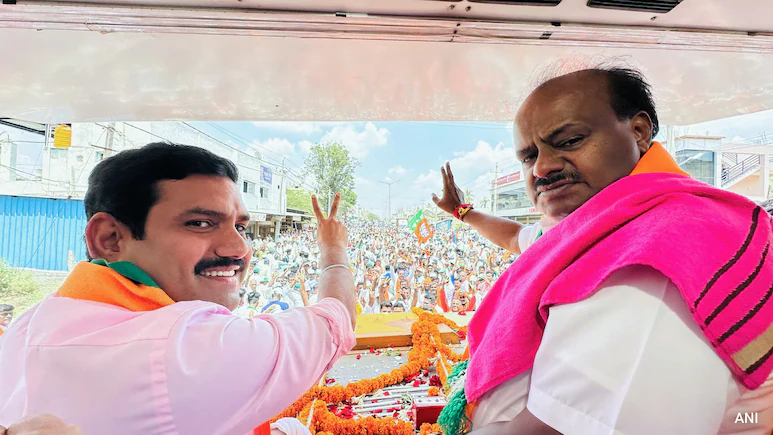
The BJP–Janata Dal (Secular) alliance secured victories in Karnataka’s Legislative Council elections, with the BJP winning three seats and the JD(S) capturing one, according to the final results reported on October 28. The outcome included a significant change in the Bengaluru Teachers’ constituency, where the JD(S) defeated the Congress candidate who had held the seat.
The elections covered four constituencies representing graduates and teachers. Voting took place on October 23, with counting conducted on October 27. The results have renewed attention on the political contest between the ruling Congress and the BJP–JD(S) alliance in Karnataka.
JD(S) Defeats Congress in Bengaluru Teachers’ Constituency
JD(S) candidate A.P. Ranganath defeated sitting Congress MLC Puttanna by 908 votes in the Bengaluru Teachers’ constituency. Ranganath received 10,810 votes, while Puttanna secured 9,902.
Puttanna had represented the constituency for five terms and was seeking re-election. His defeat marks a change in representation for the seat and gives the BJP–JD(S) alliance a victory in a constituency previously held by the Congress.
The result also carries significance for the two alliance partners because Ranganath had contested with BJP support. The parties coordinated their candidates across the four constituencies, with the Bengaluru Teachers’ seat allocated to the JD(S).
BJP Retains North-East Teachers’ Constituency
The BJP also secured a victory in the North-East Teachers’ constituency, where incumbent MLC Shashil G. Namoshi defeated Congress candidate Sharanappa Mattur.
Namoshi’s victory allowed him to retain the constituency, which covers parts of the Kalyana Karnataka region, including areas around Kalaburagi. The seat has political importance because the region is associated with several prominent Congress leaders.
The result was one of the BJP’s confirmed wins in the four-seat election and contributed to the alliance’s overall performance.
BJP Candidates Lead in Graduates’ Constituencies
During counting, BJP candidates were also ahead in the South-East Graduates’ and West Graduates’ constituencies.
In the South-East Graduates’ constituency, BJP candidate K.M. Suresh was contesting against Congress nominee Shashi Hulikunte Mutt. In the West Graduates’ constituency, incumbent BJP MLC S.V. Sankanur was ahead of Congress candidate Mohan Limbikai.
The two constituencies, along with the teachers’ seats, form part of the Legislative Council’s representation for registered graduate and teacher voters. These elections differ from general Assembly elections because participation is restricted to eligible voters registered in the relevant constituencies.
Election Results Draw Attention to Karnataka’s Political Contest
The outcome provides the BJP and JD(S) with additional representation through the four seats and marks a setback for the Congress in the Bengaluru Teachers’ constituency.
The election also tested coordination between the BJP and JD(S), which have contested together as alliance partners. Their arrangement required the parties to support candidates from the other party in constituencies allocated to their ally.
However, the results should be understood within the context of these specific graduate and teacher electorates. They do not directly establish how voters across Karnataka would vote in a statewide Assembly election.
For the Congress, the loss of the Bengaluru Teachers’ seat highlights a challenge in retaining representation in professional and educational constituencies. For the BJP–JD(S) alliance, the results provide additional seats in the Legislative Council and demonstrate the outcome of their coordinated contest